Appliances & Heat
Chemex
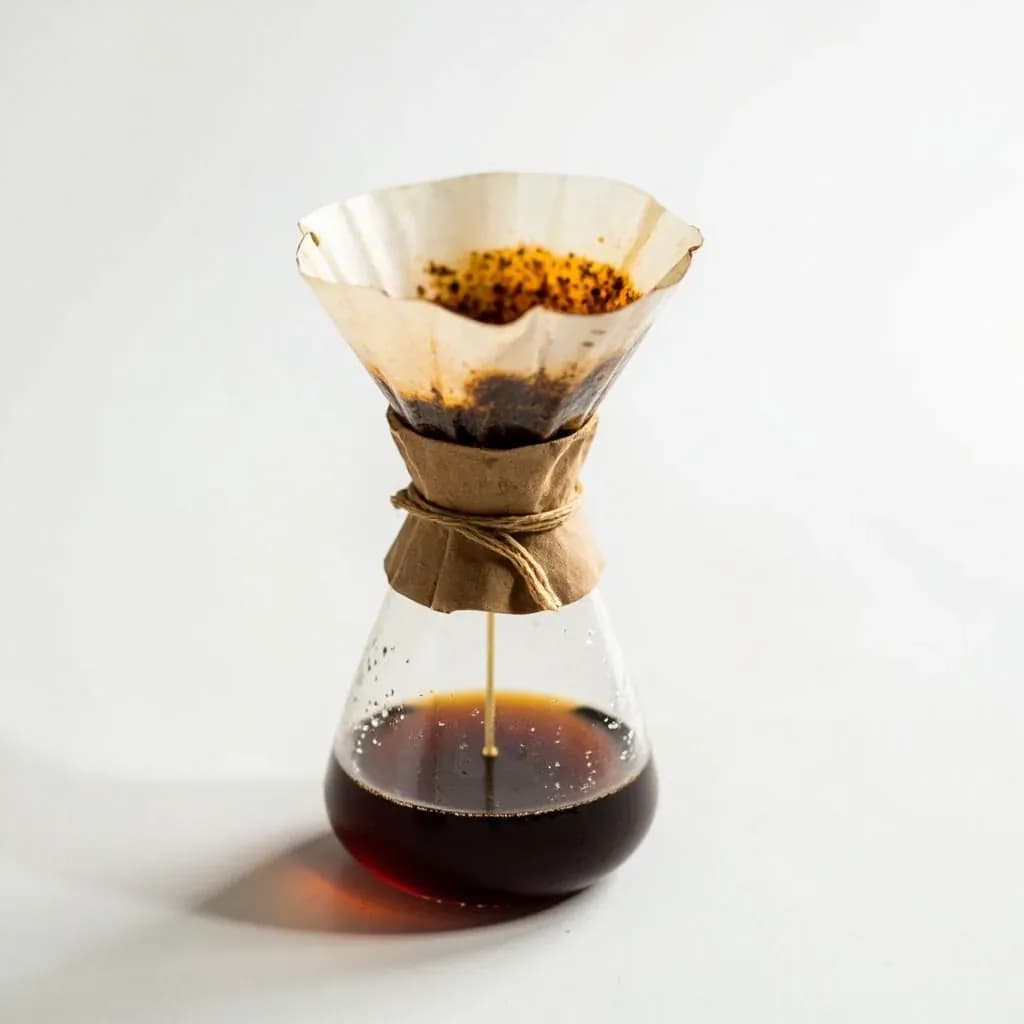
An hourglass glass pour-over carafe that brews clean, bright coffee through a thick paper filter.
A Chemex is a one-piece hourglass-shaped borosilicate glass carafe used for manual pour-over coffee. A thick bonded paper filter sits in the top cone, holding the grounds while hot water is poured slowly, yielding a notably clean, sediment-free cup. Its design has been a kitchen icon since the 1940s and is valued for highlighting delicate coffee flavors.
The Chemex is a single-piece pour-over coffee brewer designed in 1941 by Dr. Peter Schlumbohm, a German-born chemist who emigrated to the United States. Its hourglass silhouette, conical upper funnel, flat-bottom filter bed, and integrated pouring spout are formed from one piece of laboratory-grade borosilicate glass, cinched at the waist by a wooden collar and a leather tie. The brewer is in the permanent design collection of the Museum of Modern Art in New York and has remained essentially unchanged in production for more than eighty years.
What distinguishes the Chemex from other pour-over cones is its thick, proprietary bonded paper filter. Roughly 20–30% heavier than standard paper, it traps not only fine sediment but most of the coffee's oils and lipids, producing an exceptionally clean, bright, almost tea-like cup. That same thickness shapes how the brewer behaves: it is slower than a mesh or thin-paper pour-over, it stalls easily if the grind is too fine, and it rewards a measured, methodical pour rather than a single drenching stream. The lower chamber doubles as a serving carafe, and the wide base keeps it stable on a counter or a dinner table.
The Chemex is not a forgiving tool. It exposes grind inconsistencies, off temperatures, and lazy pouring more harshly than a French press or an automatic drip machine. In return, it gives a cup with a clarity and aromatic definition that few other home brewers can match, served from a single vessel that goes straight from kettle to table.
Alternatives
Types & varieties
The original design with a wooden collar and leather tie, available in 3-, 6-, 8-, and 10-cup sizes.
Same brewing geometry but with a glass handle in place of the wooden collar; easier to clean, fully dishwasher-safe, no wood to maintain.
Smaller-batch individually blown glass, more delicate, typically offered in 3- and 5-cup sizes; prized for craftsmanship and aesthetics.
Companion electric brewer engineered to deliver the proper pour pattern over a 6-cup Chemex; sold as a set and useful for hands-off brewing.
The Filter Is the Whole Point
Most pour-over debates focus on cone shape, hole size, and pour technique, but the Chemex conversation is really about the paper. The bonded filter is significantly denser than the paper used in thin-paper pour-over cones, and that density has two practical consequences. First, it slows the brew — a Chemex pull should take roughly four to five minutes from pour-on to final drip, and most of that is achieved through a wide slurry rather than a fast column. Second, it strips most of the coffee's lipids and fine particulate, which is why a Chemex cup reads as clean, light-bodied, and very aromatic: the aromatic compounds are water-soluble and pass through, while the heavy oils do not.
The trade-off is body. A French press cup is rounder and heavier on the palate; a Chemex cup is closer to tea. This is a feature, not a flaw, but it shapes the coffee you should buy for it: washed, light-to-medium roasted single origins tend to sing, while heavy chocolate-and-nut dark roasts can taste thin and washed out.
Brewing Parameters That Actually Matter
Because the filter is so thick, three variables do almost all the work: grind size, pour rate, and water temperature. Get those right and the cup makes itself; get any of them wrong and the brewer either stalls or under-extracts.
- Grind: medium-coarse, the texture of coarse sea salt or just a notch finer. Espresso-fine will plug the bed within seconds; a true coarse/filter grind will run through too quickly and taste sour.
- Ratio: 1:15 to 1:17 by weight. A 6-cup Chemex with 30 g coffee to 500 g water is a reliable starting point; go to 1:16.5 if you want to taste terroir more clearly, or 1:15 if you prefer a heavier cup.
- Temperature: 93–96°C / 200–205°F. A full rolling boil scalded across the slurry can mute aromatics; water that has sat for a couple of minutes off the boil is ideal.
- Pour rate: pulse in 2–3 stages of 100–150 g each, keeping the slurry level steady rather than flooding or letting the bed go dry. A gooseneck kettle makes this dramatically easier than a stovetop kettle.
Care and Longevity
The glass body is tough and dishwasher-safe, but the wooden collar needs a little attention. Wipe it with a damp cloth rather than soaking it, and treat it with a thin coat of food-safe mineral oil once or twice a year to keep the wood from drying, cracking, or picking up kitchen odors. The leather tie is functional, not decorative — replace it if it frays, and never put the collar in the dishwasher. Spent bonded filters compost readily and, because of their density and oil content, double as excellent small cleaning cloths for eyeglasses, phone screens, and car interior glass.
Common uses
Tips & pitfalls
- Always rinse the paper filter with hot water before adding coffee; this removes papery taste and preheats the carafe, then discard the rinse water before the brew begins.
- Use a gooseneck kettle. The Chemex rewards a slow, concentric pour, and a stovetop kettle's wide spout will channel water down one side of the bed and extract unevenly.
- Weigh both coffee and water on a scale. The tall filter bed and wide mouth of the Chemex make volumetric scoops especially unreliable.
- If water pools on top of the bed and refuses to drain, the grind is too fine — adjust one or two clicks coarser on a burr grinder before your next attempt.
- Pour in two or three pulse stages rather than one continuous stream; keeping the slurry level steady gives a more even extraction than a single drench-and-walk-away pour.
- Remove the spent filter promptly after brewing. Coffee left sitting on the spent grounds will go bitter and taint the carafe's flavor within minutes.
- Avoid strongly scented dish soap on the carafe and never let the wooden collar soak; wipe the wood with a damp cloth and condition it occasionally with food-safe mineral oil.
- Do not substitute generic #4 cone filters for Chemex bonded filters. The shape is wrong, the thickness is wrong, and the filters will not seat in the funnel.
Good to know
- Invented
- 1941 by Dr. Peter Schlumbohm, a German-born chemist who emigrated to the United States
- Material
- Laboratory-grade borosilicate glass body; wooden collar (typically walnut or birch); leather or rawhide tie
- Standard sizes
- 3-cup, 6-cup, 8-cup, and 10-cup; the 6-cup (~600 ml brewed) is the most common home size
- Filter
- Proprietary Chemex bonded paper filters, 20–30% heavier than standard paper; pre-folded squares that open into a cone
- Grind
- Medium-coarse, similar to coarse sea salt or slightly finer; finer grinds clog the thick filter
- Coffee-to-water ratio
- 1:15 to 1:17 by weight; a 6-cup Chemex is commonly brewed with ~30 g coffee to 500 g water
- Water temperature
- 93–96°C / 200–205°F, just off the boil
- Brew time
- About 4–5 minutes total, including a 30–45 second bloom
- Design collection
- In the permanent collection of the Museum of Modern Art (MoMA) in New York
- Filter compatibility
- Only Chemex-branded bonded filters seat correctly; generic #4 cone filters are a different shape and will not fit the funnel
Also called
Chemex coffee maker · pour-over carafe
Related

Stovetop
The everyday burners where most cooking actually happens

Oven
Enclosed dry heat for roasting, baking, and braising

Grill
Live-fire or gas grates for char, smoke, and high heat

Smoker
Low, slow heat and wood smoke for barbecue and brisket

Air Fryer
Countertop convection that crisps with little or no oil

Slow Cooker
Set-and-forget low heat for stews, beans, and braises

Pressure Cooker
Sealed steam pressure that cooks tough food in a fraction of the time

Rice Cooker
Foolproof, perfectly steamed rice every single time