Appliances & Heat
Chocolate Enrober
A machine that coats centers in a continuous curtain of tempered chocolate as they pass through.
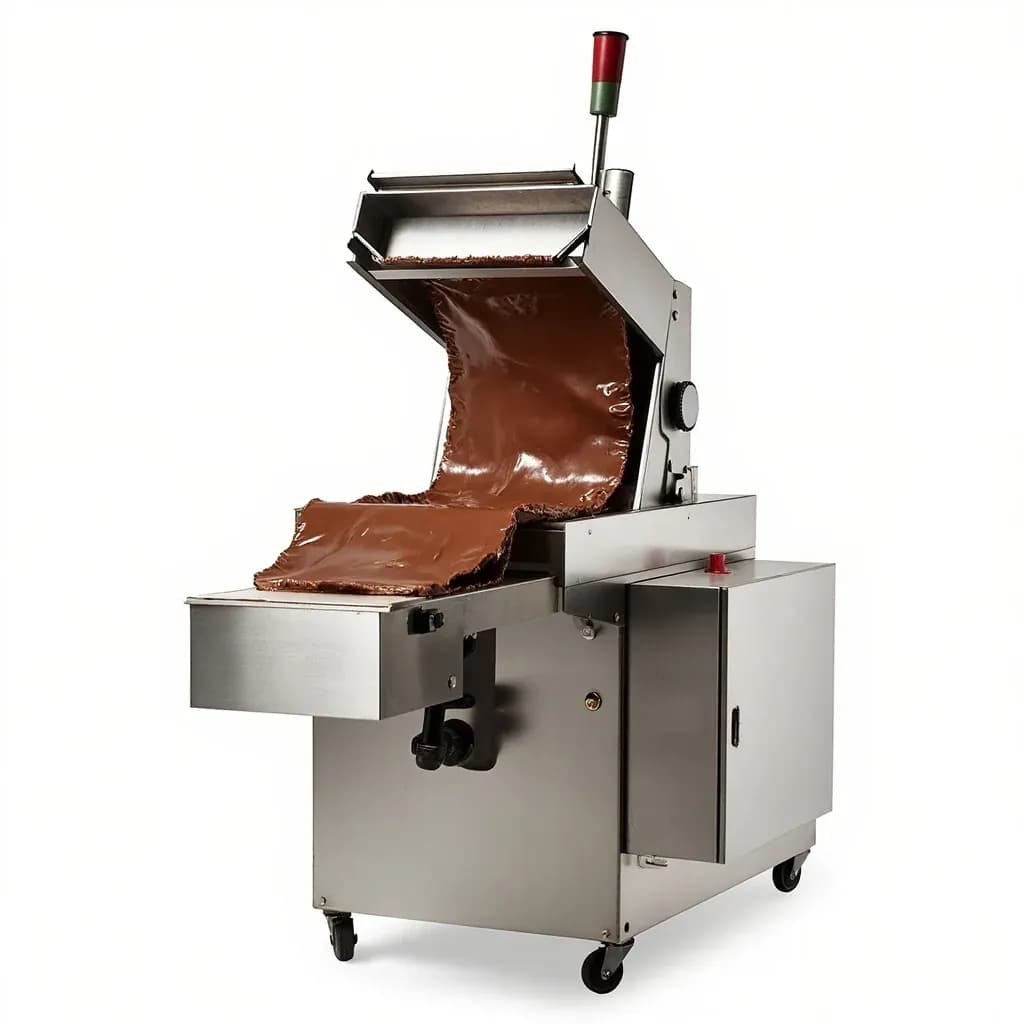
A chocolate enrober is a machine that flows a falling curtain of tempered chocolate over candy centers, biscuits or fruit carried beneath it on a conveyor belt. It coats each piece evenly, blows off the excess, and passes the items into a cooling tunnel to set. It is a confectionery tool for producing uniformly enrobed chocolates at volume.
A chocolate enrober is the machine that turns hand-dipping into a production line. Tempered chocolate is held in a jacketed, gently heated reservoir, pumped over a weir or slot, and falls as a continuous curtain over a moving wire or polymer belt. Centres — ganache-filled bonbons, nut clusters, marshmallows, ice cream bars — ride into that curtain, emerge coated, and pass beneath a vibrator and a blast of air (the air knife) that strips off the excess and returns it to the bath before a chilled, humidity-controlled tunnel sets the chocolate with a gloss and a clean snap.
The case for enrobing is uniformity and speed. A skilled hand-dipper produces beautiful bonbons one at a time; an enrober delivers the same thin, even coat across thousands of pieces per hour with predictable weight, thickness, and shine. The reservoir holds the chocolate at a steady working temperature so it is always ready to pour, but pump shear and constant gentle heat slowly erode the temper over a shift — a good operator checks the set and re-seeds as needed rather than trusting the bath indefinitely.
Two design choices separate the practical categories: whether the machine seals the base of the piece (a "bottomer") and whether a cooling tunnel is built in. Single-curtain units leave the bottom bare, which suits hand-finished truffles. Full-cover enrobers with a bottoming bath or second curtain seal the base and are the standard for commercial bars, moulded shells, and ice cream bars on a stick.
Alternatives
Types & varieties
Compact unit for pastry kitchens and artisan chocolatiers; often no integrated tunnel; manual loading tray at the entry end.
Coats the top and sides only; bottoms remain bare — standard for hand-finished truffles whose base is dipped separately.
Adds a second chocolate bath or curtain beneath the belt to seal the base; the workhorse design for commercial bars, moulded shells, and ice cream bars.
Applies a second coloured or contrasting chocolate over a base coat, e.g. white over dark.
Common on mid- and large-scale lines; tunnel length is matched to belt speed and product mass.
Specialised machine that seals the base of pre-dipped or pre-coated items such as date and fig bars.
Industry reference design: deep chocolate bath, broad wire belt, gentle vibration; long-standing benchmark for thin, even coats in fine chocolate work.
How the Machine Works
Understanding the moving parts helps you diagnose problems on the line.
- Heated jacketed reservoir holds the chocolate at working temperature, usually with a slow-moving scraper or auger to keep it homogeneous.
- Pump lifts chocolate to a height-adjustable weir or pouring slot that shapes the curtain — height sets coat weight.
- Vibrator shakes the belt to even out the coat and help release any trapped air; intensity is a key thickness control alongside belt speed.
- Air knife blows excess chocolate downward into a catch tray, where it drains back into the reservoir — never sideways, which splatters and wastes chocolate.
- Cooling tunnel drops the piece from working temperature to set point in roughly 8–15 minutes; air speed and humidity are tuned to avoid bloom and condensation.
Choosing the Right Enrober
Match the machine to the product and volume, not the other way around.
- A few hundred bonbons per day in a pastry kitchen: a tabletop single-curtain unit plus a separate chocolate cabinet or blast chiller for setting is usually enough.
- Continuous production of bars or ice cream: a full-cover machine with bottomer and integrated tunnel pays back in labour and uniformity.
- Fine chocolate work where coat weight matters: look for a deep-bath, wide-belt design in the Forgrove/Rasch KA tradition with adjustable vibration.
- Patterned or imprint bases (logos, polka dots): choose a polyurethane or silicone belt rather than wire mesh, which leaves a waffle mark on the underside.
Common uses
Tips & pitfalls
- Always pre-temper the chocolate before it goes into the reservoir — the tank holds temper, it does not build it.
- Keep reservoir temperature within 1 °C of the target working temperature; swings break temper and dull the gloss.
- Measure viscosity with a Bostwick or simple flow test; thin coats typically want 40–60 mm at 30 seconds, thicker for ice cream bars.
- Adjust belt speed first — slower belt gives a thinner coat, faster belt gives a thicker coat — then fine-tune with the air knife and vibrator.
- Aim the air knife downward into the catch tray, not sideways; angle and intensity matter more than volume.
- Run the cooling tunnel at 10–15 °C, not colder; an arctic tunnel shock-sets the chocolate and can cause bloom and cracking.
- Re-seed chocolate that has been circulating in the reservoir for several hours; pump shear and steady heat slowly erode temper.
- De-bubble ganache centres by tapping the loading tray before they enter the curtain — trapped air breaks the coat and leaks filling.
- Flush the machine with fresh chocolate for 5–10 minutes after a colour or type change to purge the previous batch.
- Common mistakes: a coat that is too thick because the belt was too slow, streaking from an uneven curtain height, fat bloom from a tunnel running too warm, and grey streaks from condensation when warm pieces hit cold tunnel air.
Good to know
- Kind
- Continuous-flow chocolate coating machine
- Common materials
- Stainless steel food-grade construction; food-safe polyurethane or polymer for belts
- Working chocolate temperature
- ~29–32 °C (84–90 °F) for tempered dark; slightly lower for milk and white
- Belt type
- Open wire mesh (most common) or plastic/polyurethane for delicate or pattern-sensitive items
- Belt speed
- Adjustable, roughly 0.5–6 m/min on small units; much faster on industrial lines
- Cooling tunnel
- 10–18 °C with controlled humidity; tabletop models often omit it
- Typical throughput
- Tabletop ~30–80 kg/h; industrial lines 500–3,000+ kg/h
- Origin
- Industrial chocolate-coating machines developed in the late 19th and early 20th centuries for mass confectionery
Also called
Enrober · Enrobing Machine
Related

Stovetop
The everyday burners where most cooking actually happens

Oven
Enclosed dry heat for roasting, baking, and braising

Grill
Live-fire or gas grates for char, smoke, and high heat

Smoker
Low, slow heat and wood smoke for barbecue and brisket

Air Fryer
Countertop convection that crisps with little or no oil

Slow Cooker
Set-and-forget low heat for stews, beans, and braises

Pressure Cooker
Sealed steam pressure that cooks tough food in a fraction of the time

Rice Cooker
Foolproof, perfectly steamed rice every single time