Appliances & Heat
Clay Bread Oven (Tannour / Tandoor)
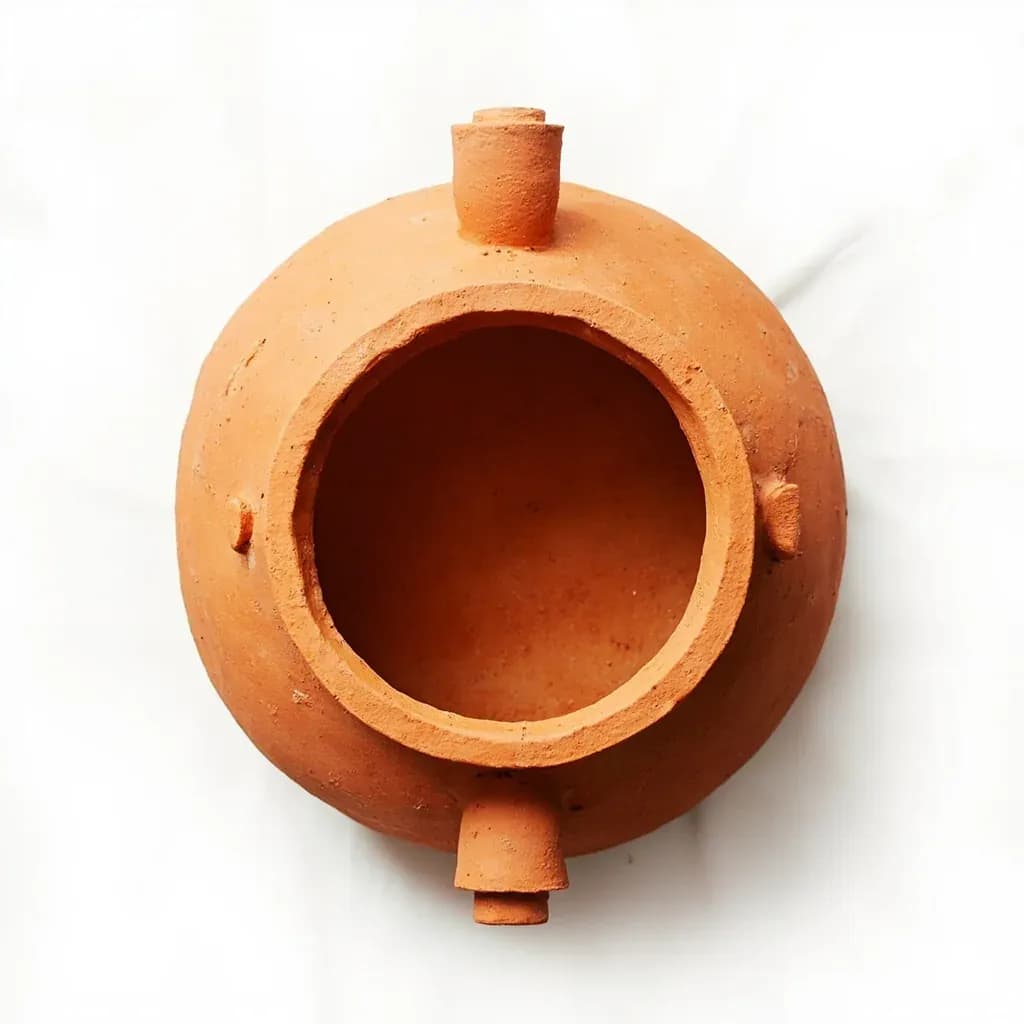
Cylindrical clay oven that bakes flatbreads on its walls and roasts meats at high heat.
A clay bread oven is a thick-walled cylindrical oven, called tannour or tandoor, fired with wood or charcoal to very high temperatures. Flatbreads are slapped onto the hot inner walls to bake in seconds, while skewered meats and marinated chicken cook in the radiant heat from above. The clay retains and radiates intense heat, giving breads their characteristic blistered, smoky crust.
The tannour, tandoor, tonir, and tandyr are all names for a vertical clay oven in which food is cooked by direct contact with an intensely hot refractory surface and by radiant heat reflected from the dome. A traditional unit is a thick-walled (5–10 cm) cylinder or bell of refractory clay mixed with mud, straw, and sometimes goat hair, set above ground or sunk into the earth and fired with hardwood or charcoal. Wall temperatures during bread baking reach 400–480 °C (750–900 °F), which is why a flatbread slapped onto the inner surface can blister, char, and cook through in 30–90 seconds — a speed no domestic oven can match.
The oven behaves more like a thermal battery than a conventional oven: the clay mass absorbs heat during the firing and then releases it as a steady, even, downward radiation long after the active flames die down. That stored heat is what allows the cook to bake continuously for several hours, switching between breads, skewered meats, whole birds, vegetables, and finally a sealed stew pot without reheating. Two techniques define the tool. The first is wall-baking: a wet, hydrated dough is pressed onto the inner wall and peeled off moments later with a hooked iron. The second is skewer-roasting: marinated meats on long metal skewers are lowered from the top into the radiant column, where they char on the outside while staying moist inside.
The tannour/tandoor is the ancestor of nearly every high-heat, fast, dry bread and roast tradition from the Balkans to Bengal. Understanding it as a piece of stored heat, not just a fire, is the key to using one well — and to appreciating why its modern substitutes can approximate, but never quite replicate, the combination of clay contact and a true radiant dome.
Alternatives
Types & varieties
Tall, upright, partially buried clay cylinder; charcoal- or wood-fired; naan slapped on the walls, meats threaded on long skewers lowered from the top.
Often buried to the rim in the ground with a narrower mouth and a whitewashed exterior; used for tandyr nan and for simmering lagman or dimlama in a pot sealed over the neck.
Above-ground brick or mud cylinder with a wider mouth than the Uzbek version; bakes naan-e-Afghani and roasts whole chickens.
Often dug into the floor of a covered patio, conical or barrel-shaped; embers sit at the base while lavash, matnakash, and choreg bake on the walls; a stew pot can be hung from chains inside.
Both above-ground (tabaqi) and semi-buried forms; used for sangak (baked on a bed of hot pebbles) and barbari, which bake in pairs on the oven floor or lower wall.
Traditionally a horizontal, pit-style oven partially buried in courtyards; used for pide, yufka, and slow-cooked güveç stews; less common as a vertical wall-baking oven than its eastern cousins.
Earthen cylindrical oven used across North Africa and the Levant for taboon and markook bread; often smaller and community-shared.
Stainless-steel cylindrical shell with a clay or ceramic liner and a gas burner or electric elements; designed for restaurant use without live charcoal.
Small metal-bodied oven with a clay liner and charcoal tray, sized for home counters and grills.
The mechanics of clay-fired heat
A tandoor is best understood as a thermal battery, not a flame cooker. During the initial burn, the fire heats the air inside the cylinder, but it is the thick clay walls and floor that absorb and store most of the energy. Once the active flame is raked down to a bed of glowing coals, the oven transitions into a steady radiant-heat chamber: heat radiates from the dome downward and from the walls outward, cooking food placed anywhere in that column at a constant 400–480 °C. This is why a flatbread slapped against the side cooks in under a minute, and why a tandoori chicken threaded on a long skewer sears within 6–8 minutes of being lowered from above. The clay also does something metal cannot: it radiates in the infrared band where Maillard browning is most efficient, producing a particular smoky, slightly earthy char that is the signature flavor of the oven.
Wall-baking and skewer-roasting
These are the two defining techniques, and the oven is built to do both at once. In wall-baking, the cook dips a hand in water, scoops a ball of soft, high-hydration dough (55–65% hydration for naan, lavash, and tandyr nan), shapes it by slapping between wet hands, and slings it against the inner wall where it sticks by surface tension. Within 30–90 seconds the bread bubbles, chars in spots, and is peeled off with a hooked iron. In skewer-roasting, a long flat or square metal skewer is threaded through marinated meat and lowered vertically from the top; the radiant dome sears the upper surface while convection from the coals below cooks the rest. The two techniques run in sequence through a service: breads first while the oven is hottest, then skewers as the temperature moderates, and finally a covered pot of stew suspended on chains to use up the residual heat.
Working without a tandoor
Most home cooks will use a domestic stand-in, and the right substitute depends on which function you want. For wall-baked flatbreads, a pizza stone preheated in a 250–300 °C (480–575 °F) oven is the closest substitute; an inverted cast-iron skillet preheated on a burner works for individual rounds of naan. For the roasting function, a charcoal chimney starter sitting in the bottom of a kettle grill with the lid closed mimics the radiant dome, though it cannot match the clay's heat storage or its flavor contribution. A commercial deck oven with steam injection can approximate the blistering crust of a tandoor-baked bread, but not the smoky char. Whichever substitute you choose, accept that the combination of clay contact, true 400 °C+ wall temperature, and hardwood smoke is the signature of the real oven; everything else is a competent compromise.
Common uses
Tips & pitfalls
- Cure a new tandoor slowly: build a series of small, progressively hotter fires over 3–7 days so steam can escape and the clay does not crack from thermal shock.
- Wet the wall, not the dough, with a damp cloth or wet fingers just before slapping each bread on; rehydrate between rounds so the surface stays tacky enough for the dough to cling.
- Use only dry, well-seasoned hardwood such as oak, mulberry, or acacia; resinous softwoods like pine and spruce produce bitter smoke and soot that flavor the food and clog the clay.
- Rake the active flames down to a bed of glowing coals before baking bread; open flames lick the dough and scorch it before the inside cooks through.
- Marinate tandoori meats in yogurt and citrus for at least 4 hours, ideally overnight, so the high heat does not dry them out before the surface chars.
- Use square metal skewers, not round, so the meat grips and does not spin; soak any wooden skewers in water for 30 minutes before loading them.
- Never douse a hot tandoor with cold water to clean it — the thermal shock will craze the clay lining and shorten the oven's life.
- Sweep ash from the bottom between batches and rotate skewers; the top of the radiant column sears faster than the bottom, so move skewers up or down to even the cook.
Good to know
- Etymology
- From Persian/Punjabi/Hindi 'tandoor' and Arabic/Turkish 'tannūr' (تنور), both ultimately derived from the Akkadian 'tinūru' (c. 2000 BCE).
- Operating temperature
- Roughly 400–480 °C (750–900 °F) at the walls during bread baking; interior air climbs higher when the mouth is lidded for roasting or stewing.
- Bread bake time
- 30–90 seconds per flatbread; thicker stuffed breads 2–5 minutes.
- Curing time
- A newly built tandoor must be slowly dried and fired over 3–7 days before full-temperature use, or the clay cracks from trapped steam.
- Heat retention
- Thick clay walls (5–10 cm) store enough radiant heat to bake continuously for several hours after the active fire dies down.
- Fuel
- Hardwood (oak, mulberry, tamarisk, acacia) or lump charcoal; modern commercial versions may run on natural gas or electric elements.
- Domestic vs commercial size
- Home units are 30–60 cm tall and 25–40 cm in diameter; commercial Indian tandoors are 90–120 cm deep with a 60–75 cm mouth.
- Dough hydration
- Wall-baked doughs (naan, lavash, tandyr nan) are typically 55–65% hydration and are slapped onto the wall with wet hands.
Also called
clay-bread-oven-tannour · tannour-clay-oven · tandoor-oven · tatakua-oven · tagine-base-clay · Tannour · Tandoor
Related

Stovetop
The everyday burners where most cooking actually happens

Oven
Enclosed dry heat for roasting, baking, and braising

Grill
Live-fire or gas grates for char, smoke, and high heat

Smoker
Low, slow heat and wood smoke for barbecue and brisket

Air Fryer
Countertop convection that crisps with little or no oil

Slow Cooker
Set-and-forget low heat for stews, beans, and braises

Pressure Cooker
Sealed steam pressure that cooks tough food in a fraction of the time

Rice Cooker
Foolproof, perfectly steamed rice every single time