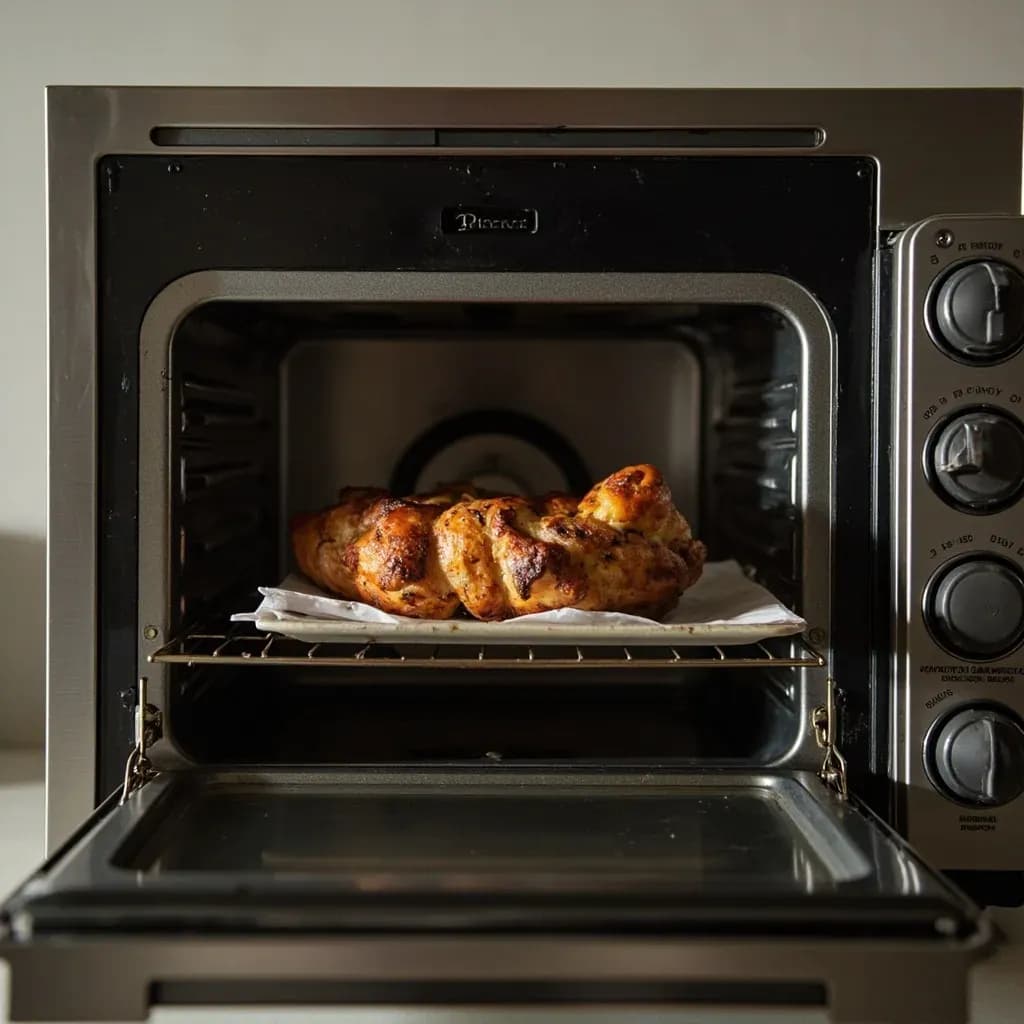
Appliances & Heat
Convection Oven
An oven with an internal fan that circulates hot air for faster, more even baking and roasting.
A convection oven uses a built-in fan, often with a dedicated heating element, to push hot air around the cavity instead of relying on still heat. The moving air cooks food more evenly and quickly, browns surfaces well, and lets you bake on multiple racks at once. Recipes usually call for lowering the temperature about 20 degrees Celsius versus a conventional oven.
A convection oven is a standard oven fitted with a fan — and usually an extra heating element wrapped around that fan — that forces hot air to circulate continuously around the food instead of pooling in layers the way still heat does. That single mechanical change has outsized consequences in the kitchen: the moving air strips the thin layer of cool, moist air that normally clings to food, so heat transfers faster and more evenly. The result is roughly 25% shorter cook times, more consistent browning across multiple racks, and the kind of dry, crisp exterior that a conventional oven has to work hard to achieve.
In day-to-day cooking, that means convection excels at the jobs where browning and crispness matter most — roasted poultry with crackling skin, vegetables with caramelized edges, puff pastry that shatters, cookies that brown identically on the top and middle racks. It is less suited to anything that depends on a still, humid environment: custards, soufflés, delicate cakes, and braises all benefit from switching the fan off.
The single biggest difference between convection ovens is whether the fan has its own heating element behind it. Standard fan-only convection recirculates air that's already been heated by the top and bottom elements — fine for most home cooking. True, European, or third-element convection adds a heater around the fan itself, which is what allows two or three loaded racks to bake truly evenly, and what pastry professionals look for.
Alternatives
Types & varieties
Fan at the back wall moves air already heated by the top and bottom elements. Adequate for most home baking and roasting.
A third heating element wraps the fan, pre-heating the air before it enters the cavity. The most even browning and the best choice for pastry and multi-rack baking.
Built-in unit, typically 24, 27, or 30 inches wide; common in modern kitchens, often paired with a microwave or steam oven.
Freestanding or slide-in range with a convection oven below the cooktop; available in gas, dual-fuel, and all-electric.
Compact plug-in unit from makers like Breville, Cuisinart, and KitchenAid; 120V, smaller cavity, well suited to small kitchens and quick jobs.
Microwave cavity with a convection element and fan; doubles as a small second oven for bakes and roasts.
Professional and high-end home units that inject steam alongside convection heat; used for bread, roasts, and gentle reheating.
Heavy-duty full-size unit, often with manual controls; used in restaurants and bakeries, frequently stacked double.
Convection Bake vs. Convection Roast
Most modern ovens offer two settings that look interchangeable but actually direct which heating elements the fan cycles. Convection Bake pairs the fan with the bottom (and sometimes top) bake elements — gentler radiant heat from below, ideal for items in pans where you want an even rise and controlled browning. Convection Roast pairs the fan with the top broiler element, throwing more heat at the surface to drive browning and crisping. As a rule: bake for things in pans, roast for things on pans.
- Cookies, cakes, quick breads, casseroles → Convection Bake
- Whole poultry, roasts, tray vegetables, pizza, open-pan fish → Convection Roast
- When in doubt, start with Bake — you can always finish under the broiler for color
Converting Conventional Recipes
Recipes written for a still-air oven will over-brown or dry out in convection unless you adjust. The rule is to either lower the temperature by 25°F (about 14°C) and keep the time, or keep the temperature and cut the time by 25% — not both, or the food dries before the interior cooks. Lean proteins, cookies, and vegetables benefit most from the time-reduction approach; large roasts and dense baked goods usually do better with the temperature drop so the center finishes without the crust burning.
- Drop temp 25°F, keep time → for thick, dense items (loaf cakes, whole ham, bread)
- Keep temp, cut time 25% → for thin items, cookies, vegetables, fish
- Start checking at the lower end of the original cook time — visual cues come earlier
- Trust an instant-read thermometer or toothpick over color, especially on roasts
Common uses
Tips & pitfalls
- When converting a conventional recipe, lower the temperature by 25°F OR shorten the time by about 25% — never both — and start checking at the early end of the original time range.
- Use rimmed sheet pans or low-sided trays so air can reach the food; tall walls, deep roasting pans, and Dutch-oven lids block airflow and effectively turn the oven back into a still-air one.
- Leave at least 1 inch of clearance between pans and the oven walls and between pans themselves — a crowded cavity defeats the fan's whole purpose.
- Aluminum sheet pans (light or half-sheet) are ideal because they conduct heat quickly; dark nonstick pans over-brown on the bottom, so drop the temperature another 25°F if that's all you have.
- For soufflés, custards, angel food cakes, and other delicate batters, switch to conventional (bake) mode — the moving air can tilt the rise or skin the surface before the center sets.
- When roasting, pat proteins dry and set them on a wire rack inside a sheet pan so air circulates underneath; otherwise the bottom steams and the skin never crisps.
- Cover anything that shouldn't crisp — lean breast meat, the tips of a roast, the edges of a casserole — with a loose tent of foil. Convection browns aggressively and will scorch exposed lean surfaces before the inside is done.
- Fan noise is normal; rattling, scraping, or intermittent operation is not — that points to the fan motor or a loose element and is worth servicing before you blame the heating element.
Good to know
- Core mechanism
- A fan — usually paired with an extra heating element around it — forces hot air to circulate continuously around food rather than rising in still layers.
- Cook time vs. conventional
- Roughly 25% faster than a conventional oven at the same temperature, because moving air strips away the cool boundary layer on the food's surface.
- Recipe conversion
- Lower the temperature by about 25°F (≈14°C) OR shorten the cook time by about 25% — never both.
- Multiple racks
- Even airflow makes it practical to load 2–3 (sometimes 4) trays of cookies or pastries at once with reasonably consistent browning.
- Preheat and recovery
- Preheats in 5–8 minutes and recovers temperature faster than a conventional oven after the door is opened.
- Temperature range
- Roughly 100–500°F (40–260°C); some commercial units reach 550°F or higher.
- Power source
- Full-size wall and range ovens run on 240V electric or natural gas; countertop models plug into a standard 120V outlet.
- Also called
- Fan oven (UK/EU), turbo oven, forced-air oven, convection bake (the setting name).
Also called
Fan-Forced Oven · Fan Oven · Fan-Bake Oven
Related

Stovetop
The everyday burners where most cooking actually happens

Oven
Enclosed dry heat for roasting, baking, and braising

Grill
Live-fire or gas grates for char, smoke, and high heat

Smoker
Low, slow heat and wood smoke for barbecue and brisket

Air Fryer
Countertop convection that crisps with little or no oil

Slow Cooker
Set-and-forget low heat for stews, beans, and braises

Pressure Cooker
Sealed steam pressure that cooks tough food in a fraction of the time

Rice Cooker
Foolproof, perfectly steamed rice every single time