Appliances & Heat
Conveyor Pizza Oven
A tunnel oven that moves pizzas on a belt through a heated chamber for consistent, hands-off baking.
A conveyor pizza oven bakes food on a moving wire belt that carries it through a long, heated tunnel, exposing each item to the same time and temperature. The consistency and throughput make it a fixture of pizza chains and high-volume kitchens, since unskilled staff can load and unload without judging doneness. Heat is usually delivered by impingement, jets of hot air, for fast, even cooking.
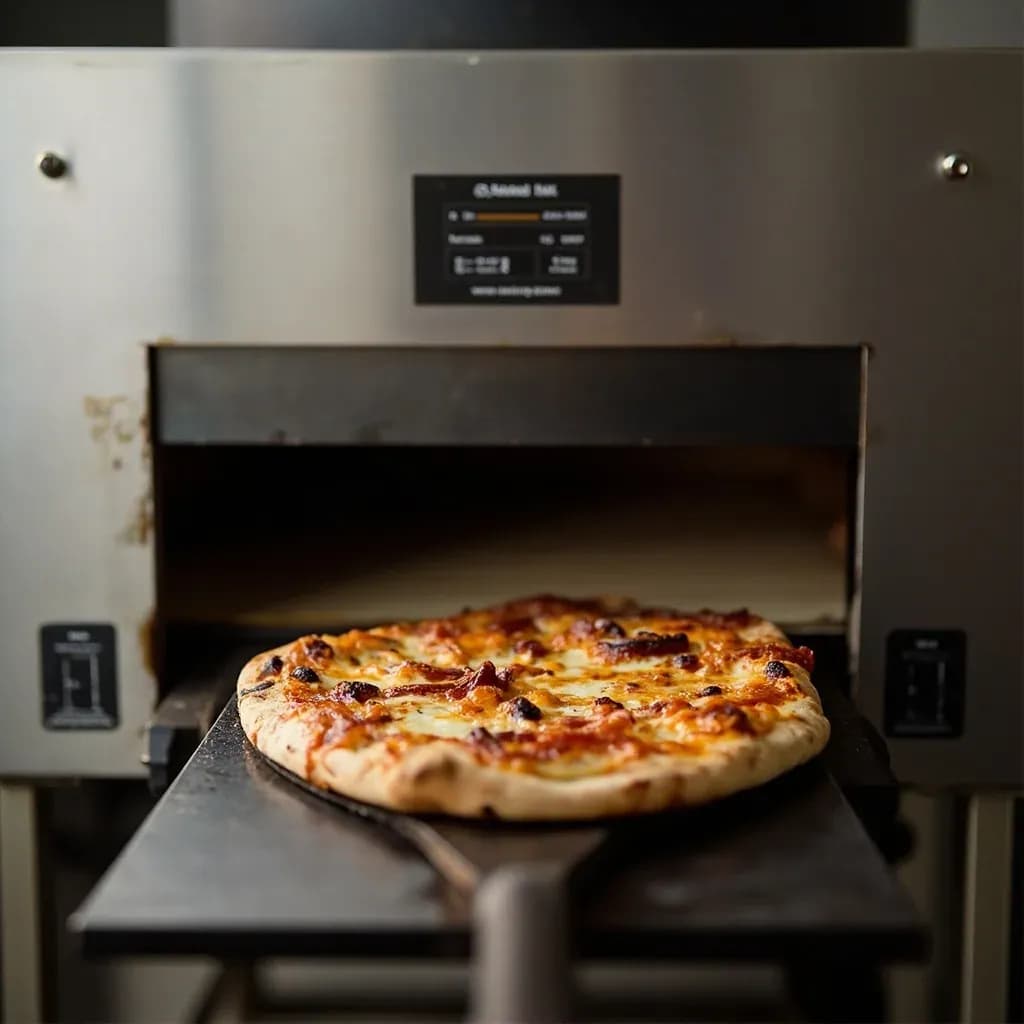
A conveyor pizza oven is a tunnel-shaped oven in which a moving belt carries pizzas through a heated chamber, so each pie bakes for a fixed dwell time set by belt speed. The cook loads the pizza at the entrance, it travels through zones of controlled heat, and it exits browned and ready — usually in 4 to 8 minutes — with no further attention. That hands-off repeatability is the entire point: once a recipe is dialed in, every pie coming out of the oven matches the one before it, hour after hour. It is why chain pizzerias, ghost kitchens, stadiums, and school cafeterias all rely on them.
Most modern conveyor ovens bake with air impingement — high-velocity jets of hot air aimed at the top and bottom of the product — which strips the cool boundary layer off the crust and cheese and drives fast, even browning. Older or specialty models use radiant elements, gentle convection, or a moving stone deck for a more hearth-style bake. The two controls the operator actually adjusts are chamber temperature and belt speed, and the real skill of running one is learning how those two interact with dough weight, sauce weight, and cheese weight.
Outside of commercial kitchens, compact countertop electric conveyor ovens exist for serious home pizzaiolos and prosumer setups. They will not deliver the charred, leopard-spotted cornicione of a 900 °F Neapolitan deck oven, but they will reliably turn out New York–style, pan, and thin-crust pies with the consistency a busy cook needs.
Alternatives
Types & varieties
Forced jets of hot air from top and bottom; the fastest and most common style in chain pizza, well suited to par-baked and frozen doughs.
Heated by infrared or radiant elements plus circulated air; slightly slower than impingement but gentler on delicate or heavily topped pies.
Stone or cordierite deck travels through the chamber; closer to a traditional deck-oven crust, with longer bake times.
Dominant in high-volume operations; higher BTU output and lower operating cost per pie, but requires a properly sized exhaust hood.
Common in ventless or smaller installations; easier to site but slower recovery between pies.
Compact electric units sized for small shops, food trucks, and serious home pizza makers.
Dialing in the bake
A conveyor oven has only two real knobs — temperature and belt speed — but they interact with every variable of the pizza itself. The standard approach is to set the chamber temperature first (most pies land in the 500–575 °F / 260–300 °C range), then adjust belt speed to hit your target bake time. As a rule, slowing the belt at the same temperature dries the bottom and crisps the crust, while speeding it up leaves a softer, more open crumb. Raising temperature shortens bake time overall; lowering it lengthens it. The single biggest mistake is changing both at once: hold one fixed and walk the other until the pie matches your standard.
- Aim for 500–575 °F (260–300 °C) for most New York and pan styles; push higher only for thin and crispy.
- Track dough weight, sauce weight, and cheese weight — a 10% drift in any of them shifts the bake.
- Use the first pie of the morning as a calibration pie; do not start serving until it matches your standard.
- If cheese browns before the crust sets, drop temperature 25 °F or speed the belt slightly.
- If the bottom burns before the top colors, either bottom-zone heat is too high or the belt is too slow — change one variable at a time to identify which.
Loading and spacing
Air impingement only works if the air can reach the food. Crowded belts, overlapping pizzas, and toppings spilling onto the belt are the most common causes of pale spots and gummy centers.
- Leave 1–2 in (2.5–5 cm) between items so the jets can wrap around each piece.
- Use screens, pans, or stones sized to the belt to keep cheese and sauce from dripping into the chamber.
- Load pies consistently at the same spot on the belt so the dwell time stays predictable.
- Avoid double-loading — airflow collapses and the second pie bakes by steam rather than heat.
Common uses
Tips & pitfalls
- Preheat for at least 20 minutes from a cold start; uneven preheat is the leading cause of inconsistent crusts in the first hour of service.
- Adjust belt speed and temperature as a pair, not independently: slower belt at lower heat dries and crisps, faster belt at higher heat softens and shortens bake time.
- Track dough weight, sauce weight, and cheese weight — a 10% drift in any of them shifts the bake and forces a recalibration.
- Use pans, screens, or stones sized to the belt so toppings do not drip into the chamber and burn onto later pies.
- Leave 1–2 in (2.5–5 cm) between items so impingement air has a path around each piece to brown evenly.
- Do not overload the belt; stacking or crowding kills airflow and produces pale, gummy centers.
- Clean the chamber and belt on a set schedule — burned cheese and flour residue smoke and taint subsequent bakes.
- If your model has separate top and bottom zone controls, balance them: too much top heat scorches the cheese, too much bottom burns the crust before the dough sets.
- For a more blistered crust, slow the belt slightly instead of raising temperature — extra dwell time at the same heat drives more surface browning.
Good to know
- Heat source
- Gas (most common in high-volume operations) or electric (common for small or ventless installs)
- Operating temperature
- Roughly 475–650 °F (245–345 °C); some models reach 700 °F (370 °C)
- Bake time
- Adjustable via belt speed, commonly 4–8 minutes per pizza
- Throughput
- 30 to 200+ pies per hour, depending on model and belt width
- Belt widths
- Common sizes 12, 18, 24, and 32 in (30, 46, 61, 81 cm)
- Chamber length
- Typically 4–10 ft (1.2–3 m)
- Preheat time
- 20–30 minutes from a cold start
- Belt surfaces
- Wire mesh, woven steel, or stone/cordierite slabs
Also called
Tunnel Oven · Impingement Oven
Related

Stovetop
The everyday burners where most cooking actually happens

Oven
Enclosed dry heat for roasting, baking, and braising

Grill
Live-fire or gas grates for char, smoke, and high heat

Smoker
Low, slow heat and wood smoke for barbecue and brisket

Air Fryer
Countertop convection that crisps with little or no oil

Slow Cooker
Set-and-forget low heat for stews, beans, and braises

Pressure Cooker
Sealed steam pressure that cooks tough food in a fraction of the time

Rice Cooker
Foolproof, perfectly steamed rice every single time