Cookware
Cooking Pot
General all-purpose pot for boiling, simmering, and stewing everyday meals.
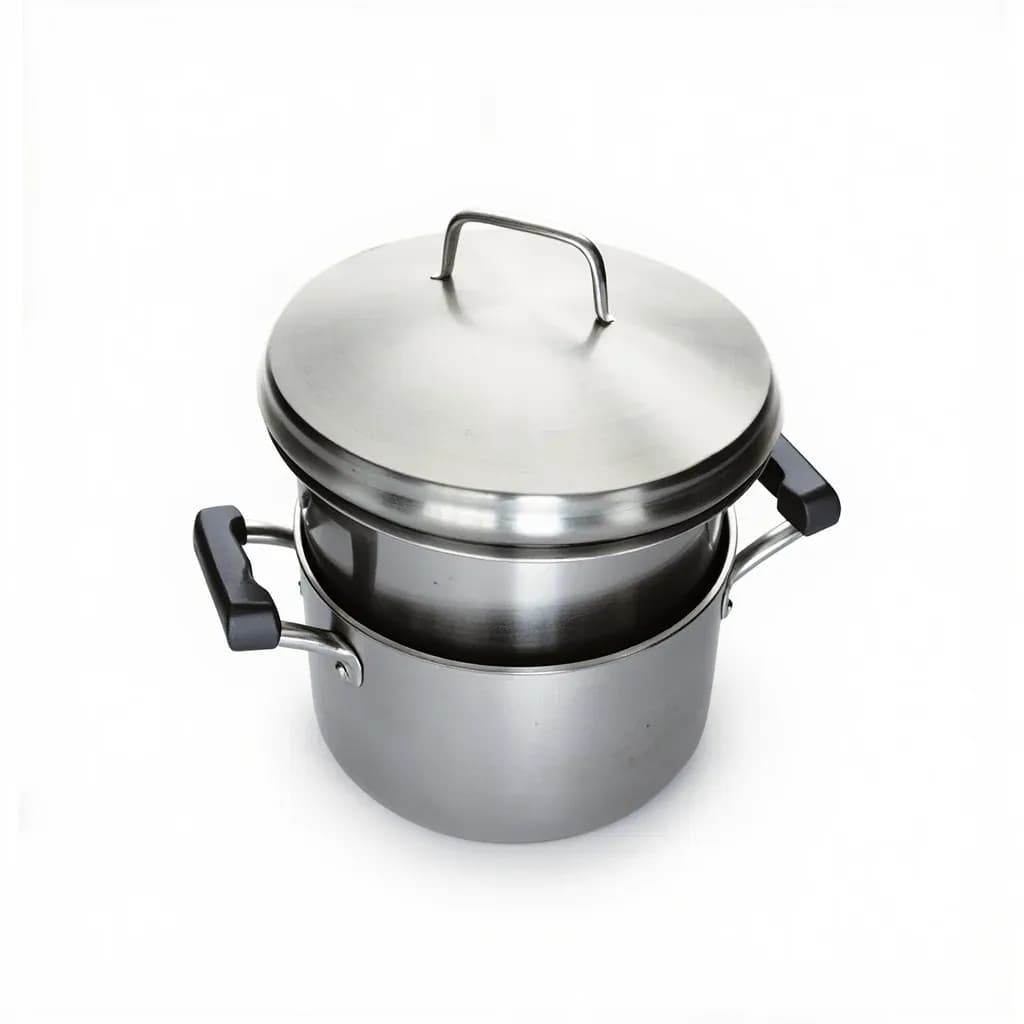
A cooking pot is a general-purpose deep vessel with a handle or two and usually a lid, used for boiling, simmering, and stewing a wide range of dishes. It is the everyday workhorse for cooking rice, soups, pasta, and braises in homes around the world. Made of stainless steel, aluminum, brass, or enamel, it spans a broad range of sizes.
A cooking pot is a deep, lidded vessel designed to hold liquid or food over direct or indirect heat — the workhorse of nearly every cuisine, from a four-quart saucepan of rice to a twenty-quart stockpot of Sunday broth. Its function is straightforward physics: walls and base conduct heat into the contents, the lid traps steam, and condensation drips back to keep moisture cycling through the food. That simple design has changed little in twenty thousand years; what has changed is the material, and the material determines almost everything about how a pot cooks.
A good pot matches three things: the heat source, the food, and the cook's hand. Cast iron and clad stainless hold steady heat for long braises; bare aluminum boils water fast but reacts with acid; copper is the most responsive common cookware metal but high-maintenance; enameled cast iron can move from stovetop to oven to table without complaint. For most home cooks, two pots — a four-quart saucepan and an eight-quart Dutch oven or stockpot — cover the vast majority of liquid-based cooking, from rice and grains to stocks, stews, and pot roasts.
Beyond the practical, the cooking pot is where most cooking actually happens — the vessel in which soups are tasted, beans are tested for doneness, stocks are skimmed of foam, and bread dough is judged by its spring. Learning to choose the right size and material, and to manage a pot's quirks of heat distribution, lid behavior, and fill limits, is one of the highest-leverage skills a cook can develop.
Alternatives
Types & varieties
Tall and narrow, 8–20+ qt; built for stocks, broths, pasta water, and seafood boils.
Heavy, deep, lidded pot, often cast iron (enameled or bare); braising, bread baking, deep-frying, and stewing.
2–4 qt with a single long handle; sauces, small portions of grains, vegetables, and reheating.
Medium-tall, 6–12 qt, slightly wider base than a stockpot; everyday soups and stews.
Wide and shallow relative to depth; browning and slow braising with more surface area for evaporation.
Tall, narrow, often stoneware with a lid; traditional for baked beans and slow oven cooking.
Conical-lidded clay or cast-iron pot; North African braises with steam recirculation that bastes the food.
Unglazed clay, soaked in water before use; traditional for bread, roasts, and casseroles.
Sealed-lid pot that raises the boiling point; faster braises, beans, and tough cuts.
Electric, low-wattage countertop pot for unattended long cooking — a pot in function, an appliance in form.
Two nested pots for gentle indirect heat; custards, hollandaise, and tempering chocolate.
Choosing the Right Material
The material a pot is made of shapes its cooking personality more than its size does. A practical home setup needs to match metal to task.
- Stainless-clad aluminum (tri-ply or five-ply) is the modern default: even heating, non-reactive, induction-ready, and dishwasher-safe. The best general-purpose choice.
- Cast iron (bare or enameled) excels at steady, retained heat — searing, braising, deep-frying — but is heavy and slow to respond to temperature changes. Bare iron needs seasoning; enameled iron does not, but cannot be dry-heated empty for long.
- Bare aluminum is cheap and a fast conductor, but reacts with acidic foods (tomato, wine, citrus) and discolors. Fine for water boils, not for long acidic simmers.
- Copper is the most thermally responsive common cookware metal — sauces react almost instantly to a change in burner setting — but is expensive, requires polishing, and reacts with food unless lined with stainless or tin. A specialist's tool.
- Enameled cast iron is the most versatile: oven-safe, induction-safe, non-reactive, and presentable at the table. Worth the weight and the price for braises, bread, and stews.
Capacity and Fill Rules
A pot's working capacity is always smaller than its advertised capacity, and the difference matters for safety and for results.
- Plain liquids: fill to no more than ¾ full to allow space for rolling boils and for stirring without sloshing.
- Starchy foods (beans, pasta, potatoes, grains): fill only ½ full. Starch-laden foam rises and can boil over, clog the lid vent, or cause a stovetop mess.
- Deep-frying: fill to no more than ⅓–½ full of oil. Food releases moisture on contact, and oil foams up violently — a full pot of hot oil overflowing is one of the most dangerous kitchen accidents.
- Bread baking in a Dutch oven: the dough should fill only about ⅓ of the pot's height to allow for oven spring before the lid traps it for steam.
Heat and Lid Management
Two habits separate a cook who knows pots from one who merely owns them: controlling heat, and resisting the urge to lift the lid.
- Match pot diameter to burner diameter. A small pot on a large gas flame scorches the sides and wastes heat; a large pot on a small electric coil heats unevenly.
- Resist the lid. Every peek drops the pot's internal temperature by 10–25 °F and adds several minutes to cooking time. Trust the process and time the cook instead.
- Use the lid's tilt. For reducing sauces or finishing braises, set the lid ajar to let steam escape; for braises and rice, set it on tight to retain moisture.
- Preheat gradually. Putting a cold enameled or glass-lidded pot onto high heat invites thermal shock and cracking. Bring it up with the burner, or on low first.
Common uses
Tips & pitfalls
- Match pot diameter to burner diameter — an undersized pot on a huge flame scorches the sides and wastes energy, while an oversized pot on a small coil heats unevenly and never simmers properly.
- Preheat an empty pot gradually, especially enameled cast iron or glass-lidded pots; plunging a cold pot onto high heat can crack it from thermal shock.
- Fill only to ¾ capacity for plain liquids, ½ for starchy foods (beans, pasta, potatoes) that foam and can climb out of the pot or clog a lid vent.
- For even browning on stew meats, dry the meat thoroughly with paper towels and brown in batches — crowding the pot steams the meat instead of searing it.
- Resist lifting the lid repeatedly. Every peek drops the pot's internal temperature by 10–25 °F and lengthens cooking time noticeably; trust the timer instead.
- Salt boiling water only after it has reached a full rolling boil. It boils marginally faster and is gentler on stainless steel, where salt dropped into cold water can encourage pitting corrosion.
- Avoid long acidic simmers (tomato, wine, lemon) in bare cast iron or unlined copper — acid strips seasoning from iron and reacts with copper. Use stainless or enameled cast iron for those dishes.
- Lift a heavy stockpot full of liquid by sliding it off the burner onto a folded dry towel rather than grabbing both handles when it's full and hot.
- Deglaze the pot with wine, stock, or water after sautéing to capture the fond (browned crust) — it is the foundation of pan sauces and braises.
- Hard-water spots and starch films come off stainless with a paste of baking soda and water, or a simmer of water with a tablespoon of baking soda or a peeled potato.
Good to know
- Type
- Deep, lidded vessel for liquid-based cooking methods
- Primary materials
- Stainless steel, aluminum, cast iron, enameled cast iron, copper, anodized aluminum, ceramic/clay
- Standard home sizes
- 4–12 qt (3.8–11 L); commercial sizes run to 60+ gallons
- Construction
- Two loop or stick handles, tight-fitting lid, often with a clad or encapsulated base for even heat
- Heat compatibility
- Cast iron and clad stainless work on all stovetops including induction; copper and bare aluminum need an induction-compatible base
- Capacity rule
- Fill no more than ¾ full for liquids, ½ full for starchy foods (beans, pasta, potatoes) that foam and climb
- Origin
- Clay cooking pots date to c. 20,000 BCE (Jomon period, Japan); metal versions were widespread by the Bronze Age
- Typical weight (8 qt)
- Stainless 3–5 lb; cast iron 12–15 lb; enameled cast iron 13–16 lb
Also called
cooking-pot · pot · large-cooking-pot · large-pot · rice-cooking-pot · milk-pot · brass-pot
Related

Steamer
Gentle moist heat that keeps vegetables, fish, and dumplings tender

Frying Pan
Shallow sloped pan for frying, sautéing, and quick sears

Saucepan
Tall, straight-sided pot for sauces, grains, and small batches

Sauté Pan
Wide straight-sided pan with room to brown and braise

Dutch Oven
Heavy lidded pot that turns tough cuts tender over hours

Stock Pot
Tall, roomy pot for stocks, pasta, and big-batch cooking

Wok
High-sided bowl pan built for blistering-hot stir-fries

Griddle
Flat, broad surface for pancakes, smash burgers, and breakfast