Appliances & Heat
Cooling Tunnel
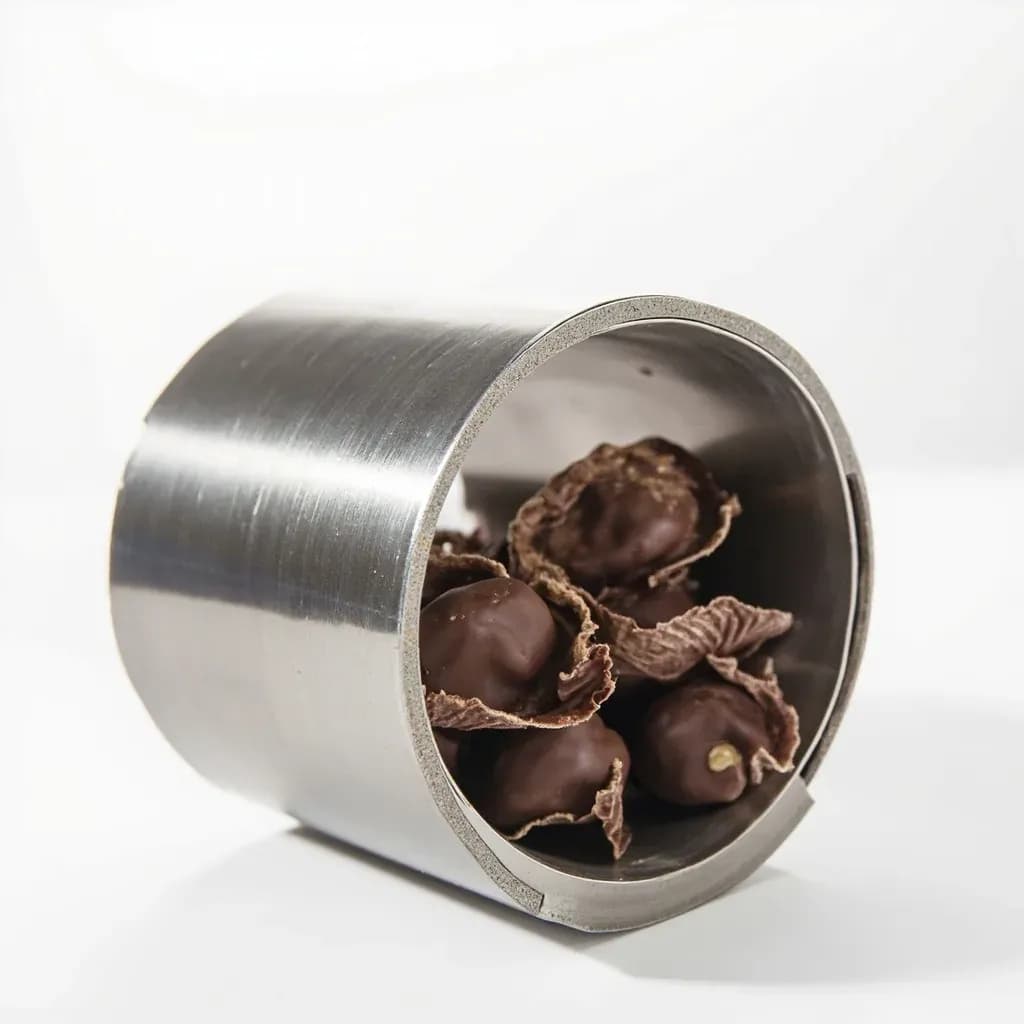
A conveyor through chilled air that sets chocolate and bakery goods as they pass.
A cooling tunnel is an enclosed conveyor that moves product through a controlled stream of cold air to set or solidify it quickly and evenly. Chocolatiers and bakeries use it to harden enrobed chocolates, glazes, and confections in line with production so items emerge ready to wrap. Steady airflow and temperature prevent the bloom and uneven set that random refrigeration can cause.
A cooling tunnel is the industrial workhorse that turns molten chocolate, hot bread, or warm candy into a packaged product you can hold. Picture a long, insulated enclosure — six to thirty meters of stainless steel, sometimes coiled upward into a spiral — with a food-grade belt threading through it. Refrigerated air is blown across the belt from overhead and underneath nozzles, and each section of the tunnel is held at a different temperature. As the belt carries product from one end to the other, the air strips heat in a controlled curve rather than all at once.
The reason a tunnel is zoned rather than set to one cold temperature is that food has physics. Chocolate that drops straight from 30 °C to 5 °C will fat bloom, the surface turning grey and streaky as cocoa butter migrates. A loaf of bread cooled too fast in still air can end up with a set crust and a gummy, under-set crumb because the interior did not have time to finish. A cooling tunnel solves both by giving product a ramp — warm entry, cold middle, slightly warmer exit — so the surface and interior cool at compatible rates. Humidity is independently controlled as well, because moisture on the surface of cooling chocolate is what causes sugar bloom and tacky packaging.
For anyone working at production scale, the tunnel is where the line's pace and the product's quality are finally decided. It is almost always custom-specified: belt width, dwell time, number of zones, refrigeration medium, and footprint (linear or spiral) are all chosen around the SKU, the factory floor, and the throughput target. For a small chocolatier or baker, a refrigerated cabinet with circulating fans serves the same role in batch form — but loses the continuous flow that justifies a tunnel's capital cost.
Alternatives
Types & varieties
Multi-zone tunnel paired with an enrober; uses a gentle ramp-down curve to avoid fat bloom on tempered chocolate.
Higher air volumes and faster heat transfer, designed to drop product from oven temperature (80–100 °C) to handling temperature in minutes.
Vertical spiral belt that delivers a long residence time in a small footprint — common for cakes, bread loaves, and enrobed bars.
Horizontal belt with simpler mechanics; chosen where floor space is not the limiting factor.
High-velocity air jets aimed perpendicular to the product for very fast heat transfer; standard in industrial bakeries.
Uses liquid nitrogen or CO2 spray for very fast cooling of thin products, sidestepping water-based humidity control entirely.
Distinct, independently controlled zones for a fully tailored cooling curve; the standard on premium chocolate lines.
Zoning the tunnel
A cooling tunnel is a piece of process equipment, not just a refrigerator, and the zoning is where the engineering lives. Each zone has its own coil, fan, damper, and setpoint, and the operator dials in a curve that matches the product's glass transition and moisture behavior.
- Zone 1 (entry) is held just below the product's starting temperature so the surface does not shock-set; for tempered chocolate that means around 25–28 °C, for a cake straight from the oven closer to 80 °C.
- Zone 2 (main cooling) does the heavy lifting — chilled air at high velocity — and pulls the bulk of the heat out of the product.
- Zone 3 (exit / conditioning) is the most-forgotten zone and the cause of most field complaints. It gently re-warms the product toward ambient so it does not sweat the moment it meets a warm packing hall.
- Dehumidification runs across all zones on chocolate lines; a stable 30–50% RH is more important to surface finish than the exact air temperature.
Spiral versus linear
The first design decision on any new tunnel is footprint, and that almost always means choosing between a long horizontal run and a vertical spiral. The mechanics, capital cost, and cleanability differ in ways that shape the rest of the line.
- Linear tunnels are simpler: one straight belt, easier access, easier to thread a new SKU through. They win on flexibility and on short-residence products like thin enrobed cookies.
- Spiral tunnels trade mechanical complexity for floor space. A 3–5 m diameter spiral can deliver 30–80 m of belt path, so dwell times of 20–40 minutes fit on a footprint a linear tunnel cannot match.
- Spirals are the usual answer for fragile cakes and tall enrobed bars that need long residence without taking over the bakery floor.
- Impingement tunnels are typically built as linear runs, where the straight belt geometry makes it easier to aim and balance high-velocity air across the product width.
Common uses
Tips & pitfalls
- Match zone temperatures to the product's glass transition: chocolate should never be plunged below about 18 °C or fat bloom will follow.
- Always condition (slightly re-warm) the product at the exit zone; a cold bar going into a warm wrapping area sweats inside the pack.
- Watch humidity first, not just temperature — sugar bloom in chocolate is almost always a moisture problem, not a temperature problem.
- Run the belt empty for several minutes after start-up so the air profile stabilizes before product enters.
- Keep the belt and air nozzles clean; chocolate dust and crumbs deflect airflow and create uneven cooling stripes that show up as soft spots.
- Avoid overloading the belt — too dense a product mass will not reach the cooler's center, causing soft centers and cracked surfaces on the bottom.
- For bakery lines, do not pull bread out of the tunnel too cold; an internal core 5–10 °C above ambient helps residual moisture redistribute evenly during slicing.
- Log belt speed and zone setpoints per SKU; a 0.5 m/min drift can change exit temperature by several degrees and quietly ruin a run.
- CIP cycles should include the air-handling unit, not just the belt — mold growing in the air stream will land on every product that follows.
Good to know
- Type
- Industrial conveyorized cooling system: a long enclosed tunnel with a moving belt passing through refrigerated air zones.
- Zones
- Usually three independently controlled temperature zones — warm entry, cold middle, conditioning/pre-warming exit.
- Belt speed and dwell
- Belt speed typically 1–10 m/min; total residence time roughly 10–30 minutes depending on product mass and target exit temperature.
- Chocolate temperature profile
- Entry ~25–28 °C, main cooling ~10–15 °C, exit/conditioning ~18–22 °C to bring product back toward ambient and prevent condensation.
- Bakery temperature profile
- Entry around 80–100 °C (straight from the oven), rapid drop to 30–40 °C by mid-tunnel, exit near ambient (~25 °C).
- Humidity control
- Dehumidification is standard on chocolate lines, typically 30–50% RH, to prevent sugar bloom and surface moisture.
- Belt and dimensions
- Belt widths 400–1200 mm (industrial lines up to 1600 mm); linear tunnels 6–30 m, spiral tunnels 3–5 m diameter delivering 30–80 m of belt path.
- Throughput
- From a few hundred kg/h on small lines to several thousand kg/h on large chocolate enrobing installations.
- Construction and cleaning
- Stainless steel and insulated polyurethane panels; food-grade PU, fabric, or wire-mesh belt; designed for wash-down or CIP (clean-in-place).
Also called
Chocolate Cooling Tunnel · Conveyor Cooler
Related

Stovetop
The everyday burners where most cooking actually happens

Oven
Enclosed dry heat for roasting, baking, and braising

Grill
Live-fire or gas grates for char, smoke, and high heat

Smoker
Low, slow heat and wood smoke for barbecue and brisket

Air Fryer
Countertop convection that crisps with little or no oil

Slow Cooker
Set-and-forget low heat for stews, beans, and braises

Pressure Cooker
Sealed steam pressure that cooks tough food in a fraction of the time

Rice Cooker
Foolproof, perfectly steamed rice every single time