Appliances & Heat
Cracker & Winnower
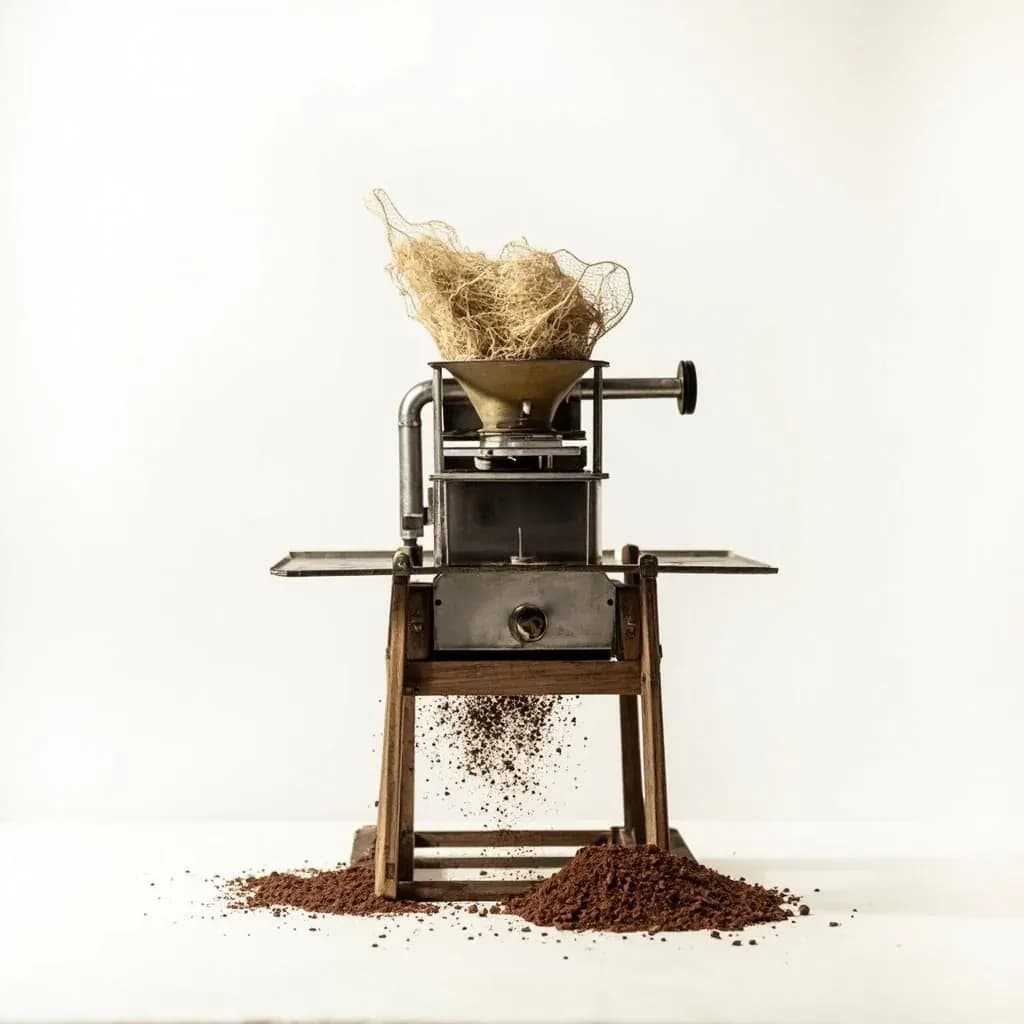
A machine that cracks roasted cacao beans and blows away the shells, leaving clean nibs.
A cracker and winnower is a chocolate-making machine that crushes roasted cocoa beans into pieces, then uses airflow to separate the lighter papery husk from the heavier cocoa nibs. The clean nibs are what get ground into chocolate liquor, so good winnowing is essential to flavor and smoothness. Small bean-to-bar makers use compact versions, while factories run large continuous lines.
A cracker-winnower is the dedicated machine that sits between the roaster and the refiner in any bean-to-bar chocolate workflow. Roasted cacao beans arrive with a thin, papery husk that accounts for roughly a fifth to a third of their weight; that husk is bitter, fibrous, and unwelcome in finished chocolate. The machine's job is to fracture that husk without pulverizing the nib inside, then lift the lighter shell fragments away on a stream of air. Without it, a maker either hand-winnows a few hundred grams at a time or feeds shell-laden nibs straight into the melanger and lets the grit tell the story.
Mechanically, the unit is two tools in one frame. The cracker stage uses either a pair of corrugated rollers set to a narrow gap or an impact mechanism to snap the brittle husk while leaving the dense nib largely intact. The cracked mixture — nib chunks, husk flakes, and fines — then drops into the winnower, where a variable-speed fan pulls air up through a cyclone or fluidized column. Shell pieces are light enough to be lifted into a separate collection chamber; the heavier nibs fall through. The result is three streams: clean nibs, coarse husk, and a fines fraction that some makers recover as 'cocoa meal.'
The real skill is calibration. Get the roller gap wrong and you either crush the nib into dust or leave it sealed inside unbroken shell; get the fan speed wrong and you either blow good nibs into the husk bin or let shell ride along with the nibs. A well-tuned small machine delivers 95–99% shell-free nibs in a single pass, and a second pass pushes past 99%. The cracker-winnower cannot rescue a bad roast, but paired with well-fermented, evenly roasted beans it is the unglamorous workhorse that makes clean chocolate possible.
Alternatives
Types & varieties
Two corrugated or smooth rollers at a narrow gap; the standard for craft chocolate because it cracks husk without smashing nibs into fines.
Beats beans against a screen or rotating paddles; higher throughput but tends to create more nib dust, so the winnower has to work harder.
Spins beans against a stator; found on some industrial lines where very high capacity is the priority.
One frame with hopper, cracker, blower, and cyclone/collection bin; the workhorse of craft chocolate.
Paired with a separate cracker; common in mid-scale operations where cracking and winnowing are decoupled for throughput.
Air swirls through a cyclone so shells drop into a side chamber; clean separation and easy to dial in.
Air moves up through a column of cracked beans so shells lift off the top; simple and effective on small machines.
Calibration: Where the Real Skill Lives
The cracker-winnower looks like a simple machine, but the difference between a clean 99% nib yield and a dusty, shell-laden mess comes down to two dials. The first is the roller gap on the cracker; the second is the fan speed on the winnower. Both are interdependent, and both reward a methodical, ears-open approach rather than guesswork.
- Start with cool, fully rested beans. A hot bean behaves differently from a room-temperature one, and any 'recipe' tuned on warm beans will be wrong once they cool.
- Set the roller gap first with a feeler gauge, then confirm by eye: cracked pieces should look like coarse gravel, not flattened discs and not whole beans.
- Bring fan speed up from the lowest setting until you see shells lifting cleanly into the cyclone and nibs falling through. If nibs start appearing in the shell bin, back off.
- Plan for a second pass. Most craft operations winnow twice — coarse, then clean — and treat any single-pass result under 97% as 'first pass only.'
- Keep a small sample jar from each run. A quick visual check under a light tells you more than any gauge whether the calibration has drifted mid-batch.
Common uses
Tips & pitfalls
- Cool roasted beans completely — at least 15–30 minutes, ideally longer — before cracking. Warm shells stay pliable and cling to the nib instead of fracturing cleanly.
- Don't over-roast. Deep, dark roasts give a brittle nib that shatters into fines and a shell that turns toasted-bitter; lighter 'snapping' roasts winnow noticeably cleaner.
- Set the roller gap with a feeler gauge or by feeding a single bean through first. You want the husk to fracture, not the nib to flatten — white powder at the outlet means the gap is too tight.
- Match fan speed to particle size. Too strong and you blow nibs into the shell bin; too gentle and shells ride along with the nibs. Always start low and ramp up.
- Run cracked beans through twice for the cleanest nibs — first pass as a coarse separation, second pass for residual shell.
- Keep the hopper fed steadily; an empty hopper means the cracker processes its own fines and the winnower starves.
- Brush the cracker rollers down between batches; shell dust cakes on the rollers and quietly changes the effective gap mid-run.
- Wipe the cyclone with a dry brush, not water. Residual moisture in the winnower causes shells to stick and the next batch to clog.
- Don't throw the shells. Roasted cacao husks make a mild tisane, can be smoked into salt, and some makers compost them or use them as garden mulch.
- Wear a dust mask when emptying the shell bin; winnowing dust is very fine, tannin-rich, and irritating to breathe.
- Listen for a steady 'hum' from the cracker. Chatter or squeal usually means a rock, an unroasted bean, or a mis-set gap — stop and inspect before continuing.
- Plan for 1–3% shell carry-over as 'normal loss' in your yield calculations; the percentage swings with bean origin, with thin-shelled Criollo winnowing cleaner than thicker-shelled Forastero.
Good to know
- Process stage
- Post-roast, pre-refining — the bridge step between whole roasted beans and clean nibs ready for the melanger or refiner.
- Shell share of bean
- Roughly 20–30% of a roasted cacao bean's weight is husk, depending on origin and fermentation.
- Target nib purity
- A good single pass produces 95–99% shell-free nibs; a second winnow pass is often used to push past 99%.
- Typical capacity
- Countertop bean-to-bar units handle 1–5 lb (0.5–2 kg) per hour; mid-scale machines run 10–50 kg/h; industrial lines exceed 100 kg/h.
- Output stream
- Three fractions — clean nibs, coarse husk, and a fines/dust mix; the fines are sometimes recovered as 'cocoa meal.'
- Power and build
- Electric; small countertop units run 110–120 V, industrial units 220–480 V three-phase; stainless steel contact parts and food-grade bearings throughout.
Also called
cocoa winnower · cracker winnower · cacao cracker
Related

Stovetop
The everyday burners where most cooking actually happens

Oven
Enclosed dry heat for roasting, baking, and braising

Grill
Live-fire or gas grates for char, smoke, and high heat

Smoker
Low, slow heat and wood smoke for barbecue and brisket

Air Fryer
Countertop convection that crisps with little or no oil

Slow Cooker
Set-and-forget low heat for stews, beans, and braises

Pressure Cooker
Sealed steam pressure that cooks tough food in a fraction of the time

Rice Cooker
Foolproof, perfectly steamed rice every single time