Appliances & Heat
Cubing / Tenderizing Machine
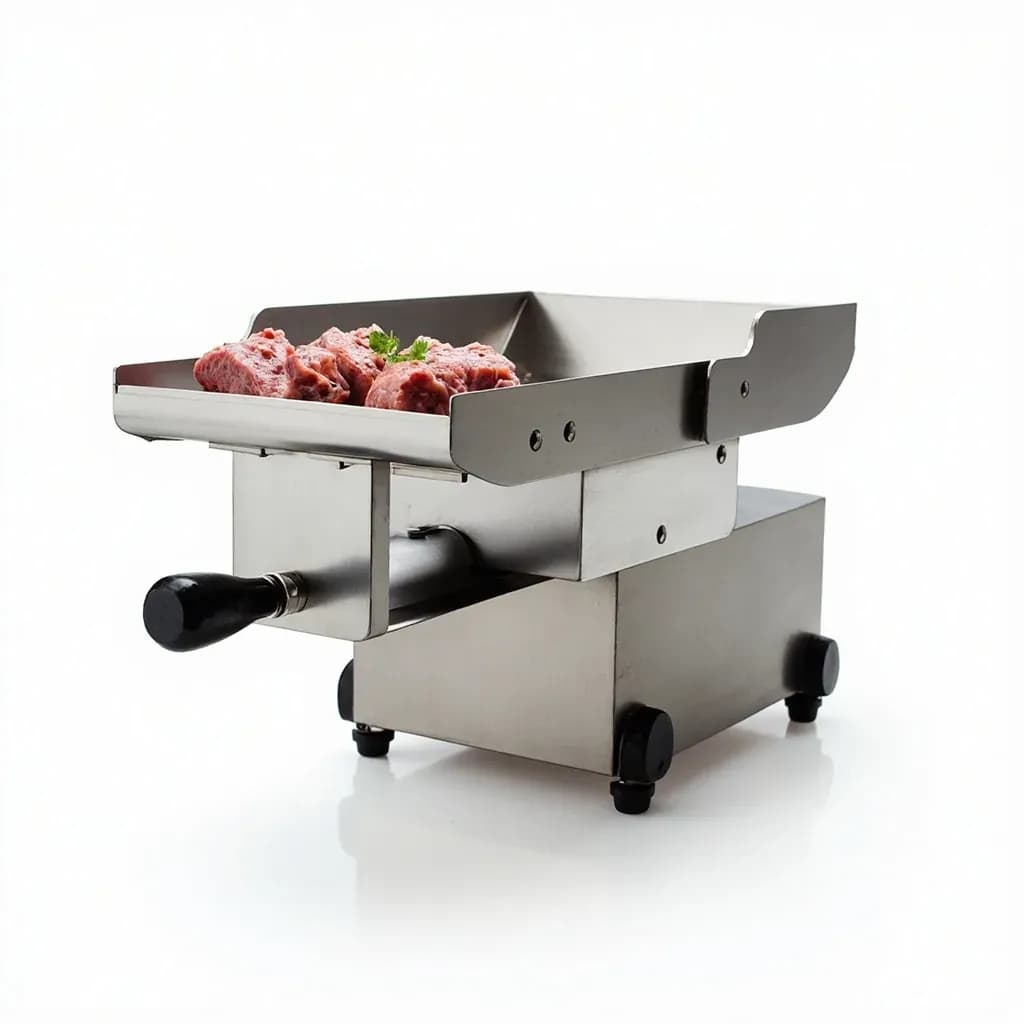
A machine that runs meat through toothed rollers to tenderize it and form even cube steaks.
A cubing or tenderizing machine passes cuts of meat between rotating blades or studded rollers that score and pierce the muscle fibers. This breaks down tough connective tissue and flattens the meat into uniform cube steaks ready for quick cooking. It is common in butcher shops and diners for turning economical cuts into tender, fast-frying portions.
A cubing machine — also called a tenderizing machine or, in production kitchens, simply a cuber — is a roller-style appliance that mechanically breaks down the long muscle fibers of tougher cuts of meat. Steaks are fed between two counter-rotating rollers studded with rows of small square or diamond-shaped blades. Each blade severs a portion of the fiber without cutting all the way through, leaving a connected sheet of meat marked with a regular grid of small cuts on both sides. The effect is essentially an industrial version of the old hand-pounding mallet: what a cook could accomplish in a minute or two of whacking is done in a single pass, at a uniform depth, hundreds of steaks per hour.
The texture this creates is unmistakable — diners across the American South and Midwest recognize it on sight as cube steak, and it is the defining preparation for chicken-fried steak, Swiss steak, and country-fried steak. Beyond visual recognition, the cubed surface has real functional value: it shortens fibers so a thrifty round or chuck slice can be cooked through without turning leathery, and it multiplies the surface area available to absorb dry brines, spice rubs, and marinades. A cube steak that would have needed an overnight soak in marinade will drink the same liquid in fifteen minutes once it has been through the rollers.
The cuber is often confused with two related but distinct machines. A needle tenderizer punches hundreds of fine holes through a whole muscle (brisket, pork shoulder) so brine can be absorbed; an injector forces liquid in under pressure. The cuber is for portioned steaks and is not interchangeable with either. Most production kitchens run all three in sequence on different products, and for the home cook a hand-held Jaccard-style blade tenderizer is the closest analog — though it lacks the distinctive cubed pattern that consumers expect to see.
Alternatives
Types & varieties
Small lever-operated roller found in butcher shops and high-end kitchens; useful for very low volume and occasional special work.
Compact single-roller machine typical in restaurants and small meat rooms; the Hollymatic Super 54 is the benchmark form factor.
Twin rollers with conveyor feed, used in grocery meat rooms and commissaries for steady mid-volume production.
Cuts a grid of small square indentations on each side — the classic cube-steak appearance diners recognize.
A 45°-rotated pattern that breaks fibers more aggressively and shows less of the visible 'cube' on the finished steak.
Smooth blades that slice fibers without leaving the cubed pattern; used when a clean appearance matters more than the cube-steak visual.
Production-line machines that cube, then drop steaks onto a conveyor that runs them through a vacuum tumbler or injection manifold in one pass.
Choosing the right blade pattern
The blade set you load is the single biggest decision you make each time you run the machine, and it determines both the look and the eating texture of the finished steak. The three patterns to understand:
- Square-cube is the default. It produces the recognizable checkerboard indentations on both faces and is what most diners picture when they hear 'cube steak.' Use it for chicken-fried steak, Swiss steak, and any menu item where the cubed visual is part of the brand.
- Diamond-cube is rotated 45° relative to the feed direction and cuts across more fibers per pass. It is more aggressive — useful for very tough cuts such as shank slices or round — but leaves a less obvious cube pattern, which can confuse customers expecting the classic look.
- Flat-blade tenderizes without cubing. Choose this when you are working with a tender cut that simply needs a small amount of fiber-breaking, or when a clean, unmarred surface is required for plating, photography, or a deli-style presentation.
Common uses
Tips & pitfalls
- Partially freeze steaks to 30–40 °F (-1 to 4 °C) before cubing — firmer flesh produces cleaner, less ragged cuts and noticeably extends blade life.
- Always feed meat across the grain of the muscle so the blades sever, rather than align with, the long fibers; cutting parallel to the grain does almost nothing.
- Run each steak through only once; double cubing tears the meat into a mush that falls apart during cooking and refuses to hold a breading.
- Skip already-tender cuts such as ribeye, tenderloin, and well-marbled chuck eye — they do not benefit and lose juiciness in the process.
- Keep a dedicated blade set for beef and a separate one for poultry, pork, or lamb to prevent cross-flavor and to keep allergen control manageable.
- Disassemble, scrub, and sanitize the rollers, feed pan, and guards between species and ideally between batches; meat residue trapped under a worn bearing can harbor spoilage bacteria.
- Hand-wash rather than power-spray the assembled machine — water forced into bearings or the motor housing is the single most common cause of commercial cuber failure.
- Replace or rotate blades the moment cuts start to look ragged or require multiple passes; dull blades tear fibers instead of slicing them and ruin the texture.
- Wear a cut-resistant glove on the hand that guides meat near the rollers and never reach fingers past the safety guard.
- If the finished cube steak is for breading, blot surface moisture before dredging — the cubing opens many small pockets that hold water and cause spattering or a soggy crust.
Good to know
- Operating principle
- Meat is fed between counter-rotating rollers studded with rows of small square or diamond-shaped blades that cut partially through the flesh without severing it
- Cut thickness range
- Usually accepts steaks ½–1¼ in (12–30 mm) thick
- Blade patterns
- Square-cube, diamond-cube, double-cut, and flat-blade (tenderize-only) sets are interchangeable on most rollers
- Throughput
- Bench units roughly 200–400 steaks/hour; production-line cubers 1,500–3,000+ lb/hour
- Output
- Sold as cube steak (US), minute steak (UK/Australia), or smashed steak; when braised it becomes Swiss steak
- Cleaning
- Rollers and feed pans are removable; the machine must be fully disassembled and hand-washed — it cannot be hosed down while assembled
- Cost range
- Bench-top manual or electric units run a few hundred to about $2,000; commercial Hollymatic-class machines $3,000–$15,000
- First commercialized
- Roller-style cubing machines were developed in the US meat-processing industry during the 1940s–50s to add value to cheaper chuck and round
Also called
cube steak machine · meat tenderizer machine · meat cuber
Related

Stovetop
The everyday burners where most cooking actually happens

Oven
Enclosed dry heat for roasting, baking, and braising

Grill
Live-fire or gas grates for char, smoke, and high heat

Smoker
Low, slow heat and wood smoke for barbecue and brisket

Air Fryer
Countertop convection that crisps with little or no oil

Slow Cooker
Set-and-forget low heat for stews, beans, and braises

Pressure Cooker
Sealed steam pressure that cooks tough food in a fraction of the time

Rice Cooker
Foolproof, perfectly steamed rice every single time