Appliances & Heat
Curd Mill
A cheesemaking machine that breaks pressed curd into small, even pieces before salting and molding.
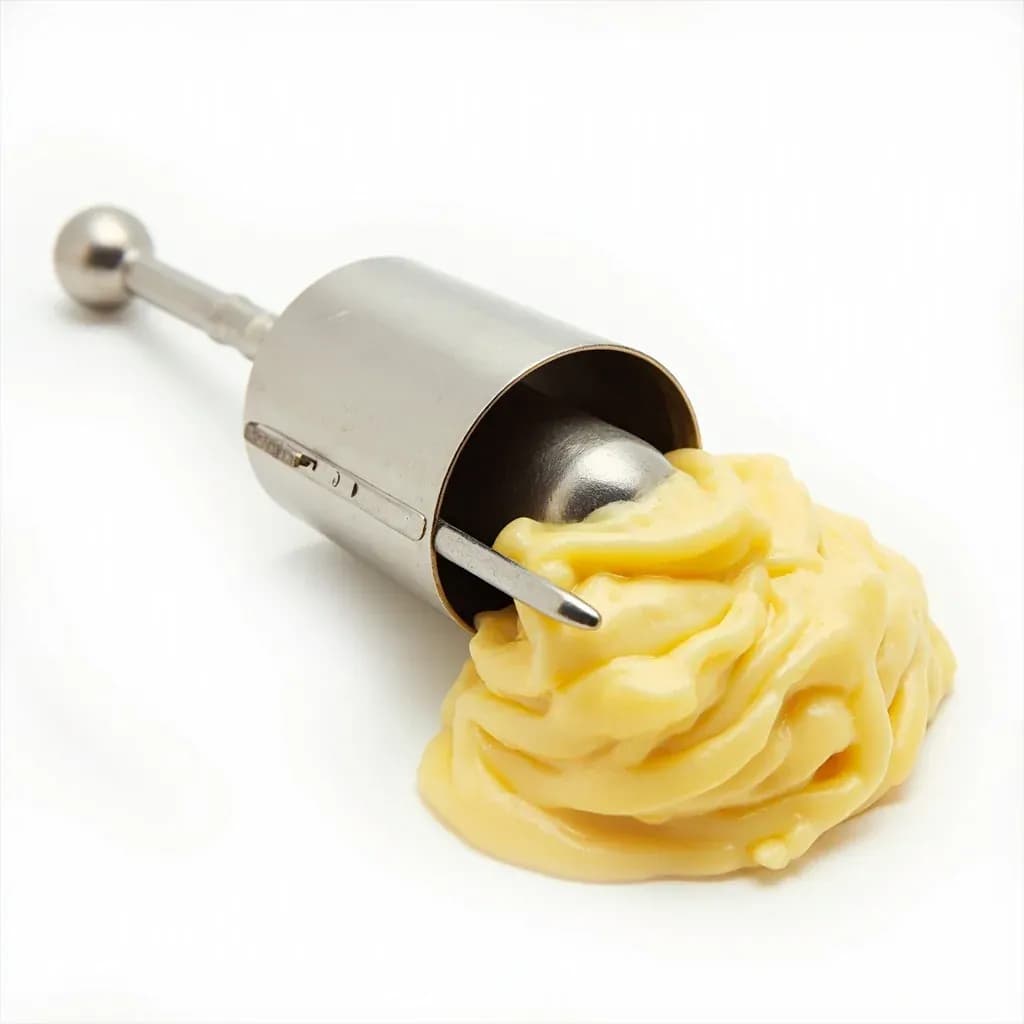
A curd mill cuts or grinds matted blocks of pressed cheese curd into uniform fingers or crumbs, a step called milling. Breaking the curd evenly lets salt distribute thoroughly and releases more whey, which is essential for cheeses like cheddar. Small dairies use hand-cranked mills while larger operations run motorized stainless units.
A curd mill is a cheesemaking tool that breaks a pressed slab of curd into small, uniform pieces so salt can be distributed evenly before the curd is hooped and pressed into wheels. Without milling, salt would only season the outside of large curd chunks, leaving the interior bland and producing an uneven, rubbery or crumbly body. The mill sits late in the make, after the curd knife has cut the gel in the vat, after the curd has been stirred, cooked, and consolidated, and well after the cheddared mat has been formed — it is the bridge between the milled-curd block and the final molded wheel.
In practice, the mill feeds the block through cutting surfaces — perforated plates, burrs, or small blades — that tear it into roughly rice- or pea-sized fragments. The size of those fragments matters: finer milling produces a drier, more crumbly cheese, while coarser pieces retain more whey and knit into a moister, springier body. Because curd behaves like a viscoelastic solid — pliable when warm, brittle when cold, smearing when too soft — temperature control around the mill is critical. Hand-cranked mills are standard for home and small-scale work; motorized versions process the block quickly in creamery settings, but the goal is the same in both: a uniform pile of curd fragments ready to be salted and hooped.
Alternatives
Types & varieties
Hopper-fed mill turned by a crank; the standard in small and home cheesemaking operations, and the type most cheesemakers learn on.
Electrically driven variant used in creameries; processes the curd block quickly and consistently with less operator fatigue.
Uses a perforated plate or screen; the curd is forced through the openings, which sets the piece size by hole diameter.
Series of small blades or pegs that tear the block apart as it is pushed through; produces a more ragged, torn texture than a screen mill.
Where the curd mill fits in the make
A curd mill is easy to confuse with other tools at the make table, but each has a distinct moment in the process. The curd knife (or harp) cuts the gel in the vat while the curd is still suspended in whey. The curd is then stirred, cooked, drained, and piled into a mat that is cut, stacked, and turned — the cheddaring stage that develops the characteristic texture and acidity of cheddar-style cheese. Only after the mat has been consolidated, rested, and lightly pressed into a firm slab does the mill come into play: the slab is broken into fragments, salted, hooped, and finally pressed into a wheel. Substituting a kitchen food grinder at this step is a common error; the cutting geometry and piece size of a proper mill are tuned to the way milled curd knits, drains, and accepts salt, and a grinder produces a noticeably different — usually wetter and less uniform — result.
Why piece size matters
The size of the milled fragment controls two things at once: how fast salt penetrates the piece, and how much whey the curd retains as it is hooped and pressed. Consistency of piece size matters as much as the target size itself, because uneven milling leaves a mix of fine, fast-salting pieces and coarse, slow-salting pieces, producing mottled flavor and irregular texture in the finished wheel.
- Fine mill → drier, crumblier texture; faster salt penetration.
- Coarse mill → moister, smoother body; slower salt penetration.
- Uniform mill → even flavor and consistent texture across the wheel.
- Mixed mill → blotchy salt distribution and irregular body.
Common uses
Tips & pitfalls
- Mill the curd while it is still warm and pliable — too cold and it shatters into dust; too warm and it smears into clumps.
- Aim for uniform, pea- to rice-sized pieces; uneven milling leads to uneven salt uptake and inconsistent texture.
- Mill and salt quickly to keep the curd above the temperature at which the fat becomes too firm to coalesce properly.
- Salt immediately after milling and toss gently to coat the pieces; overworking will cause them to mat back together.
- Sanitize every part thoroughly between batches — lodged curd in the mechanism sours fast.
- On hand-crank models, feel for resistance; if the handle binds, stop rather than forcing the curd through.
- Mill finer for a drier, more crumbly cheese; mill slightly coarser for a moister body.
- Do not substitute a kitchen food grinder: the cutting action and piece geometry of a proper curd mill are different and affect whey retention.
Good to know
- Also called
- Curd grinder, curd breaker (French: moulin à caillé)
- Primary function
- Shreds a pressed block of cheddar-style curd into small, uniform pieces so salt can be distributed evenly before molding
- Common material
- Food-grade stainless steel body and cutting surfaces
- Power source
- Hand-cranked for artisan use; small electric or motorized units for dairy rooms
- Typical placement
- Mounted or clamped over a catch tray or table at the make table
- Cleaning
- Disassembles for washing; all parts in contact with curd must be sanitized between batches
- Typical curd piece size
- Roughly rice- to pea-sized fragments, depending on cheese style
- Cheese styles
- Cheddar, Colby, Monterey Jack, and other stirred-curd, milled (pressed) cheeses
- Stage in make process
- After draining and pressing the curd mat or block, before salting and hooping
- Origin
- Developed alongside the industrialization of cheddar production in the late 19th century, replacing hand-tearing of the curd slab
Also called
cheese curd mill · peg mill
Related

Stovetop
The everyday burners where most cooking actually happens

Oven
Enclosed dry heat for roasting, baking, and braising

Grill
Live-fire or gas grates for char, smoke, and high heat

Smoker
Low, slow heat and wood smoke for barbecue and brisket

Air Fryer
Countertop convection that crisps with little or no oil

Slow Cooker
Set-and-forget low heat for stews, beans, and braises

Pressure Cooker
Sealed steam pressure that cooks tough food in a fraction of the time

Rice Cooker
Foolproof, perfectly steamed rice every single time