Appliances & Heat
Curing Chamber
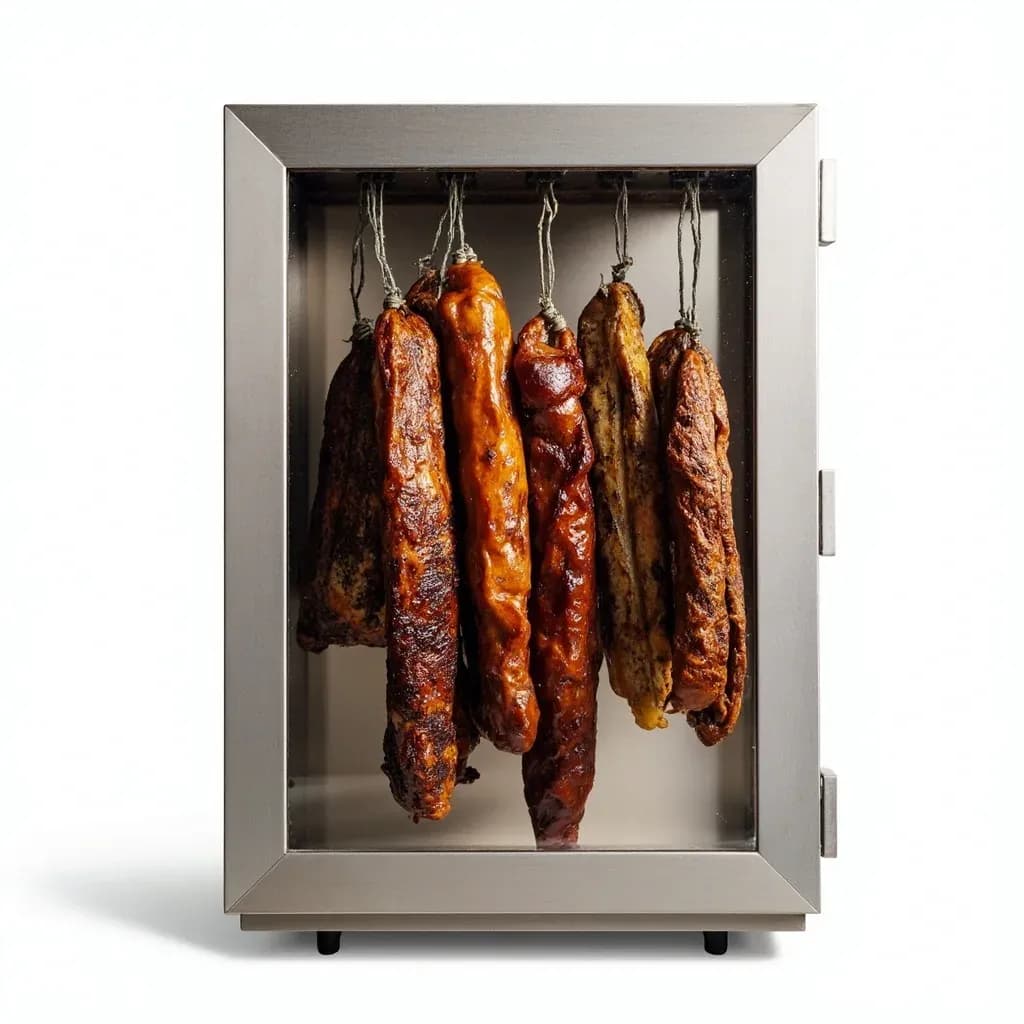
A climate-controlled cabinet that holds temperature and humidity for dry-aging meat and curing charcuterie.
A curing chamber is an enclosed, climate-controlled space that maintains steady cool temperatures and precise humidity for drying and aging food. It is used to dry-age beef and to cure salami, prosciutto, and other charcuterie, where controlled moisture loss and airflow develop flavor while preventing spoilage. Dedicated units add fans, humidifiers, and sensors to hold conditions over weeks or months.
A curing chamber is a temperature- and humidity-controlled cabinet that creates the slow, cool, moist environment in which salted meat, fish, or cheese is transformed into aged charcuterie, hard cheese, or dried fish. Where a refrigerator is engineered to halt microbial activity, a curing chamber is engineered to support it within tightly defined limits: salt draws moisture from the meat while beneficial bacteria and molds colonize the surface, breaking down proteins and fats into the complex flavors and firm, sliceable textures that define a properly aged product. Without that controlled climate, the same salt either dries the meat to leather or fails to suppress spoilage organisms long enough for the cure to complete.
At its core, a curing chamber is a precision refrigerator married to a humidifier. A compressor or thermoelectric cooling circuit holds the air cool; a small heating element stabilizes the temperature; an ultrasonic or steam humidifier adds moisture; and a digital controller — usually a combined PID unit, sometimes a mechanical hygrotherm — holds the targets within roughly ±1 °C and ±5% relative humidity. A low-RPM circulation fan keeps air moving so no pocket becomes stagnant, where uneven drying or rogue mold can take hold. Most chambers include a condensate drip tray and removable slatted racks, ideally made of untreated hardwood such as beech or maple, which buffers humidity swings the way traditional curing cellars once did with adobe and stone walls.
For the home cook, the appliance has come down dramatically in cost and complexity. A purpose-built charcuterie cabinet runs from a few hundred to several thousand dollars, but a converted refrigerator or chest freezer fitted with an aftermarket controller (such as an Inkbird ITC-308), a USB ultrasonic humidifier, and a small 40–80 mm DC fan delivers roughly 80–90% of the performance at a fraction of the price. What every chamber — DIY or commercial — must do is hold a stable climate for weeks or months while gently resisting the very microbial activity that defines the craft.
Alternatives
Types & varieties
Compact 80–150 L compressor unit sized to fit beneath a standard counter; the popular entry point for home charcuterie.
Floor-standing 300–800 L units with multiple racks; some offer dual zones for fermenting then drying in the same cabinet.
Insulated commercial room with glycol or split-system cooling, steam humidification, and UV sterilization; sized for hanging whole legs.
A standard fridge or chest freezer fitted with an external controller (such as an Inkbird ITC-308), an ultrasonic humidifier, and a low-voltage fan — the common home builder's route.
Quiet and vibration-free, with lower cooling capacity; better suited to cheese and cool-stage cures than to warm fermented sausages.
Two independently controlled compartments — typically a warmer, more humid fermentation zone (20–24 °C) and a cooler, drier drying zone (12–15 °C) — for full salami production in a single cabinet.
Climate targets by product
Different cures need different climates. Use these ranges as starting points; real practice is adjusted by weight loss, surface feel, and aroma, not by the dial alone.
- Dry-aged beef primals: 0–4 °C (32–39 °F), 75–85% RH, 21–60+ days
- Whole-muscle dry hams (prosciutto, jamón, country ham): 12–15 °C (54–59 °F), 65–75% RH, 6–24 months
- Fermented sausages (salami, chorizo, soppressata): 20–24 °C (68–75 °F) and 85–95% RH for the 24–72 h fermentation, then 12–15 °C and 70–75% RH for drying
- Whole-muscle charcuterie (bresaola, pancetta, coppa, guanciale): 12–15 °C, 70–80% RH
- Hard and alpine cheeses: 10–13 °C, 80–90% RH
- Washed-rind cheeses: 12–15 °C, 90–95% RH
The converted refrigerator route
The most common way home cooks enter the craft is by retrofitting a working refrigerator or chest freezer. The cabinet becomes the insulated box; an external controller (such as an Inkbird ITC-308 or a more capable PID) cycles the compressor and a small heating element to hold a tight temperature band; a USB or tabletop ultrasonic humidifier is piped into the chamber and switched by a humidistat; and a 40–80 mm low-voltage DC fan on a timer or running continuously prevents stagnant air. Add a calibrated hygrometer/thermometer on the middle shelf (not at the controller's probe), food-grade beech or maple slats in place of the wire racks, and a drip tray, and you have a working chamber for well under $200 in parts. The compromises are real: most domestic fridges cannot reliably hold below 4–5 °C, so very long, very cold dry-aging is harder, and a chest freezer used as the base needs a hole drilled for the humidifier inlet and for the fan wiring. But for fermented sausages, dry-cured whole muscles, and cheese, a converted refrigerator is genuinely sufficient.
Common uses
Tips & pitfalls
- Place a separate calibrated hygrometer/thermometer inside on the middle shelf; the factory sensor drifts and reads the air near its probe, not the conditions at the product.
- Run a low-RPM 40–80 mm DC fan continuously or on a timer. Stagnant air is the most common cause of uneven drying and rogue mold in home chambers.
- A UV-C germicidal bulb (5–8 W, on a timer) suppresses surface mold without chemicals; run it between batches to sanitize the chamber.
- Never use a standard kitchen refrigerator for long cures — its 30–40% RH will case-harden the surface and lock moisture inside, leading to rot rather than controlled drying.
- A wine cooler is the wrong tool: it cannot drop below about 12 °C and has no humidity control at all.
- Stage humidity downward — hold 80–85% RH during the salt-equalization phase (the first 1–2 weeks for whole-muscle cures), then drop to 70–75% as the surface firms up. Jumping straight to dry air case-hardens the exterior and traps moisture.
- Do not overload: air must reach every surface. Leave at least 3–5 cm between pieces, and never let products touch each other or the walls.
- Use untreated hardwood racks — beech, maple, or linden — which buffer humidity swings. Avoid pine and oak, whose resin and tannins leach off-flavors into the cure.
- Rest cured meats back to near-room temperature before opening the chamber door, especially in winter — cold metal surfaces will condense moisture onto the product.
- Sanitize walls, ceiling, racks, and drip tray with a food-safe sanitizer (such as diluted peracetic acid) between batches; spores from a previous cure will colonize the next one.
- Log temperature and humidity daily. Small drifts are normal, but a sustained climb in RH above 90% signals a stalled cure or surface contamination.
Good to know
- Typical temperature ranges
- 10–15 °C (50–59 °F) for most charcuterie; 0–4 °C (32–39 °F) for dry-aged beef; 10–13 °C for hard-cheese aging
- Typical relative humidity
- 60–85% RH for most charcuterie; 75–85% RH for dry-aged beef; up to 90–95% for washed-rind cheeses
- Airflow
- Low, gentle circulation required — stagnant air causes uneven drying and rogue mold pockets
- Core controls
- Thermostat plus humidistat (often a combined PID controller), an ultrasonic or steam humidifier, and a small circulation fan
- Home sizes
- Compact units ~100 L (under-counter) to full upright 300–500 L; walk-in rooms for commercial use
- Power and cooling
- Standard 110–240 V outlet; thermoelectric (Peltier) units draw less power but cool less powerfully than compressor units
- Materials
- Stainless-steel or ABS interior; food-grade plastic or untreated hardwood (beech, maple) shelving
- Origin of the appliance
- Modern precision chambers descend from the curing cellars and caves of Parma, San Daniele, the Iberian dehesa, and the Alpine cheese valleys
Also called
Curing Chamber (Climate-Controlled) · dry-aging fridge · charcuterie chamber
Related

Stovetop
The everyday burners where most cooking actually happens

Oven
Enclosed dry heat for roasting, baking, and braising

Grill
Live-fire or gas grates for char, smoke, and high heat

Smoker
Low, slow heat and wood smoke for barbecue and brisket

Air Fryer
Countertop convection that crisps with little or no oil

Slow Cooker
Set-and-forget low heat for stews, beans, and braises

Pressure Cooker
Sealed steam pressure that cooks tough food in a fraction of the time

Rice Cooker
Foolproof, perfectly steamed rice every single time