Appliances & Heat
Food Dehydrator
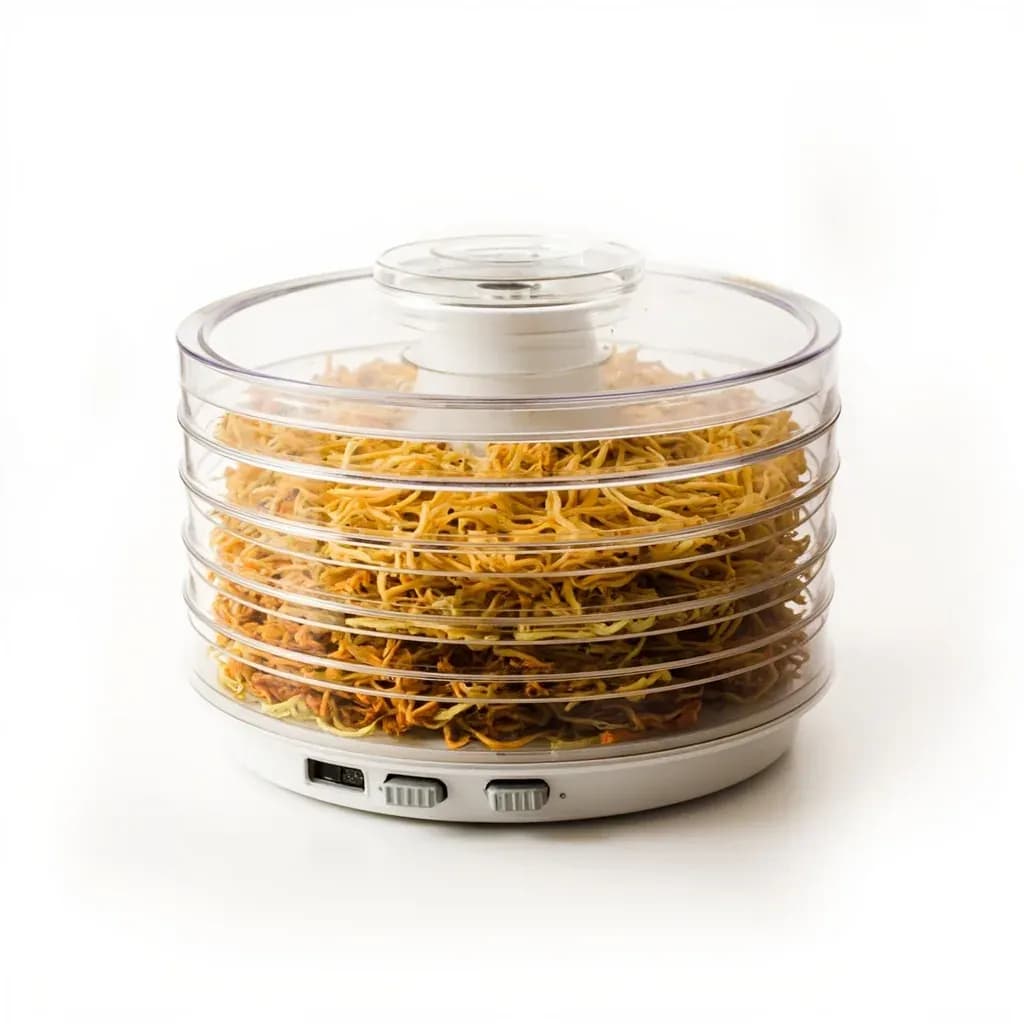
An appliance that gently warms and circulates air to dry fruit, herbs, jerky, and vegetables.
A food dehydrator uses a low-heat fan to pull moisture out of food slowly and evenly across stacked trays. Cooks use it to make dried fruit, herbs, vegetable chips, fruit leather, and jerky, concentrating flavor and extending shelf life without refrigeration. Steady low temperatures preserve more color and nutrients than a hot oven and free up the stove for other work.
A food dehydrator is essentially a low-temperature, high-airflow oven designed to remove moisture from food without cooking it. By holding temperatures between 95 and 160°F while moving air steadily across each tray, a dehydrator creates conditions that inhibit bacterial growth and slow the enzymatic reactions that cause spoilage, while preserving color, flavor, and a surprising share of the food's nutrients. The result is shelf-stable food that weighs a fraction of its original weight, concentrates the natural sugars in fruit, and develops the dense, chewy texture that defines jerky.
Understanding a dehydrator means thinking of it as an air machine, not a heat machine. The work is done by steady evaporation of water, and the rate of that evaporation depends on air movement more than on temperature, since still air becomes saturated almost immediately. Horizontal-flow models, with a rear fan pushing air across flat shelves, treat every tray equally and are the format serious users and jerky makers prefer. Vertical stackable units are cheaper and perfectly fine for herbs, fruit leather, and small fruit batches, but the trays nearest the heater dry faster, so they require rotation. This single fact, that air circulation is the engine, explains nearly every technique that follows.
For most produce and herbs, a dehydrator is forgiving: slice uniformly, leave space around each piece, and let time do the work. Jerky is the one application that demands attention to food safety, because the appliance runs below the pasteurization range of meat and is the rare situation in which a thermometer matters more than instinct.
Alternatives
Types & varieties
Round or square tower with a base- or top-mounted heater and removable trays. Compact and inexpensive, but drying is uneven unless trays are rotated.
Box-shaped with a rear fan and heater pushing air across flat trays on pull-out racks. The most consistent drying and the format favored by jerky makers and serious users.
Large upright unit, often with a glass door and multiple interior racks, aimed at hunters, gardeners, and small-batch producers.
Outdoor unit using solar gain and natural convection. Slow and weather-dependent, and unsuitable for low-acid foods or meat.
Not a true dehydrator but achieves similar results using a conventional oven on its lowest setting with the door cracked; higher energy cost and less consistent airflow.
Jerky and Food Safety
Jerky is the one dehydration task where inattention carries real risk. Because dehydrators operate below the pasteurization range of meat for most applications, lean meat and game require deliberate steps to be safe.
- Use a calibrated thermometer to confirm the dehydrator holds at least 160°F (71°C) throughout the run, per USDA guidance for poultry, game, and ground meat jerky.
- Pre-cook ground meat to 160°F before drying; whole-muscle jerky should be marinated in an acid (vinegar or citrus juice) and held at 160°F the entire time.
- Trim all visible fat from meat before drying; fat oxidizes quickly in storage and turns jerky rancid far sooner than the protein itself spoils.
- Pat marinated strips dry with paper towels before loading the trays; surface moisture slows drying and encourages bacterial growth.
Testing Doneness and Conditioning
Drying continues after food leaves the machine as residual moisture redistributes through the pieces. A two-step process, testing then conditioning, prevents the moldy surprises that come from packing food that looked dry on the outside but still held moisture in the center.
- Cool a test piece to room temperature before judging: properly dried fruit should be leathery and pliable, jerky should bend and crack without snapping cleanly, and vegetables should be brittle with no soft spots.
- Condition dried food before long storage: pack loosely in a glass jar, shake once a day for a week, and return any pieces that feel damp to the dehydrator for another hour or two.
- Store finished products in airtight containers in a cool, dark, dry place; vacuum sealing or adding an oxygen absorber extends shelf life dramatically.
- Keep strong-smelling foods (garlic, onion, herbs) on separate dehydrator runs from delicate ones (berries, fruit leather) when possible, since shared airflow can carry flavor between trays.
Common uses
Tips & pitfalls
- Slice food to a uniform thickness, ideally 1/8 to 1/4 inch; a mandoline is the best tool for this and gives more even drying.
- Do not overcrowd or overlap pieces; air must circulate on every surface for even drying.
- In stackable vertical units, rotate trays top-to-bottom and front-to-back at least once during drying to compensate for uneven heat distribution.
- Pre-treat light-colored fruit (apples, pears, bananas) with a quick dip in lemon juice and water to slow browning, and blanch most vegetables in steam or boiling water for 1–3 minutes to halt enzyme action and shorten drying time.
- Leave the vent open early in drying to release moisture, then close it in the final hours to finish the food evenly.
- Clean mesh trays with a soft brush between batches and avoid strong detergents on plastic trays, which absorb odor and flavor.
- Label each batch with the food, date, and target weight or texture so older jars don't get mistaken for fresh ones.
Good to know
- Origin
- Food drying is among humanity's oldest preservation methods; the first electric home dehydrators appeared in the United States in the early 1970s, with American Harvest (a brand later sold under the Nesco name) among the pioneering makers.
- Operating temperature
- Typically 95–160°F (35–70°C); most units have an adjustable thermostat or fixed presets.
- Airflow
- Vertical (air rises from a base- or top-mounted heater through stacked trays) or horizontal (fan and heater in the back push air across parallel trays).
- Power draw
- Most consumer models draw 350–800 watts from a standard 110V household outlet.
- Capacity
- Home units range from about 4 to 15 square feet of tray space; cabinet and commercial models can exceed 30 square feet.
- Typical drying times
- Herbs 2–4 hours; fruit slices 6–12 hours; jerky 4–8 hours; fruit leather 4–8 hours; vegetables 4–10 hours.
- Yield
- Most fresh foods lose 75–90% of their weight in water; roughly 4 pounds of fresh apple yields about 1 pound of dried apple.
- Shelf life
- Properly dried and stored, fruit and jerky keep 1–6 months at room temperature; longer if vacuum-sealed or frozen.
Also called
Dehydrator
Related

Stovetop
The everyday burners where most cooking actually happens

Oven
Enclosed dry heat for roasting, baking, and braising

Grill
Live-fire or gas grates for char, smoke, and high heat

Smoker
Low, slow heat and wood smoke for barbecue and brisket

Air Fryer
Countertop convection that crisps with little or no oil

Slow Cooker
Set-and-forget low heat for stews, beans, and braises

Pressure Cooker
Sealed steam pressure that cooks tough food in a fraction of the time

Rice Cooker
Foolproof, perfectly steamed rice every single time