Prep Tools
Digital Deli Scale
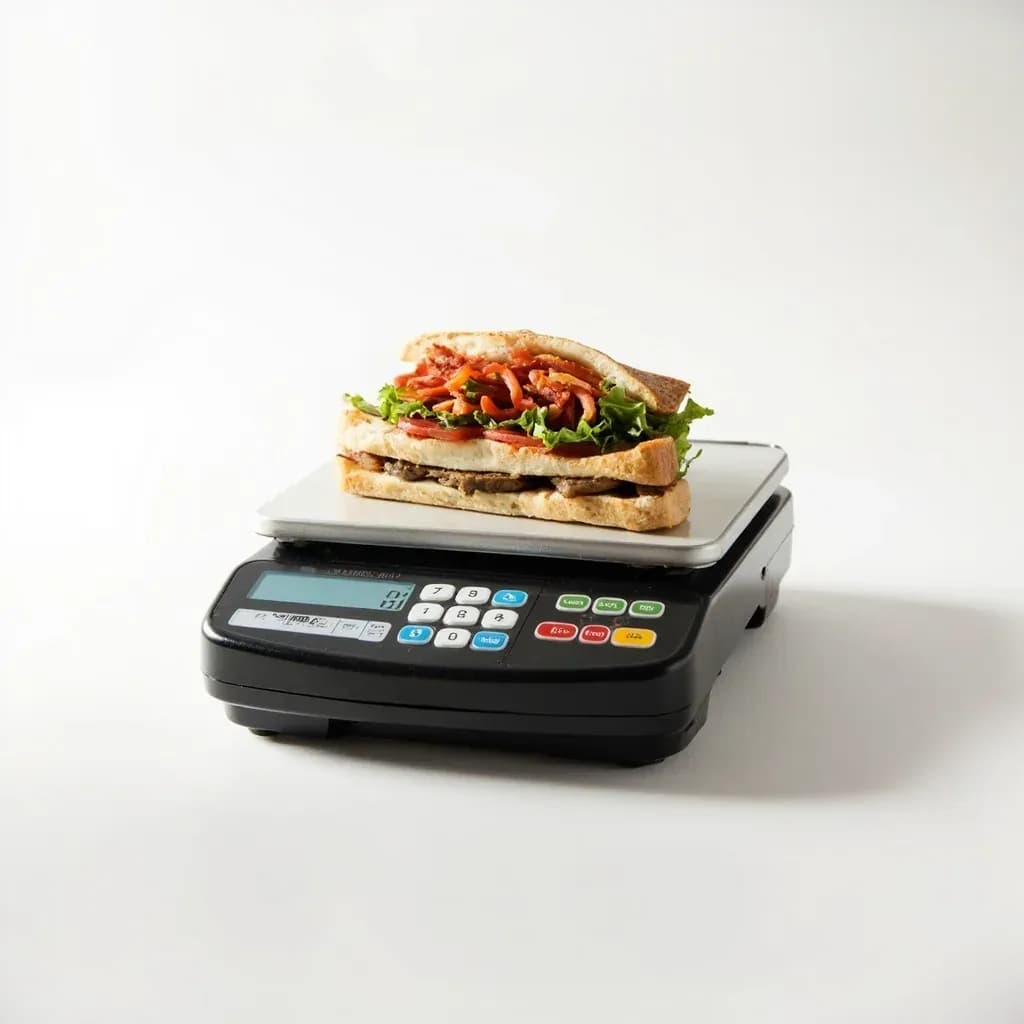
A countertop scale that weighs portions and can calculate price by weight for the counter.
A digital deli scale is a precise countertop scale used to weigh cut meats, cheeses, salads, and bulk goods at a service counter. Many models include a price-computing display that multiplies weight by a per-unit price and prints a label. The flat platter and tare function make it equally useful for portioning ingredients in any kitchen.
A digital deli scale is the stainless, dual-display counter unit you see behind the cheese and cold-cuts case: a portion is set on the platter, the operator keys in a per-pound or per-kilo price, and the customer-facing panel reads back weight, unit price, and total at a glance. Under the hood it is a strain-gauge load cell with a digital readout, a sealed membrane keypad for entering unit prices and recalling stored PLU (price-look-up) numbers, and a removable food-grade stainless platform sized to take a wrapped wedge of provolone or a mound of potato salad. What separates it from a home kitchen scale is less about accuracy than about role: it is a point-of-sale device that has to be legally certified to determine price by weight in retail, which is why the better models carry NTEP (National Type Evaluation Program) or Measurement Canada approval.
In daily service the scale behaves like a small calculator bolted to a weigh plate. You set a deli sheet or container on the platter and press tare to zero it out, place the product, key in the per-unit price, and the total appears on both displays within a second. Higher-end units remember frequent items as PLU keys, so the operator simply hits a button for 'Black Forest ham' or 'Gouda' rather than retyping the price. Capacities typically run from about 6 lb (3 kg) for cheese counters up to 30 or 60 lb (15–30 kg) for produce and meat cases, and most modern units switch between imperial and metric so the same machine can sell in either unit. The internal rechargeable battery keeps the scale running through a power outage or a long farmers-market day without the cord.
For most home cooks a kitchen portion scale covers recipe weighing perfectly well; a true deli scale earns its counter space only when you are selling by weight, portioning proteins to a target cost, or running a small food business that needs a customer-facing readout. If you are opening a counter, the right questions to ask are capacity, readability (finer than 0.01 lb / 5 g is plenty for cheese and charcuterie), platform size, and whether the unit is certified for commercial trade in your jurisdiction.
Alternatives
Types & varieties
The classic style with operator and customer displays plus PLU keys; required wherever price is determined by weight at retail.
Simpler model showing only weight; used in back-of-house for portioning proteins and sides to a target weight rather than customer-facing sales.
Higher-capacity (60–150 lb / 27–68 kg) platform scale for checking incoming deliveries against invoices; usually not customer-facing.
Top-mounted load cell with a hook, used for whole primal cuts, sides of fish, or large sacks in back-of-house prep.
Combines weighing, price calculation, and an integrated thermal printer that produces a PLU label for pre-packaged items in the case.
Slim-profile, low-platform design built for bulk-bin grocery and candy counters where the customer scoops and weighs.
Sealed housing and sealed keypad rated to IP65 or higher for fish counters, butcher prep rooms, and wash-down areas.
Small-footprint units (under 8"×8" / 20×20 cm) used in coffee bars, bakeries, and pastry kitchens for ingredient weighing.
Legal-for-Trade and Calibration
A deli scale is a regulated commercial device, not a kitchen accessory. In the United States any scale used to determine price at retail must carry a National Type Evaluation Program (NTEP) certificate of conformance, issued under NIST Handbook 44; weights-and-measures inspectors can and do visit shops to verify the unit in use matches a current certificate and that it is sealed against tampering. The Canadian equivalent is Measurement Canada approval. A non-certified kitchen scale may give you the same gram, but it is not legal to base a sale on it. Calibration matters just as much: monthly or quarterly checks with a certified test weight of at least half the scale's capacity are standard, with a quick daily spot-check using a known weight in busy shops. Drift in either direction is a problem — under-weighing is a customer-protection issue, over-weighing is a margin-killer. Keep the calibration certificate and the most recent inspection sticker near the unit; inspectors will ask, and so will your accountant at audit time.
Common uses
Tips & pitfalls
- Confirm NTEP (U.S.) or Measurement Canada (Canada) approval before using any scale to sell by weight; a non-certified unit cannot legally determine price in most jurisdictions.
- Level the scale on a flat, stable surface and let it warm up for a minute after power-on before zeroing — load cells drift slightly as temperature equalizes.
- Tare with a clean container, deli paper, or tray on the platter every time, even if the container is the same as the last sale; crumbs and moisture change the tare weight.
- Calibrate on a schedule (commonly monthly or quarterly) with a certified test weight of at least half the scale's capacity, and do a quick daily spot-check in busy shops.
- Avoid placing hot items (just-grilled meats, warm bread, hot cheese) directly on the platter; heat affects the load cell and skews the reading. Let food reach room temperature or set it on an insulating mat.
- Don't exceed the scale's capacity, even momentarily — dropping a heavy cut or slamming a full tray onto the platter can damage or crack the load cell.
- Reset to zero between customers rather than relying on the previous tare or PLU; a carryover price on a different item is one of the most common (and expensive) counter errors.
- Clean the platter and the under-platter area at the end of every shift with a food-safe sanitizer; food debris shifts the zero and causes slow drift across the day.
Good to know
- Tool type
- Countertop electronic price-computing scale, common in delis, butcher shops, and prepared-food counters
- Measuring technology
- Strain-gauge load cell with digital signal processing
- Typical capacities
- 6 lb, 12 lb, 30 lb, and 60 lb (≈ 3, 6, 15, and 30 kg) are the most common commercial capacities
- Readability
- 0.005 lb to 0.02 lb (≈ 2 g to 10 g) depending on capacity; higher-capacity models usually have coarser resolution
- Display
- Front and rear LCD or LED panels so operator and customer can both read weight, unit price, and total price simultaneously
- Platform
- Removable food-grade stainless steel platter, commonly 8"×11" to 12"×14" (≈ 20×28 cm to 30×36 cm)
- Tare range
- Full-capacity subtraction, allowing a container's weight to be zeroed out
- Memory presets
- Higher-end models store PLU (price-look-up) numbers for fast recall of frequently sold items
- Power
- AC adapter with internal rechargeable battery backup, typically 50–100 hours of cordless use
- Units
- Switchable between lb/oz and kg/g on most modern units
- Legal-for-trade
- Models sold for selling by weight in the U.S. require NTEP certification under NIST Handbook 44; in Canada, Measurement Canada approval
- Origin
- Electronic price-computing scales replaced mechanical beam scales in retail food service from the 1970s onward and were widespread by the 1990s
Also called
price-computing scale · deli scale · counter scale
Related

Peeler
Swift blade for stripping skin off fruit and vegetables

Grater
Sharp-toothed surface for shredding cheese and vegetables

Microplane
Ultra-fine rasp for citrus zest, garlic, and hard cheese

Mixing Bowl
All-purpose bowl for combining, whisking, and tossing

Whisk
Looped wires that beat air into eggs, cream, and sauces

Spatula
Flat blade for flipping, lifting, and scraping

Slotted Spoon
Pierced spoon that lifts solids and drains the liquid behind

Wooden Spoon
Gentle, heat-friendly spoon for stirring anything