Appliances & Heat
Deli / Meat Slicer
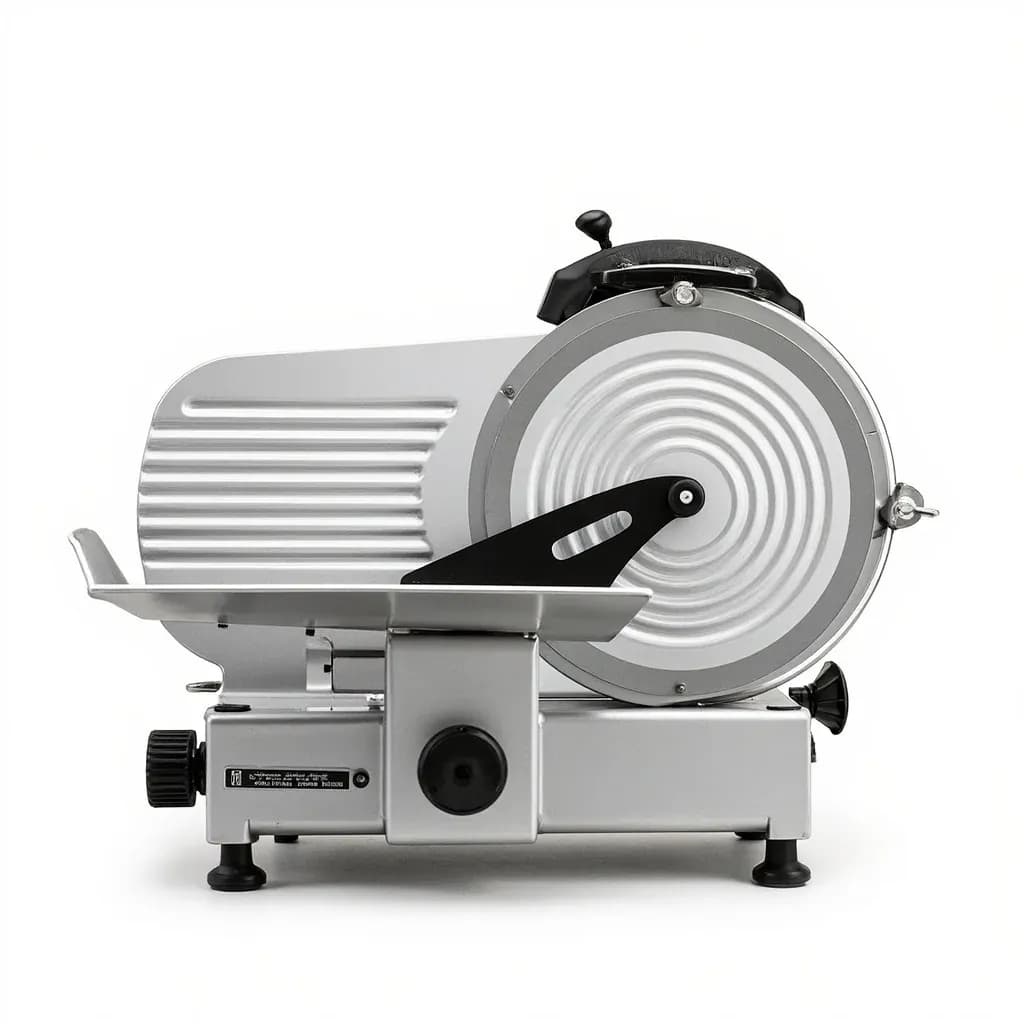
A motorized rotary-blade machine that cuts meat, cheese, and bread into precise even slices.
A deli slicer uses a spinning circular blade and an adjustable gauge plate to shave uniform slices off cured meats, cheeses, and roasts. Delis and restaurants rely on it for paper-thin prosciutto, sandwich stacks, and consistent portions far faster than hand-slicing. The thickness dial sets each cut, and a guard and gripping carriage keep hands clear of the exposed blade.
A deli slicer is a powered cutting tool built around a large, rotating circular blade and a sliding food carriage with an adjustable thickness gauge. The carriage feeds the food past the spinning blade at a controlled rate, producing slices of identical thickness far more consistently than any knife stroke. The machine's value in a serious kitchen is uniformity: a single slice thickness means every portion cooks or presents the same way, and presentation on a charcuterie board, sandwich, or catering tray depends on that consistency.
The modern rotary slicer was patented in 1898 by Wilhelmus van Berkel in Rotterdam, and the red Berkel flywheel machine that followed became both a deli workhorse and an icon of food machinery. Today's machines range from a 7-inch home countertop unit to a 14-inch gear-driven commercial machine capable of shaving prosciutto paper-thin or handling the sustained daily output of a busy deli or butcher counter.
What separates a slicer from a sharp knife is repetition and safety, in that order. A skilled cook with a long slicer can match a single perfect cut, but matching it across fifty slices of cold roast beef, or shaving a whole cured ham into draping slices for a board, is where the machine earns its place. The trade-off is real: the combination of an exposed high-speed blade and a hand-guided carriage makes the slicer one of the most injury-prone tools in any kitchen, and it should be treated with the same respect given to a bandsaw.
Alternatives
Types & varieties
Hand-cranked with a large cast-iron flywheel, traditionally painted Berkel red, that drives the blade. Prized by charcuterie artisans and collectors; the original Berkel Model 7/8 dates to the early 20th century and working machines are still serviced by specialty shops.
The standard deli and restaurant machine: an angled carriage lets gravity feed the food toward a powered rotating blade. The workhorse of commercial kitchens.
A motorized carriage moves the food past the blade automatically, used for high-volume production. The operator still sets thickness and guards.
Food is held vertically and lowered onto the blade, favored for portioning large roasts, whole hams, and prosciuttos into uniform cuts.
Smaller countertop units with 7–9 in blades, geared for occasional slicing of roast chicken, bread, vegetables, and small charcuterie boards.
10–14 in blade, gear-driven, often with a built-in sharpener, built for sustained daily use in delis, butcher shops, and grocery counters.
How the parts work together
Three elements do the actual work: the blade, the carriage, and the gauge plate. The blade is a plain circular steel disk, sharpened on the outer edge only, mounted on a motor-driven shaft. The food carriage slides back and forth on rails, and the operator (or, on automatic machines, a motor) pushes it past the blade. The gauge plate is the adjustable back wall the food rests against; setting it closer to or farther from the blade controls slice thickness. Everything else on the machine — guards, sharpeners, drip trays, interlocks — exists to keep those three elements cutting safely and consistently.
Safety and sanitation
The slicer deserves more care than almost any other tool in the kitchen. Its blade is unguarded during use, rotates at high speed, and meets the operator's hands on every stroke. The single most important habit is to use the food pusher or carriage handle at all times, never the fingers or palm. Between different proteins, the slicer should be broken down: remove the blade, gauge plate, and carriage, then wash and sanitize each. Slicers are a documented vector for Listeria and other cross-contamination, which is why food-safety codes treat them the way they do. A dull slicer is also more dangerous than a sharp one, because the operator pushes harder to make the blade bite, and that extra force is what slips.
Choosing and using one at home
A home cook who slices a holiday ham once a year and roasts a whole turkey on holidays has little need for a slicer. A cook who cures charcuterie, smokes brisket regularly, roasts whole cuts like prime rib, or buys cheese by the wheel is exactly the audience the home slicer is built for. A 9- or 10-inch blade covers most home and small-catering jobs, while 7- to 9-inch compact models handle bread, vegetables, and small charcuterie boards well. Larger 12- to 14-inch machines make sense only when slicing whole prosciutto, large cured hams, or full sheet-pan terrines. Manual flywheel machines are beautiful but expensive, slow, and prized enough that serious cooks often reserve them for showcase slicing.
Common uses
Tips & pitfalls
- Chill food to about 35–40 °F (2–4 °C) before slicing: cold meat and firm cheese produce cleaner slices and resist tearing or smearing on the blade.
- Always use the food pusher or carriage handle. The slicer is one of the most injury-prone pieces of kitchen equipment, and fingers belong nowhere near the blade path.
- Match blade size to workload: 9–10 inches handles most home and light commercial work, while 12–14 inches is justified only for whole prosciutto or very large roasts.
- For soft items like fresh mozzarella, butter, or pâté, lightly oil the surface or chill briefly (15–20 minutes) so the food holds shape against the blade instead of smearing.
- Sanitize between proteins. Remove the blade, gauge plate, and carriage and wash each before moving from beef to poultry or cheese; slicers are a known vector for cross-contamination.
- Sharpen when slices start to drag or shred. A dull slicer is more dangerous, not less, because it forces extra hand pressure against the blade.
- Never send bone, frozen food, or very hard items (winter squash, frozen meat blocks) through a standard slicer; you will chip the edge or stall the motor.
- Wipe the carriage and gauge plate with a damp cloth between slices to keep slices from sticking and the thickness accurate.
- For very thin slicing, take a single shaving pass at near zero, then adjust the gauge up to your target thickness so the first slice does not drag.
- Store with the carriage locked at zero (or behind the gauge plate) and the power cord secured so the slicer cannot be accidentally activated.
Good to know
- Origin
- Modern rotary slicer patented in 1898 by Wilhelmus van Berkel in Rotterdam; Berkel's Patent Slicing Machine Company popularized the design and the red flywheel is now iconic.
- Primary component
- A circular steel blade, typically 7–14 inches (18–36 cm) in diameter, that rotates against a moving food carriage, controlled by an adjustable thickness gauge.
- Slice thickness range
- Home models roughly 1/32 in (1 mm) to about 3/4 in (19 mm); commercial units from paper-thin up to about 1 in (25 mm) or more.
- Drive types
- Direct-drive (gear) for commercial durability; belt-drive common in mid-range home and light-duty machines; manual flywheel models are hand-cranked.
- Safety features
- Blade guard ring, food pusher or carriage handle, and interlock switches that cut power when the carriage or gauge plate is removed for cleaning.
- Cleaning
- Blade, food carriage, and gauge plate are detachable on most models and should be hand-washed and sanitized between proteins to prevent cross-contamination.
- Body materials
- Cast or anodized aluminum for home and light commercial; cast iron or stainless steel for heavy commercial use.
- Notable makers
- Berkel, Bizerba, Hobart, Globe, Waring, and Vollrath on the commercial side; Cuisinart, Chef'sChoice, Rival, OSTBA, and KWS for home and semi-commercial use.
Also called
Meat Slicer · Commercial Meat Slicer · Deli Slicer (Meat Slicer)
Related

Stovetop
The everyday burners where most cooking actually happens

Oven
Enclosed dry heat for roasting, baking, and braising

Grill
Live-fire or gas grates for char, smoke, and high heat

Smoker
Low, slow heat and wood smoke for barbecue and brisket

Air Fryer
Countertop convection that crisps with little or no oil

Slow Cooker
Set-and-forget low heat for stews, beans, and braises

Pressure Cooker
Sealed steam pressure that cooks tough food in a fraction of the time

Rice Cooker
Foolproof, perfectly steamed rice every single time