Appliances & Heat
Conveyor Dishwasher
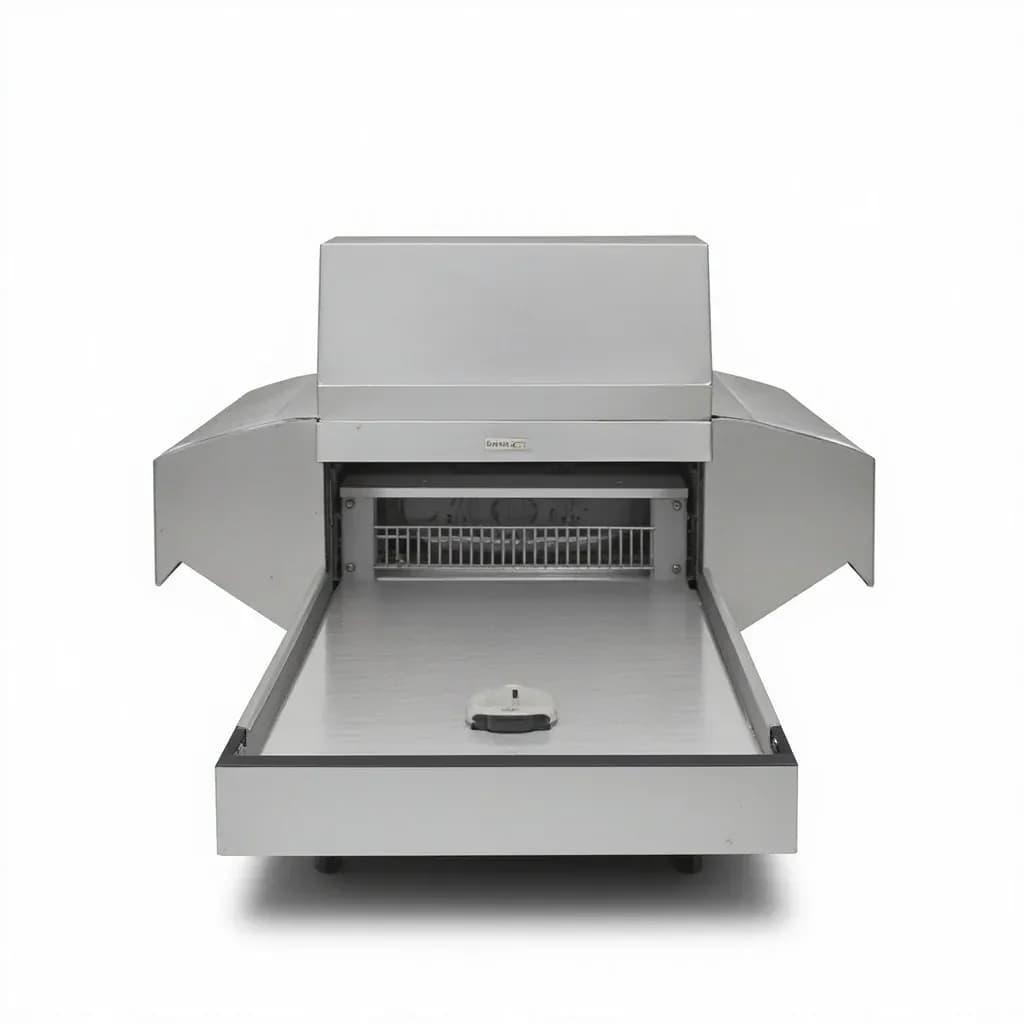
A high-volume commercial dishwasher that pulls racks of dishes through wash and rinse zones on a conveyor.
A conveyor dishwasher is a commercial machine that moves dish racks continuously through successive pre-wash, wash, and high-temperature rinse sections. It is built for high-throughput operations like banquet kitchens and large restaurants, sanitizing dishware far faster than a single-tank undercounter unit. The final rinse runs hot enough to sanitize and help dishes air-dry quickly.
A conveyor dishwasher is essentially a stainless-steel tunnel divided into wash and rinse zones, with a motor-driven chain or belt pulling racks through at a controlled speed. Where an undercounter or door-type machine cleans a single rack in a stationary cabinet, the conveyor handles a continuous stream, so the bottleneck of loading and unloading disappears and a single operator can keep pace with several hundred covers per service. Throughput is the whole point: most rack-conveyor models move 200 to 400 racks an hour, and flight-type belt machines can process close to 10,000 dishes in the same span.
Heat does the sanitizing work, not chemical contact time. The wash zone runs at 150–165°F to cut grease and loosen food soil, and the final rinse tops out at 180–195°F — NSF/ANSI 3 requires a minimum of 180°F — so ware leaves the machine already sanitized and nearly dry, the moisture flashing off as residual heat dissipates. That is why operators watch the final-rinse thermometer like a hawk: a few degrees of drift and the unit fails health inspection.
The conveyor sits at the end of a dish-washing station, downstream of a pre-rinse sink and a sorting counter, and upstream of a clean-side landing table. In tight kitchens, a rack-return conveyor loops empty racks back to the loading end, which is why the curved-conveyor design exists. Ventilation is not optional; the steam plume from the rinse zone is substantial, and a gas-boosted machine adds combustion products as well, so a hood or exhaust canopy is required.
Alternatives
Types & varieties
The most common configuration: one wash zone and one final rinse. Suits moderate-to-high-volume restaurants and hotels.
Adds a pre-wash tank that rinses off loose food before the main wash, reducing rewash and improving results on heavily soiled ware.
Adds a second pre-wash or power-rinse stage; standard in hospitals, banquet halls, and other high-soil operations.
The conveyor bends 90° or 180° at the exit so clean racks loop back to the loading side, saving floor space in cramped dish rooms.
Ware rides directly on a wide belt instead of in a rack; built for trays, sheet pans, and bulk cookware at very high throughput.
Pairs with a rack-return conveyor that feeds empty racks back to the operator automatically, removing the manual handoff.
A hinged-door, pull-through rack machine with lower throughput and a smaller footprint; often grouped with conveyors in catalogs but mechanically distinct.
Anatomy of a wash tunnel
A conveyor dishwasher is more than a single wash chamber — it is a series of zones, each doing one job, with the rack spending only seconds in each. The exact lineup varies by model, but the sequence reads roughly the same from load end to unload end.
- Pre-wash zone (optional): A coarse spray of warm water scrapes off loose food before the main wash, easing the load on the detergent bath and reducing rewash. Standard on dual- and triple-tank machines.
- Wash zone: 150–165°F water with a commercial low-foaming detergent, pumped through rotating wash arms above and below the rack. Contact time is short — about 8 to 15 seconds — so chemistry and temperature do most of the work.
- Power rinse (optional): Recycled rinse water at moderate heat strips detergent film off the ware before the final sanitizing rinse. Common in high-soil operations.
- Final rinse: Fresh potable water heated to 180–195°F by an in-line booster (electric, gas, or steam) and sprayed through a perforated stainless manifold. NSF/ANSI 3 requires a minimum of 180°F here; this single step is what actually sanitizes the ware.
- Drying: Most machines rely on flash evaporation from the residual heat of the final rinse. Larger flight-type and rack-conveyor models may add a dryer tunnel that blows warm air over ware as it exits.
Common uses
Tips & pitfalls
- Always pre-scrape and pre-rinse plates before loading — the conveyor does not replace the disher or pre-rinse sink, and heavy soil will redeposit on clean ware downstream.
- Run the conveyor continuously through service rather than stopping and starting; cold starts force the booster to recover and can drop the final rinse below the 180°F sanitization threshold.
- Check final-rinse temperature with a thermocouple or the machine's gauge at least once per shift; a failing heating element or low steam pressure is the most common cause of failed health inspections.
- Keep wash and rinse arm nozzles clear of debris — one clogged jet creates a shadow zone on every rack that passes through, and the operator rarely notices until ware comes out dirty.
- Use only commercial low-foaming detergent rated for conveyor machines; household or high-sudsing products will foam over, trigger the float switch, and shut the unit down mid-service.
- Pair detergent and rinse-aid dispensers; rinse aid prevents water spotting and helps the high-heat final rinse flash off cleanly.
- Descale the wash tank and booster weekly with a deliming product in hard-water areas, or mineral scale will insulate the heating elements, lengthen recovery time, and eventually burn them out.
- Load racks so spray water can reach every surface — nesting bowls, stacked sheet pans, and overlapping plates block the wash pattern and produce a tray of half-clean ware.
- Make sure staff load from the correct end of the machine; dishes enter the wash first and exit after the final rinse. Reversing direction is a surprisingly common setup error that ruins the whole concept.
- Keep glassware on a separate run from heavily soiled plates when possible; soil-laden wash water redeposits on glass and leaves a visible film.
Good to know
- Typical capacity
- 200–400+ racks/hour; flight-type models handle up to ~10,000 dishes/hour
- Wash water temperature
- 150–165°F (65–74°C)
- Final rinse temperature
- 180–195°F (82–90°C); NSF/ANSI 3 requires a minimum 180°F for sanitization
- Wash cycle contact time
- About 8–15 seconds in the wash zone, depending on conveyor speed
- Standard rack size
- 19.75 × 19.75 in (50 × 50 cm); some 20 × 20 in (500 × 500 mm) European models
- Rinse water use
- Roughly 0.5–1.5 gallons per rack depending on model and efficiency rating
- Power requirement
- Typically 208–240V three-phase for electric models; gas or steam needed for the booster heater
- Construction
- Type 304 stainless steel for corrosion resistance; NSF/ANSI 3 certification required for U.S. commercial use
Also called
rack conveyor dishwasher · commercial conveyor dishwasher
Related

Stovetop
The everyday burners where most cooking actually happens

Oven
Enclosed dry heat for roasting, baking, and braising

Grill
Live-fire or gas grates for char, smoke, and high heat

Smoker
Low, slow heat and wood smoke for barbecue and brisket

Air Fryer
Countertop convection that crisps with little or no oil

Slow Cooker
Set-and-forget low heat for stews, beans, and braises

Pressure Cooker
Sealed steam pressure that cooks tough food in a fraction of the time

Rice Cooker
Foolproof, perfectly steamed rice every single time