Appliances & Heat
Drum Coffee/Cacao Roaster
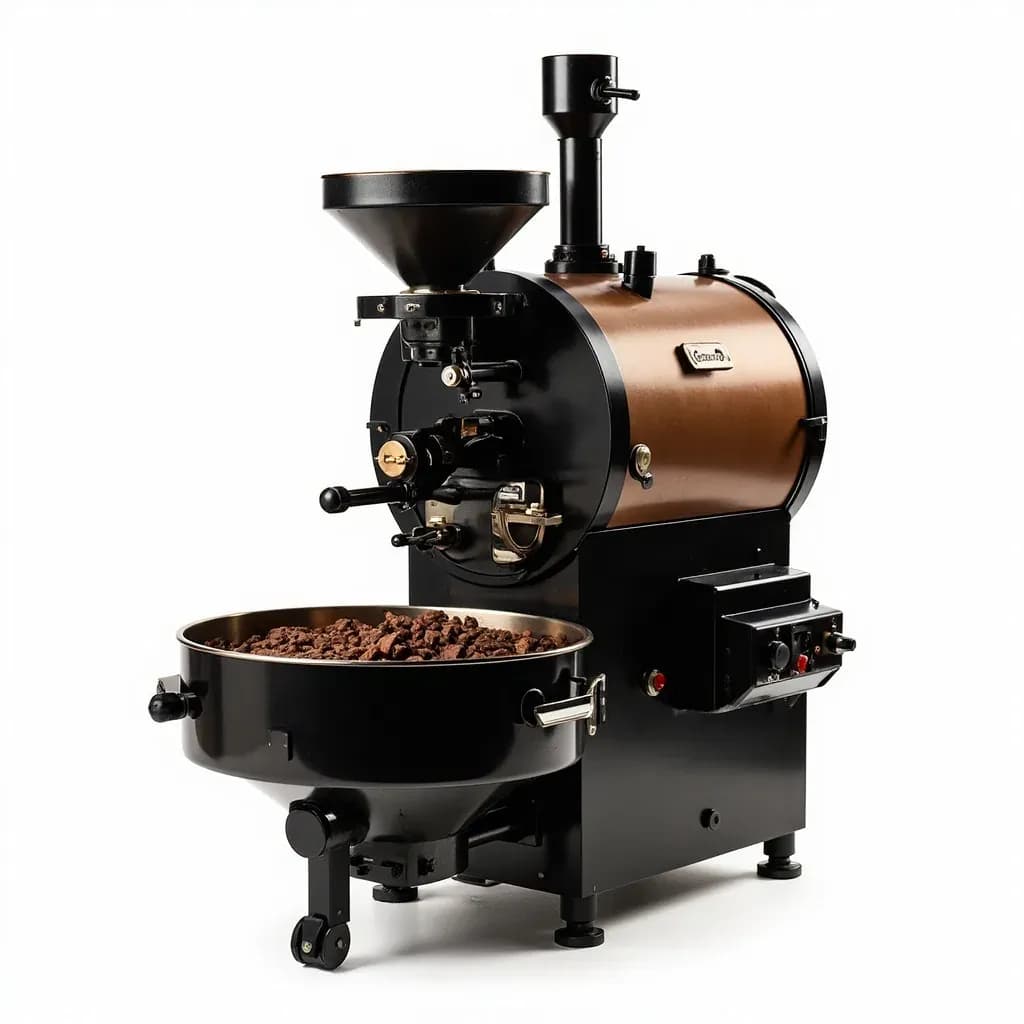
A rotating heated drum that roasts coffee beans or cacao evenly while tumbling them.
A drum roaster passes heat to coffee or cacao beans inside a rotating perforated cylinder that constantly tumbles them for even browning. The operator controls heat, airflow, and time to develop flavor, listening for the cracks that mark roast stages. Drum machines are favored for their even, conductive roast and the control they give over the roast curve.
A drum roaster is the workhorse of the specialty coffee world and, increasingly, of craft and bean-to-bar chocolate. At its heart sits a horizontal metal cylinder — the drum — that rotates over a gas, electric, or wood burner at roughly 30 to 60 RPM, carrying a measured batch of green coffee or cacao through a carefully timed temperature curve. Heat enters the beans mostly by conduction through the hot drum wall, with a smaller share from convection in the air inside the drum; the rotation keeps individual beans tumbling so no single bean sits against the metal too long while still ensuring every bean eventually contacts the heat source.
What sets drum roasting apart from other methods is the character it builds into the cup. Because the drum wall heats the beans more gently than forced hot air and the roast runs longer than in a fluid-bed roaster, Maillard reactions and caramelization have more time to develop. The result is a fuller body, rounder acidity, and the deep browning notes — cocoa, toasted nuts, caramel — that many specialty roasters prize. Cacao responds even more dramatically: a 20- to 45-minute drum roast at 120–150°C produces the long, low-temperature Maillard development that transforms raw cacao beans into aromatic roasted beans ready to be cracked and winnowed.
In practice, drum roasting is also a discipline of repeatability. Modern machines log charge weight, gas percentage, drum temperature, bean temperature, airflow, and time to first crack on every batch so the roaster can dial in a profile and reproduce it. A small drum on a kitchen counter handles 100 to 500 g at a time; a commercial Probat or Petroncini unit can charge 30, 60, or even several hundred kilograms. Whatever the size, the fundamentals are the same: a preheated drum, a measured charge, a watched Rate of Rise, and a fast cool-down once the roast hits its target.
Alternatives
Types & varieties
Wall pierced with holes so air and chaff pass through; gives a cleaner, more even roast and allows afterburner integration. Standard on most modern commercial drum roasters such as Probat and Loring.
Closed metal wall; heat transfers by conduction only, often producing a heavier-bodied roast with deeper surface browning. Found on older commercial units and most home drum roasters.
One rotating drum with its own burner — the default configuration from 1 kg up to roughly 60 kg commercial machines.
Two drums rotating in opposite directions and sharing one heat source; gentler heat transfer and larger batch capacity. Used in high-capacity Probat and Petroncini production roasters.
Very small drum (50–200 g) used by green-coffee buyers and Q-graders for cupping evaluation. Example: the Probat BRZ series.
Countertop drum units (100–500 g) with built-in smoke suppression and chaff collection. Examples: Behmor 1600 Plus, Hottop KN-8828B-3000.
Traditional style still used by some craft roasters and most notably in cacao roasting; imparts a smoky aromatic note.
Single drum with a hot-air recycling system and afterburner; markedly lower gas use and emissions than older designs.
Drum vs. fluid bed
The drum and the fluid bed are the two dominant designs in modern coffee roasting, and they produce noticeably different cups from the same green bean. A fluid-bed roaster suspends beans on a column of hot air and can finish a roast in roughly three to five minutes; a drum roaster tumbles them against a hot metal wall and typically runs eight to fifteen minutes for coffee. The shorter, hotter fluid-bed roast tends to preserve more origin acidity and produce a brighter, cleaner cup. The longer drum roast gives Maillard and caramelization more runway, yielding fuller body, rounder acidity, and the deeper browning notes that drive classic espresso blends and French and Italian profiles.
Drum roasters also generate more visible smoke and chaff, because conductive browning releases silverskin fragments that have to be vented through a cyclone or afterburner. Fluid-bed machines burn off most chaff in the airstream. For home kitchens, drum machines are rarer and larger — Behmor and Hottop are the main names — while fluid-bed units from Kaffelogic, Fresh Roast, and IKAWA dominate the countertop sample category. Most specialty cafés still anchor their production on a drum.
Roasting cacao on a coffee drum
Many bean-to-bar chocolate makers start on a repurposed 1–3 kg coffee drum roaster (small Diedrich or Probat models are common) before graduating to dedicated chocolate roasters from CocoaTown or Royal Duyvis Wiener. The technique transfers almost directly, but the targets change. Cacao is roasted to a bean temperature of roughly 120 to 150°C — well below coffee's 196–205°C first-crack range — and the roast extends to 20–45 minutes so flavor develops slowly without scorching the nibs.
Reduce gas and airflow settings accordingly: a coffee profile pushed into cacao temperatures will burn the beans within minutes and yield a flat, acrid chocolate. Many roasters pull the beans just as the husks visibly loosen, crack them, and winnow the thin shells away before grinding and conching. Because cacao carries sugar and fat that coffee does not, drum chaff management matters even more — clean the cyclone and drum thoroughly between batches to keep flavors clean and prevent buildup from catching fire.
Common uses
Tips & pitfalls
- Preheat the drum to within ~10–20°C of charge temperature before dropping beans — a cold drum causes a sharp drop in bean temperature and produces an uneven, baked roast.
- Do not overload: most drum roasters roast best at 60–80% of stated capacity so beans tumble freely and contact the hot drum evenly.
- Track Rate of Rise (RoR) early in the roast; a steady decline of roughly 30°C/min in the first few minutes is healthy, while a flat or climbing RoR after first crack signals stalling.
- Listen for first crack in coffee — the audible pop marks the boundary between light and medium roast; second crack signals entry into dark territory.
- Cool beans within ~3 minutes of dropping to halt the roast; most drum roasters have a dedicated cooling tray or fan, and slow cooling ruins the cup.
- For cacao, drop bean temperature targets to ~120–140°C and extend the roast to 20–45 minutes — chocolate needs Maillard and caramelization without the burn that coffee's high temps would deliver.
- Clean chaff from the drum, cyclone, and afterburner after every session; chaff buildup is a serious fire risk and taints flavor.
- Ventilation is non-negotiable: drum roasters produce more visible smoke and chaff than fluid-bed machines, so install under a hood or with an afterburner.
- Expect fuller body, lower acidity, and more caramelization from a drum profile compared to a fluid-bed roast of the same bean.
- For consistent results, log every roast (charge weight, gas %, drum temp, bean temp, airflow, time to first crack, total time) — drum roasters reward repeatable profiles.
Good to know
- Heat source
- Gas (most common), electric, or wood
- Drum speed
- 30–60 RPM, depending on batch size and manufacturer
- Drum styles
- Perforated (air and chaff pass through) or solid wall (conduction only)
- Batch size range
- 100 g (countertop) to 480 kg (large commercial) per charge
- Coffee roast time
- 8–15 minutes per batch
- Cacao roast time
- 20–45 minutes per batch
- Coffee first crack (bean temp)
- ~196–205°C / 385–401°F
- Cacao target bean temp
- 120–150°C / 250–300°F
- Origin of design
- Jabez Burns patented a successful commercial drum roaster in 1864 in the U.S.
Also called
drum roaster · coffee roaster · cacao roaster
Related

Stovetop
The everyday burners where most cooking actually happens

Oven
Enclosed dry heat for roasting, baking, and braising

Grill
Live-fire or gas grates for char, smoke, and high heat

Smoker
Low, slow heat and wood smoke for barbecue and brisket

Air Fryer
Countertop convection that crisps with little or no oil

Slow Cooker
Set-and-forget low heat for stews, beans, and braises

Pressure Cooker
Sealed steam pressure that cooks tough food in a fraction of the time

Rice Cooker
Foolproof, perfectly steamed rice every single time