Appliances & Heat
Ugly Drum Smoker (UDS)
A vertical barrel smoker built from a steel drum for low-and-slow barbecue.
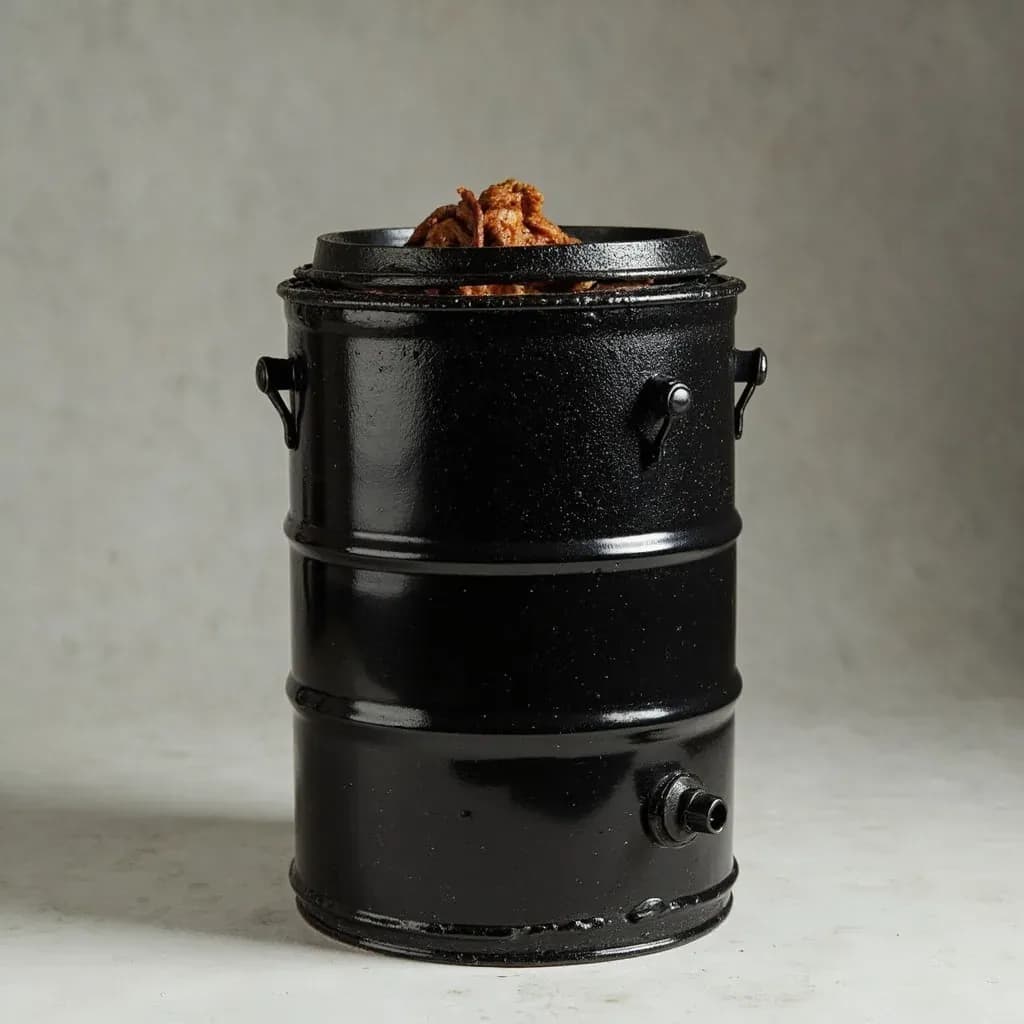
An ugly drum smoker is a vertical charcoal smoker made from a 55-gallon steel drum, with a charcoal basket at the bottom and cooking grates near the top. Airflow is controlled by intake vents and a lidded exhaust, giving long, stable low-temperature cooks ideal for brisket, ribs, and pork. Its tall, sealed design traps smoke and heat efficiently, so a single load of charcoal can burn for many hours.
The Ugly Drum Smoker (UDS) is a vertical charcoal cooker built around a repurposed 55-gallon steel drum, prized in the low-and-slow barbecue world for its thrift, simplicity, and ability to hold a steady 225–275 °F for ten hours or more without refueling. Its name was coined by pitmaster Phil McElhaney, and "ugly" is honest: there is nothing decorative about a blackened barrel with bolted nuts for dampers and a short stovepipe stuck in the lid. What it lacks in looks it makes up for in performance, because the same vertical geometry that makes it homely — a charcoal basket at the base, intake air entering through holes near the floor, and hot smoke rising past three stacked grates before exiting a single stack on top — is also why it cooks so evenly and so long.
The UDS works on natural draft. As fuel burns, heated air rises and pulls fresh oxygen in through the bottom intakes, which is why pitmasters talk about "tuning" dampers rather than chasing electronic thermostats. Food sits in clean smoke rather than over a grease fire, and because heat comes up the walls and across the grates from below, drippings fall away from the coals instead of flaring them. The trade-off is that a UDS is a smoker, not a grill: there is no direct radiant heat source for a hard sear, and the thin steel means every lid lift costs real recovery time.
For a cook weighing whether to build or buy one, the appeal is the cost-to-performance ratio. A home-built UDS can be assembled in an afternoon for well under $150 in parts, and a properly loaded charcoal basket will carry a brisket, two pork shoulders, or six to eight racks of ribs from raw to bark without being babysat. Its main competitors in the drum-style category are factory-made cousins like the Pit Barrel Cooker and Hunsaker Smoker, but the original DIY ethos is still the point — most owners build their own, and the community around them swaps build photos, drum-sourcing tips, and charcoal-counting charts as enthusiastically as any recipe.
Alternatives
Types & varieties
The standard DIY build: 55-gallon drum, charcoal basket at the base, three wire grates, bottom intakes, and a top exhaust stack.
Commercial ceramic-coated drum cooker that uses hanging hooks and a flat grate; factory-made but built on the same vertical-draft principle as the UDS.
Higher-end commercial drum smoker with thicker steel, gasketed lid, and refined airflow controls for tighter temperature management.
Smaller DIY variant built from a 30-gallon drum; popular for tailgating, camping, and smaller households where a full barrel is overkill.
Uses hooks hung from crossbars instead of, or in addition to, the grates — well suited to sausage links, ribs, and whole chickens that benefit from vertical air circulation.
Adds aluminum tuning plates around the charcoal basket to even out heat, reduce hot spots, and make temperature response to damper changes more predictable.
How the UDS Actually Works
A UDS is a study in convection. Cold air enters through the bottom intake holes, passes through the charcoal basket where it is heated, then climbs the walls of the drum past each cooking grate before leaving through the exhaust stack. Because the stack sits directly above the heat source, a strong chimney effect is established within minutes of lighting — far stronger than in a horizontal offset smoker — which is why a UDS recovers temperature relatively quickly after a lid opening and rarely goes stale on smoke.
The grates are arranged vertically, which is the key difference from a Weber kettle or offset. Heat and smoke wash up and around the food rather than rolling horizontally across it, so a full load cooks to roughly the same doneness within a small range. Pitmasters exploit this by stacking cuts that finish at different times: briskets and shoulders low (where it is hottest and most protected), ribs in the middle, and quick items like chicken or sausage up top where the air has cooled slightly and is gentler on the skin.
- Bottom intakes act as the throttle; the exhaust stack is almost always left wide open.
- The lid thermometer reads 25–50 °F hotter than grate level — trust a grate-level probe, not the lid.
- Because the fire draws from below, ash falls away from food and into the ash pan rather than back into the fuel.
Building or Buying a Drum Smoker
The hard part of building a UDS is not the fabrication — it is sourcing a safe drum. Only new, food-grade drums or drums that previously held a known food product (olive oil, fruit juice concentrate, pickles, tomato paste) are acceptable. Drums that carried solvents, lubricants, fuels, paints, or unknown industrial contents cannot be burned, sanded, or lined into something food-safe, and they must be rejected no matter how cheap.
Once a clean drum is in hand, the build is straightforward: cut the lid, drill three to four intake holes near the base (typically ¾″ or 1″), fit each hole with a bolt and nut as a damper, mount a charcoal basket (a laundry-detergent tub or expanded-metal basket works) on three short legs above an ash pan, install a 2–3″ exhaust nipple and short stack through the lid, drop in three cooking grate supports, and finish with a lid thermometer. Strip any interior paint or liner first, then burn the empty drum hot for two to three hours to season the steel and burn off residual odors before the first real cook.
- Source the drum before anything else — the build is easy, the drum is the bottleneck.
- Weld only what you must; many builders rivet or bolt the entire assembly.
- Budget a full afternoon for the build and a separate afternoon for the seasoning burn.
Common uses
Tips & pitfalls
- Only use new food-grade drums or drums that previously held a known safe food product (olive oil, juice concentrate, pickles); never use drums that contained chemicals, solvents, fuels, or unknown contents, no matter how well you clean them.
- Strip any interior paint, liner, or lacquer, then burn the drum empty at high heat for two to three hours before the first cook to season the steel and burn off residues.
- Weigh your charcoal load and pre-count fuel for long cooks — running out of charcoal during a brisket render is the single most common UDS failure and is almost always avoidable with a kitchen scale and a target number.
- Use the minion method: fill the basket with unlit charcoal and light 8–12 briquettes in the center for a slow, controlled climb to cooking temperature and a long, even burn.
- Mount a grate-level probe thermometer; the lid thermometer typically reads 25–50 °F hotter than the actual cooking surface, and chasing the lid number leads to overcooked food.
- Keep intake dampers roughly ¼ to ½ open for 225 °F — closing them further usually snuffs the fire rather than lowering temperature, because the UDS has very little thermal mass.
- Leave the lid on; every peek costs 15–20 minutes of recovery time and pumps oxygen across the coals, which can spike temperature and ash out your fire.
- Wear heavy welding gloves when handling the drum at temperature — the thin steel conducts heat aggressively and the lid handle, in particular, will burn bare skin long after the cook ends.
Good to know
- Type
- Vertical barrel-style charcoal smoker (typically DIY)
- Primary Material
- 55-gallon (208 L) food-grade steel drum
- Fuel
- Charcoal (lump or briquettes) plus wood chunks or chips for smoke flavor
- Cook Temp Range
- 225–275 °F (107–135 °C) for typical low-and-slow cooks
- Burn Time
- Roughly 8–12 hours per full basket using the minion method
- Airflow System
- 3–4 bottom intake dampers and a single 2–3″ exhaust stack on the lid
- Capacity
- About 6–8 racks of ribs, two briskets, or several whole chickens/pork shoulders per load
- Build Cost
- Typically $50–150 in parts for a home build
Also called
UDS · Drum Smoker · Barrel Smoker
Related

Stovetop
The everyday burners where most cooking actually happens

Oven
Enclosed dry heat for roasting, baking, and braising

Grill
Live-fire or gas grates for char, smoke, and high heat

Smoker
Low, slow heat and wood smoke for barbecue and brisket

Air Fryer
Countertop convection that crisps with little or no oil

Slow Cooker
Set-and-forget low heat for stews, beans, and braises

Pressure Cooker
Sealed steam pressure that cooks tough food in a fraction of the time

Rice Cooker
Foolproof, perfectly steamed rice every single time