Appliances & Heat
Dry-Aging Cabinet
A climate-controlled fridge that ages meat with set temperature, humidity, and airflow for deeper flavor.
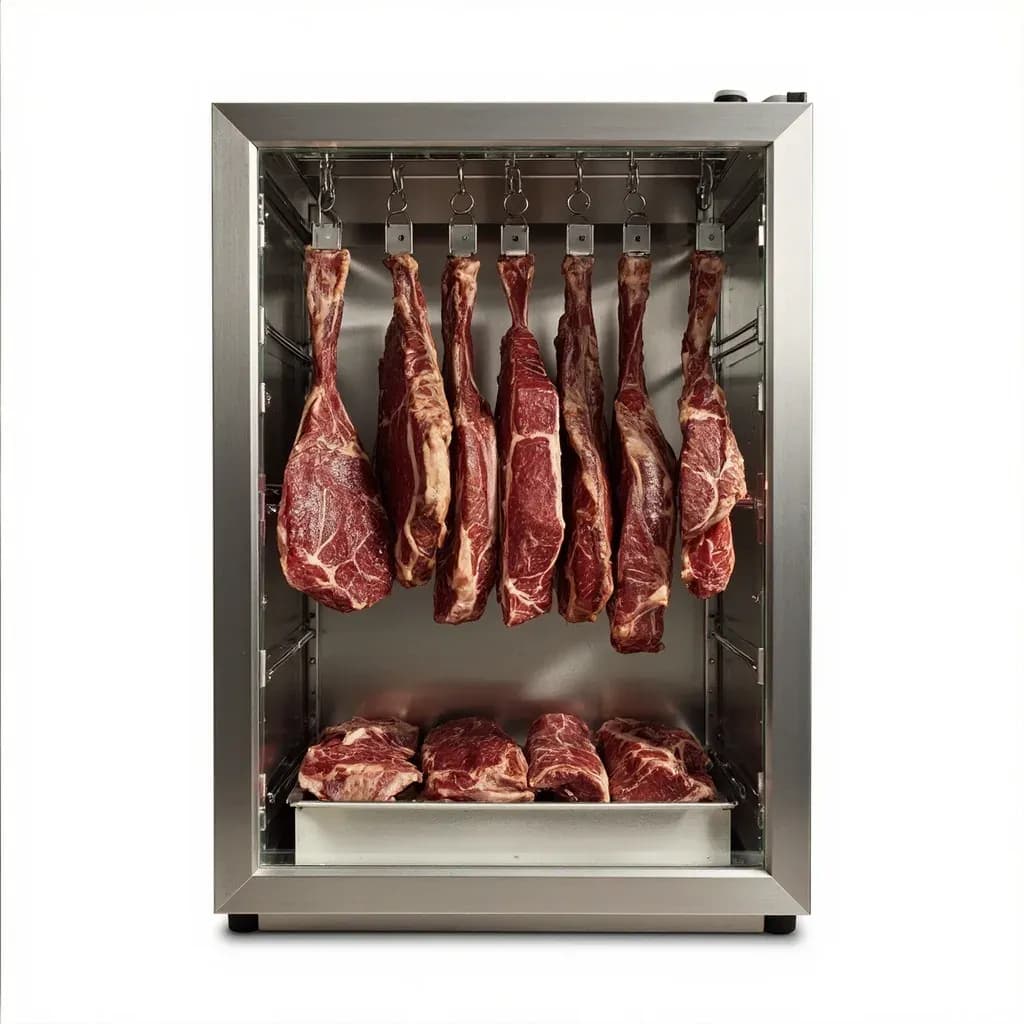
A dry-aging cabinet is a specialized refrigerator that precisely controls temperature, humidity, and airflow, often with UV sanitation, to age beef and other meats. Over weeks the surface dries and enzymes tenderize the muscle while flavor concentrates and intensifies. Unlike a normal fridge it maintains the stable conditions needed to age safely without spoilage.
A dry-aging cabinet is a precision refrigerator engineered to recreate the climate of a traditional meat locker — just above freezing, moderately humid, with gentle, continuous airflow and a sterile air supply. Where a normal fridge is built to preserve food by slowing change, a dry-aging cabinet is built to encourage a specific kind of change: the slow, controlled dehydration of a beef subprimal while natural enzymes and benign surface molds break down muscle fibers and concentrate flavor. The two non-negotiable parameters are temperature, typically held around 36–37°F (2–2.5°C), and relative humidity, usually targeted in the 70–80% range. Quality units add UV-C sterilization and HEPA filtration to suppress pathogenic bacteria and keep the air free of competing spoilage organisms.
The payoff is a piece of beef that tastes noticeably nuttier, beefier, and almost buttery or blue-cheese-like, with a more tender, almost mineral texture. The cost is weight: roughly 15–40% of the starting mass evaporates as water during the aging period, and another 10–20% of the aged piece is shaved off as the dry, leathery outer pellicle before service. Plan on keeping only about half to two-thirds of the raw weight you started with, and price or portion accordingly. Flavor shifts are subtle through the first two weeks, pronounced by days 21–28, and increasingly funky beyond 35 days; very long ages (60+) are an acquired taste and work best on heavily marbled ribeye.
Although the category is dominated by beef, the same controlled climate is useful for aging hard cheeses, mellowing wild game, and finishing dry-cured charcuterie. Modern electric cabinets, exemplified by the German-built Dry Ager line, brought this capability out of butcher cellars and into restaurant kitchens from the late 1990s onward, and home-friendly versions have proliferated since roughly 2012. Whether you buy a dedicated unit, convert a fridge with aftermarket controls, or rent locker space from a butcher, the principles are the same: cool, humid, moving, sterile air, and time.
Alternatives
Types & varieties
German-built commercial and prosumer cabinets widely considered the reference standard; precise humidity control and optional Himalayan salt blocks.
U.S. brand aimed at home cooks and small restaurants; UV sterilization and dedicated humidity control in compact sizes.
U.S. commercial-grade upright and walk-in units used by steakhouses and butcher shops for high-volume aging.
American maker of commercial smokehouses and aging rooms, with dry-aging configurations built for larger operations.
U.S. commercial manufacturer offering dedicated dry-aging models built on restaurant-grade refrigeration platforms.
European dry-aging cabinets common in butcher shops and restaurant back-of-house.
High-end residential columns that can be configured for dry-aging and fit alongside other built-in refrigeration.
Some cabinets are tuned — or dual-purpose — for hard-cheese ripening at slightly higher humidity and longer cycles.
How the science actually works
Three things happen simultaneously inside a properly running cabinet, and understanding them is what separates successful aging from a spoiled science experiment.
- Enzymatic tenderization: native proteases in the muscle slowly break down myofibrillar proteins, loosening the structure and giving aged beef its characteristic tenderness.
- Moisture evaporation: water migrates to the surface and is carried away by the gentle airflow. The remaining meat is more concentrated in flavor per gram, which is why a dry-aged steak tastes richer even before factoring in the crust.
- Surface mold and pellicle formation: a controlled bloom of white, gray, or greenish Penicillium and related molds colonizes the surface. Under proper conditions these are benign and contribute to the funky, almost cheese-like aromatic complexity; the dry, leathery outer pellicle they help form is trimmed off before service.
Reading the yield math
If you are aging for service or for sale, run the numbers before you buy, not after.
- A 20 lb bone-in ribeye can lose roughly 3–8 lb to evaporation and another ~2–3 lb to trim of the pellicle — leaving somewhere around 9–15 lb of saleable aged meat.
- At 28 days you have lost more water than at 14, and the flavor is more concentrated, so price-per-finished-pound should rise, not fall, as aging time increases.
- Bone-in subprimals retain proportionally more edible mass than boneless because the bone holds weight that is not trimmed away — useful when calculating cost per serving.
Cabinet vs. converted fridge vs. butcher locker
A dedicated cabinet is not the only path, but the cheaper routes come with trade-offs worth understanding.
- A converted fridge with a small fan, an aftermarket humidity controller, and a UV-C bulb inside can approximate cabinet conditions for home use at lower cost, but temperature and humidity swings are larger.
- A full-size butcher's locker or walk-in cooler offers volume and stable conditions, but without UV and humidity control you will see heavier pellicle formation and more aggressive mold, which raises trim loss.
- Dedicated cabinets win on repeatability: closed-loop humidity, sealed airflow paths, and timed UV cycles mean less babysitting and more predictable results batch after batch.
Common uses
Tips & pitfalls
- Start with Prime or high-Choice, well-marbled meat — dry-aging amplifies what is already there and will not rescue a lean or low-grade cut.
- Trim external fat to about ¼ inch before loading; thick fat caps block airflow and trap moisture against the surface, encouraging slime and off-odors.
- Space every cut at least an inch from the walls and from each other — contact points will not dry properly and will develop spoilage pockets.
- Keep the door closed; every opening swings humidity and temperature and pulls in unfiltered air. Pull multiple cuts at planned intervals rather than peeking daily.
- Label each cut with its start date and intended pull date, and run side-by-side tastings at 21, 28, 35, and 45 days to find the sweet spot for your cabinet and your palate.
- Do not try to age lean cuts like tenderloin for long periods — without intramuscular fat to keep them palatable, they shrink dramatically and turn dry and livery.
- Common mistake: running humidity above ~85%. The surface turns slimy, ammonia-like off-odors appear, and spoilage bacteria outcompete the desired white mold.
- Common mistake: running humidity below ~65%. The outside case-hardens into a shell that locks moisture inside, leading to sour, barnyard notes and uneven texture.
- Common mistake: using a shared cabinet for fish, cheese, and beef. Dry-aged aromas are powerful and will transfer — keep a dedicated unit, or at minimum a sealed secondary container inside it, for non-beef items.
- After trimming, rest the aged cuts uncovered on a rack in the refrigerator for an hour or two before cooking so the surface dries and forms a proper sear.
- Sanitize racks, walls, and drip trays between batches with food-safe disinfectant; residual proteins attract mold and pests.
Good to know
- Target temperature
- 34–38°F (1–3°C); most cabinets hold ~36–37°F (2–2.5°C)
- Target relative humidity
- 70–80% RH; some manufacturers aim 75–85%
- Airflow & sterilization
- Continuous gentle circulation plus UV-C lamps and/or HEPA filtration to keep the air uniform and hostile to pathogens
- Typical aging window
- 14–45 days for beef; flavor becomes distinctly nutty and complex after ~21–28 days
- Moisture loss
- ~15–40% of starting weight evaporates as water during aging
- Trim loss
- An additional ~10–20% of the aged piece is removed as the dried outer pellicle before cooking
- Net yield to cooked steak
- Expect roughly 50–65% of the original raw weight remaining after aging and trimming
- Best starting material
- USDA Prime or high-Choice, well-marbled subprimals (ribeye, strip loin, sirloin, tenderloin) from a single source for traceability
- Power
- 110–120V (home) or 220–240V (commercial); draws comparable power to a medium refrigerator
- Common capacities
- Home: 3–8 cu ft holding 10–40 lb; commercial: 20–80+ cu ft holding 100–500+ lb
- Construction
- Stainless steel interior and exterior; glass or solid door; optional salt block on some models
- Maintenance
- Defrost and clean every 60–90 days; replace or clean UV lamps per manufacturer schedule
Also called
Dry-Aging Fridge · meat aging cabinet · charcuterie chamber
Related

Stovetop
The everyday burners where most cooking actually happens

Oven
Enclosed dry heat for roasting, baking, and braising

Grill
Live-fire or gas grates for char, smoke, and high heat

Smoker
Low, slow heat and wood smoke for barbecue and brisket

Air Fryer
Countertop convection that crisps with little or no oil

Slow Cooker
Set-and-forget low heat for stews, beans, and braises

Pressure Cooker
Sealed steam pressure that cooks tough food in a fraction of the time

Rice Cooker
Foolproof, perfectly steamed rice every single time