Appliances & Heat
Electric Kettle
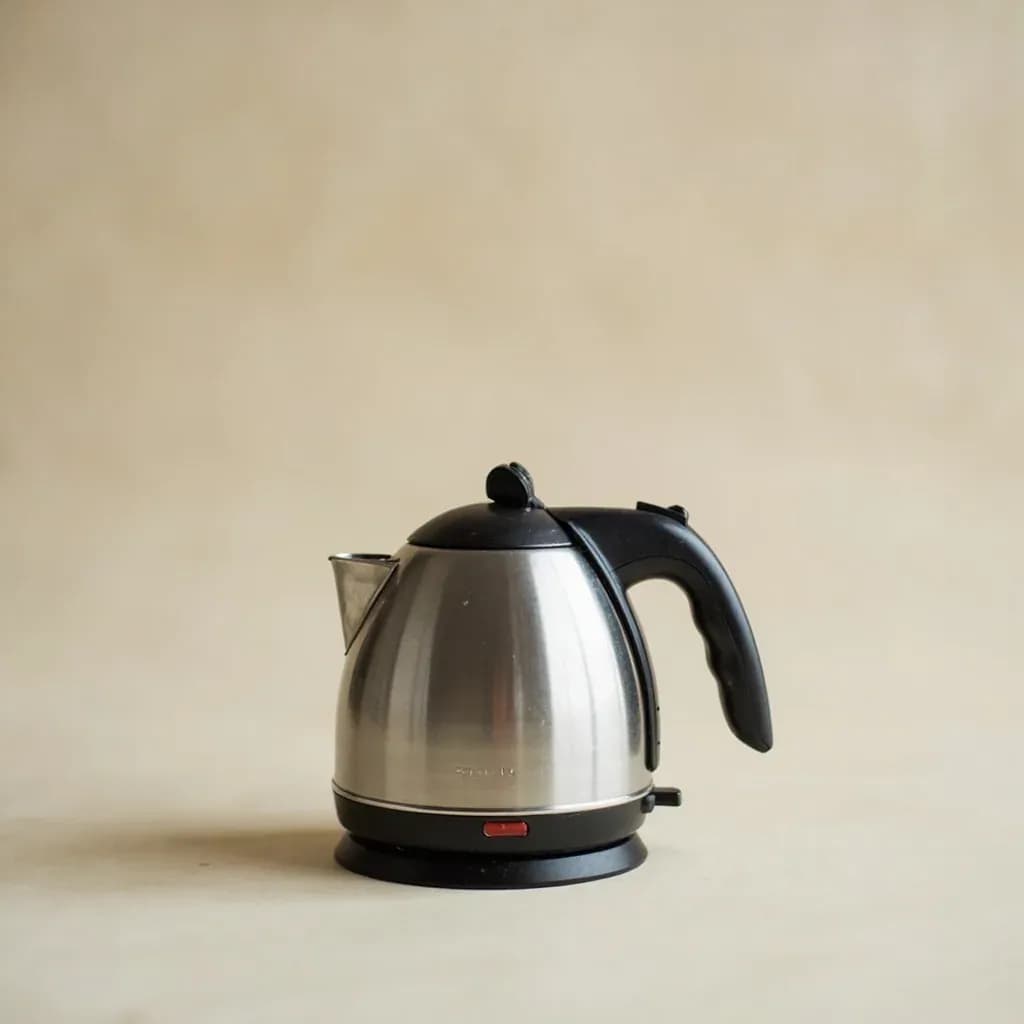
A countertop appliance that quickly boils water for tea, coffee, and cooking.
An electric kettle is a self-contained countertop appliance with a heating element that brings water to a boil faster and more efficiently than a stovetop pot. It is used for steeping tea, brewing coffee, blanching, hydrating dried foods, and getting a head start on boiling water for pasta. Many models offer automatic shutoff and variable temperature settings for different teas and pour-over coffee.
The electric kettle is the cook's precision heating tool disguised as a countertop appliance. Where a stovetop pot is a blunt instrument — slow, dependent on burner size, and indifferent to a five-degree difference — a kettle is fast, contained, and, in variable-temperature models, accurate to within a few degrees. It exists to do one job well: deliver water at a specific temperature, on demand, in under three minutes for a single cup. That focused usefulness is why the kettle has become one of the most-used appliances in British kitchens and a quietly indispensable tool in serious tea and coffee households everywhere.
Modern kettles are cordless jugs that lift off a 360° base, with a concealed stainless-steel heating element sealed under a flat floor. That sealed element — the design that became standard after 1955 — is what made kettles both safe (auto shut-off at boil) and hygienic (no exposed coil to furr with scale). Bodies are stainless steel, borosilicate glass, or BPA-free polypropylene; the only meaningful choice for a cook is whether the model offers variable temperature, because brewing is a temperature-dependent process, not just a boiling one.
The variable-temperature function is the kettle's real culinary value. Green tea steeped in fully boiled water turns grassy and bitter; white tea wants a gentler 80 °C; pour-over coffee loses aromatic complexity when scalded at 100 °C. A boil-only kettle can still do all of these jobs, but the user has to guess at cooling time. A variable-temperature kettle removes that guesswork — and for anyone who makes tea, coffee, or warm proofing water for bread, that precision is worth the modest price premium over a basic model.
Alternatives
Types & varieties
Single on/off switch; cheapest and simplest; fine when you only need fully rolling boiling water.
Preset buttons or a dial for specific targets (often 70, 80, 90, 95, 100 °C); essential for green, white, oolong, and pour-over coffee.
Long, slender spout for precise pour control; favored for pour-over coffee and tea service; usually lower wattage and slower to boil.
The mainstream form — a kettle that lifts off a 360° base; available in every temperature style.
0.5–0.8 L, ~1,000 W, dual voltage for international use; often includes two nesting cups.
Borosilicate body with a glowing internal light; lets you watch the boil and see scale buildup before it becomes a problem.
Wi-Fi or Bluetooth models triggered or scheduled from a phone; can hold a set temperature for hours.
Less common; a metal kettle that lifts off its electric base and works on gas or induction as well.
Wattage, circuits, and electrical reality
An electric kettle is one of the largest single electrical loads in a domestic kitchen, and the regional difference in wattage is worth understanding before you buy, import, or travel with one. A 3 kW UK kettle draws about 13 A on a 230 V circuit — heavy but normal on a UK ring main. The same kettle on a 120 V North American circuit would draw roughly 25 A and trip a standard 15 A (or even 20 A) breaker outright, regardless of what else is on the circuit. Conversely, a 1,500 W North American kettle on a UK ring main works safely but feels underpowered, taking noticeably longer to boil than a local 2.2–3 kW model. For most cooks this matters only when choosing a kettle: pick the highest wattage your circuit can safely handle, and accept that a 1,500 W kettle on a shared kitchen circuit is the real reason the lights dim when the microwave runs at the same time.
Common uses
Tips & pitfalls
- Descale every 1–3 months with a 1:1 white-vinegar-and-water boil (or 1–2 tbsp citric acid per litre) to keep heating fast and the cup tasting clean.
- Use filtered water if your tap is hard — scale builds faster and mutes tea flavor.
- Match temperature to the leaf: green 75–85 °C, white 80–85 °C, oolong 85–95 °C, black and herbal 100 °C; pour-over coffee 90–96 °C.
- Don't re-boil the same water repeatedly — dissolved oxygen drops and the cup tastes flat.
- Never let a kettle sit empty and switched on; boil-dry protection should still trip, but it's a needless stress on the element.
- Empty the kettle at the end of the day so minerals don't crust on the floor as the water cools.
- Fill only what you need; a full kettle of cold water takes noticeably longer and uses more energy than just enough for one cup.
- Keep the lid closed while boiling — open-lid kettles lose heat, run longer, and may never reach the cut-off temperature cleanly.
Good to know
- Invented
- 1891, by the Carpenter Electric Company of Chicago — the first electrically heated vessel for domestic water boiling.
- First auto shut-off
- 1955, the Russell Hobbs K1 in the UK — the template for every modern domestic kettle.
- Typical capacity
- 0.5–1.7 L; 1.5–1.7 L is the most common household size.
- Power draw
- 1,000–3,000 W; roughly 1,500 W in North America, 2,200–3,000 W in the UK and parts of Europe.
- Boil time
- Roughly 4–6 minutes for a full 1.7 L at 1,500 W; about 2 minutes for a single cup in high-wattage models.
- Heating element
- Almost universally a concealed stainless-steel element under a flat floor; exposed-coil corded models are largely obsolete.
- Operating temperatures
- Boil-only models reach 100 °C / 212 °F; variable-temperature models span roughly 40–100 °C / 104–212 °F.
- Common body materials
- Stainless steel, borosilicate glass, BPA-free polypropylene, and aluminum with an outer shell.
Also called
Bullidor · Electric Jug · Kettle
Related

Stovetop
The everyday burners where most cooking actually happens

Oven
Enclosed dry heat for roasting, baking, and braising

Grill
Live-fire or gas grates for char, smoke, and high heat

Smoker
Low, slow heat and wood smoke for barbecue and brisket

Air Fryer
Countertop convection that crisps with little or no oil

Slow Cooker
Set-and-forget low heat for stews, beans, and braises

Pressure Cooker
Sealed steam pressure that cooks tough food in a fraction of the time

Rice Cooker
Foolproof, perfectly steamed rice every single time