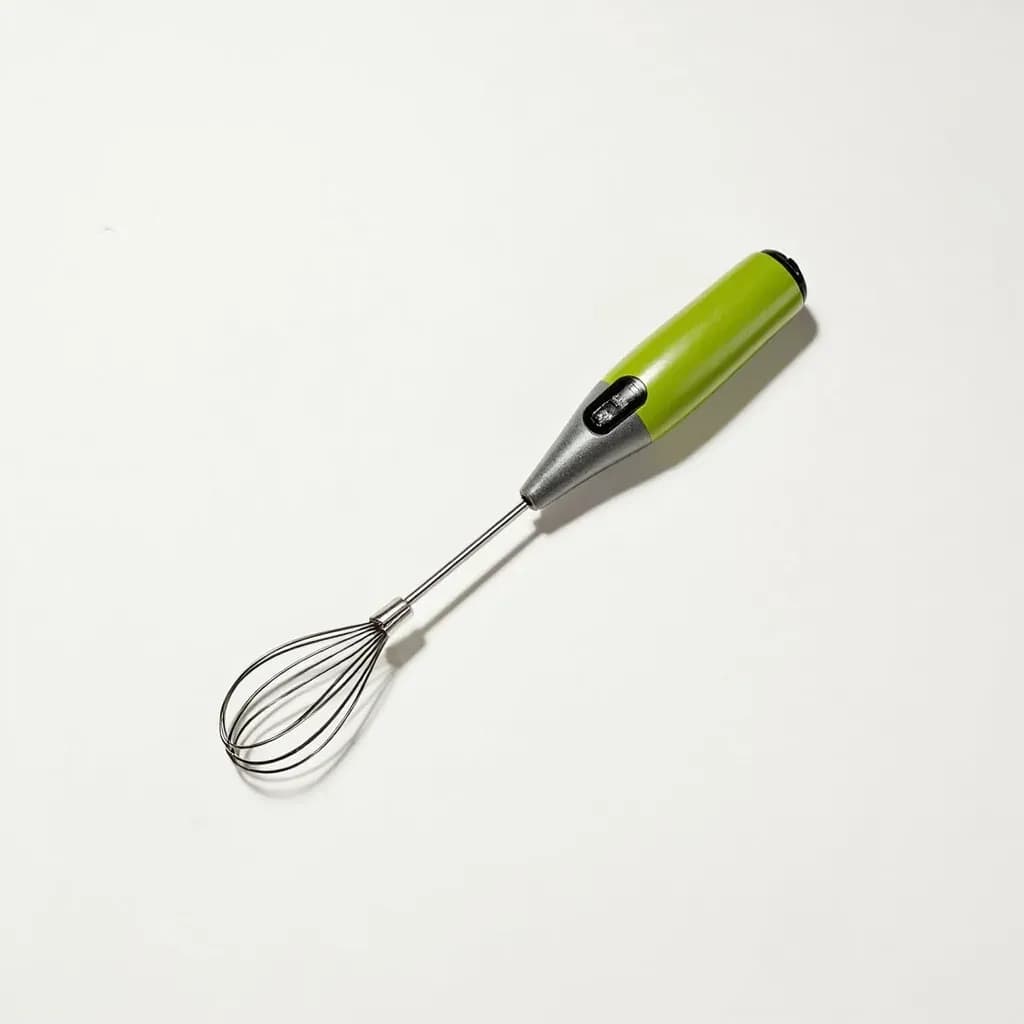
Appliances & Heat
Electric Matcha Whisk (Milk Frother)
A battery-powered handheld whisk that froths matcha, milk, and dressings into a smooth foam.
An electric matcha whisk is a small battery or rechargeable handheld device with a spinning coil or whisk head. It whips powdered matcha into hot water without clumps and froths milk for lattes and cappuccinos. The same tool quickly emulsifies dressings, blends protein powders, or aerates small mixtures.
The handheld electric milk frother is a slim, pen-shaped motor with a small spinning whisk — almost always a coiled spring of stainless steel — at the end of a long shaft. Press a button and the coil whirs at roughly 9,000 to 15,000 RPM, drawing liquid down into the spiral and flinging it back out as a vortex. Sold first as a milk frother for the home-espresso boom of the 2000s, it was rebranded as a matcha whisk once ceremonial-grade green tea went mainstream, and the same tool now does both jobs well, plus a handful of emulsions in between.
What the tool offers is speed and convenience. A stable foam or a clump-free matcha suspension in ten or fifteen seconds, in a single cup, with no steam wand, no plunger, and no brush to wash. Its limits are honest. A traditional bamboo chasen still produces a finer, more stable crema on plain matcha, and a proper espresso machine's steam wand beats it for latte art. But for the home cook who wants a foamy matcha latte, a cappuccino's worth of milk, or a one-cup emulsion of dressing or hot chocolate, nothing matches the frother for the price.
The motor is small and easily overworked, so the tool rewards the right technique. Hold it still at the bottom of the cup and you get a fully mixed liquid with no foam at all; raise and lower the whisk, or tilt the cup, and air gets folded in. Treat it as a small tool for small jobs and it will last years; use it on thick batter or run it continuously for minutes and you will cook the motor in a season.
Alternatives
Types & varieties
The standard form: AA batteries, one on/off button, detachable stainless coil head. Cheap, reliable, easy to replace.
Built-in lithium battery charged via USB; slightly more powerful and quieter, but pricier. Has largely displaced AA models in the premium segment.
Often bundled with a small ceramic stand and a ceramic or bamboo-style cup. Marketed for matcha but functionally identical to a milk frother.
Comes with interchangeable whisk attachments (coil spring, balloon, flat disc) for different tasks; typically battery-powered.
Larger appliance such as the Nespresso Aeroccino or Breville Milk Café. Quieter and more powerful than a handheld, but 5–10× the price and unnecessary for casual use.
Matcha versus the bamboo chasen
The chasen is still the right tool for traditional matcha, and the reasons are mechanical. A chasen has roughly 60 to 120 fine bamboo prongs (most commonly 80) that whisk water with a gentle, high-frequency shearing action, producing bubbles small enough that the surface reads as a uniform crema rather than a foam. The electric coil whips faster but with a coarser action, so the bubbles are larger and the crema collapses within a minute or two. For a thin bowl of usucha or the dense, almost syrupy koicha, the difference is visible and a purist will notice.
For a matcha latte, however, the difference is invisible. The milk you pour on top buries the crema under a layer of opaque white foam, and the slightly coarser texture of the electric whisk is impossible to taste. If you are making matcha for two people, or you keep a chasen clean in a drawer somewhere, use the chasen. If you are making yourself a single matcha latte in five minutes before work, the electric frother is the right call — sift, add warm water, froth, top with milk, done.
- Chasen: dozens of fine prongs, gentle shearing action, finer and more stable crema
- Electric coil: faster, coarser bubbles, crema that collapses within a minute
- Use the chasen for plain usucha or koicha; use the frother for matcha lattes and quick daily cups
- Sift the matcha through a small fine-mesh sieve before adding water — the frother cannot break up hard clumps on its own
Frothing milk: temperature, dairy, and plant
The frother is at its best with about 100 to 150 ml (roughly ½ to ⅔ cup) of milk in a deep, narrow tumbler. Cold milk gives the finest, most stable microfoam — the kind that holds latte art — because the fat is firm and the proteins are intact. Heated milk (55 to 65 °C / 130 to 150 °F) gives larger, looser bubbles suitable for a cappuccino-style cap, but at much higher temperatures the proteins denature and the foam goes flat and dry. For most drinks, the difference between cold and warm is more important than the difference between brands.
Of plant milks, oat milk froths best, with a creamy, stable foam that mimics whole dairy. Soy is a close second, especially barista-blend soy. Almond and coconut give large, unstable bubbles regardless of tool. Whole dairy milk froths noticeably better than skim because the fat stabilizes the foam, and ultra-pasteurized milk froths worse than regular pasteurized because the high-heat treatment damages the whey proteins that hold bubbles together.
- Cold milk: finest, most stable microfoam, good for latte art
- Warmed milk (55–65 °C / 130–150 °F): larger, looser bubbles, classic cappuccino foam
- Hotter than 70 °C / 160 °F: proteins denature, foam goes flat and dry
- Whole dairy > 2% > skim for stability; ultra-pasteurized milk froths worse than regular
- Plant milks, in order: oat (best) > soy > almond and coconut (worst, large unstable bubbles)
Care and motor longevity
These tools die from one of three causes: battery corrosion, milk residue hardening onto the coil, and motor burnout from continuous use. None of them are hard to prevent. The detachable whisk head is the only part that gets rinsed; the handle is wiped with a damp cloth and never put under the tap, because the seam at the top of the shaft is not watertight and a dunk will kill the motor. After every milk use, run the coil briefly in a cup of warm water to flush residue before it dries on. When the frother starts spinning slowly, replace the batteries — a weak battery strains the motor and shortens its life.
- Detach the coil head and rinse under the tap; wipe the handle with a damp cloth and never submerge it
- After milk, run the whisk briefly in a cup of warm water to flush residue before it dries
- Pulse the button rather than holding it — 5 seconds on, 2 seconds off, repeat — to keep the motor cool
- Replace batteries as soon as you notice a drop in speed; a tired battery strains the motor
- Do not use the frother for thick batters, dough, or anything more than about 200 ml at a time
Common uses
Tips & pitfalls
- Sift matcha through a small fine-mesh sieve into the cup before adding water — the frother cannot break up hard clumps on its own.
- Use warm (60–70 °C / 140–160 °F) water for matcha, never boiling; high heat turns matcha bitter and stresses the small motor.
- Move the whisk up and down and tilt the cup as you froth; holding it still at the bottom gives you a fully mixed liquid with no foam at all.
- Use a deep, narrow tumbler or chawan, not a wide mug — a wide mug causes the spinning coil to spray liquid across the counter.
- Pulse the button (a few seconds on, a few seconds off) rather than holding it continuously; this prevents the motor from overheating and noticeably extends battery life.
- Rinse the coil head immediately after milk use by running it briefly in a cup of warm water — milk residue dries onto the spring and is hard to remove once it sets.
- Don't submerge the handle or hold it under a running tap; only the detachable metal coil is waterproof, and water in the motor housing will kill it.
- Replace the AA batteries the moment the frother slows down; a weak battery produces flat, sad foam and strains the motor to the point of failure.
Good to know
- Tool type
- Battery- or USB-powered handheld frother with a small rotating whisk on a slim shaft
- Also called
- Hand frother, milk frother, mini whisk, beverage frother, electric matcha whisk
- Power source
- 1–2 AA alkaline batteries in basic models; rechargeable lithium-ion via USB-C or micro-USB in premium models
- Operating speed
- Roughly 9,000–15,000 RPM; some manufacturer claims reach ~20,000 RPM
- Shaft length
- Typically 18–22 cm (7–8.5 in) from handle to whisk tip
- Whisk head types
- Coil spring (most common), small balloon/beater, flat disc with slits
- Continuous run limit
- Manufacturers recommend no more than 30–60 seconds of continuous use to protect the motor
- Cleaning
- Only the detachable whisk end is water-safe; the motor housing must be hand-wiped and never submerged
- Price range
- Roughly $5–$15 for basic battery models; $15–$40 for rechargeable or stand-included "matcha" versions
Also called
Handheld Milk Frother · Milk Steamer/Frothing Wand · electric frother · drink mixer wand
Related

Stovetop
The everyday burners where most cooking actually happens

Oven
Enclosed dry heat for roasting, baking, and braising

Grill
Live-fire or gas grates for char, smoke, and high heat

Smoker
Low, slow heat and wood smoke for barbecue and brisket

Air Fryer
Countertop convection that crisps with little or no oil

Slow Cooker
Set-and-forget low heat for stews, beans, and braises

Pressure Cooker
Sealed steam pressure that cooks tough food in a fraction of the time

Rice Cooker
Foolproof, perfectly steamed rice every single time