Appliances & Heat
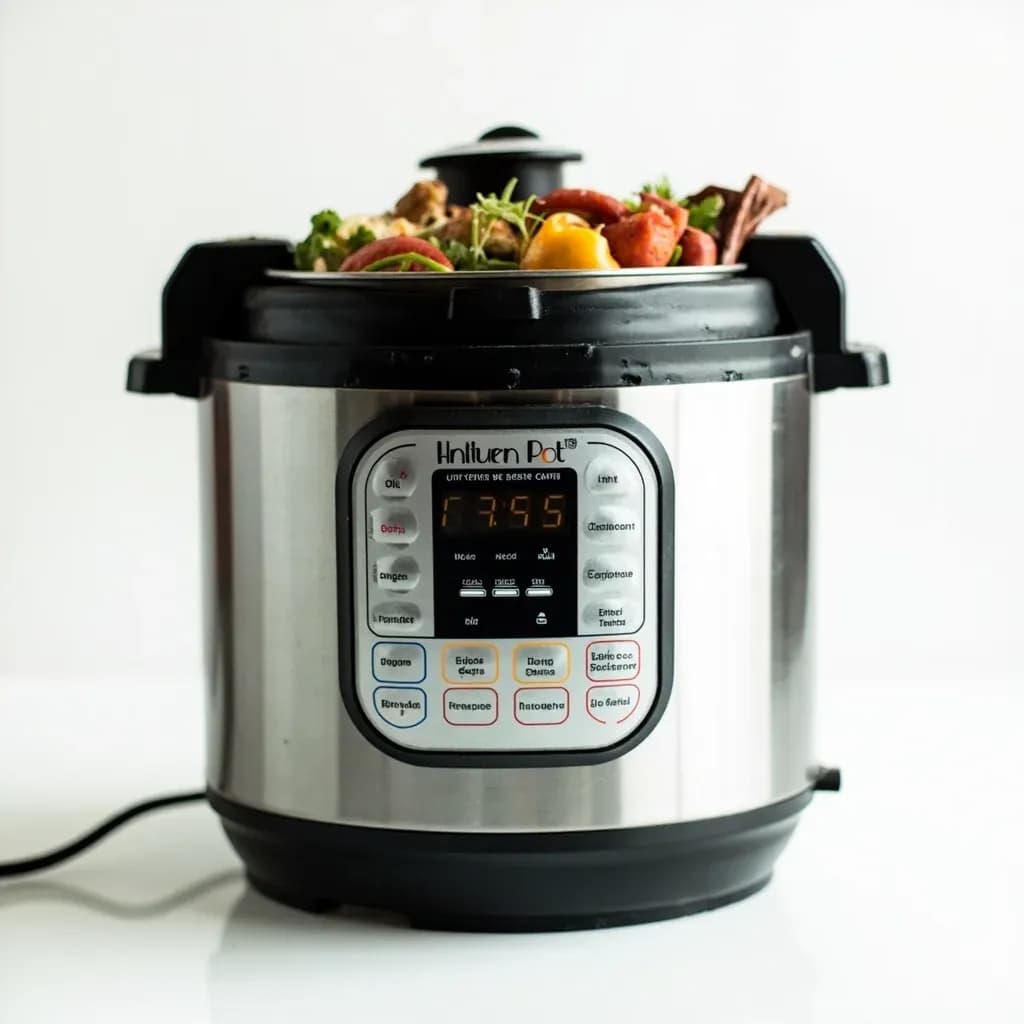
Electric Pressure Cooker
A countertop cooker that pressurizes to cook beans, stews, and grains fast on a timer.
An electric pressure cooker is a sealed countertop appliance that heats food under pressure, raising the boiling point so dishes cook much faster than on the stove. Programmable settings handle beans, rice, stews, stocks, and braises hands-off, and most double as slow cookers and sautè pans. Popular multicookers automate venting and timing for safe, convenient use.
The electric pressure cooker is a sealed, electrically heated pot governed by a microprocessor that regulates pressure, temperature, and time — essentially a stovetop pressure cooker with the fiddly parts automated. Inside, the inner pot sits on a heating element and is sealed by a locking lid with a silicone gasket and a float valve; as contents heat, steam builds and the valve locks at the target pressure. Most home units run at high pressure of about 10.2–12 PSI, which pushes the boiling point of water to roughly 115–118 °C / 239–244 °F. That 15–18 °C jump over normal boiling is the entire reason the appliance exists: it cuts dried-bean cook times by two-thirds and turns a four-hour chuck roast into a roughly sixty-minute job.
The trade-off for that speed is real. A sealed pot cannot vent steam, so it cannot reduce a sauce or brown what sits inside it. Reliable recipes therefore sear first using the open-pot sauté function, deglaze thoroughly, then pressure cook — and finish with either a quick simmer to reduce the sauce or a high-heat air-fry or broil step. Modern units are no longer single-purpose: the same vessel slow-cooks, steams, makes yogurt, and (in newer models) air-fries, which is why it has largely displaced the slow cooker on American countertops since about 2015.
Control rests as much in the release method as in the cook time. Natural Pressure Release (NPR) lets the cooker cool on its own; it is the right choice for starchy foods, big roasts, and anything you want to keep moist, because carryover cooking continues to tenderize. Quick Release (QR) vents the steam manually and stops cooking immediately — the right call for vegetables, fish, and delicate proteins. Learning when to use each is what separates competent pressure cooking from mushy greens or chalky-centered chicken breasts.
Alternatives
Types & varieties
The 6- and 8-quart workhorse with low/high pressure, sauté, slow cook, and rice presets; the default choice for most home kitchens.
Adds a 15-psi option, faster preheat, and a steam-air combo lid; the Pro Crisp swaps the lid for an air-fry crisper.
The highest-pressure consumer electric unit (~15 PSI), the only Instant Pot model approved for pressure canning low-acid foods.
Pressure cooking plus a hinged air-fry lid in one unit; the 6.5- and 8-quart models are the originals of the combo-cooker format.
Australian-engineered with dual pressure and temperature sensors, hands-free pressure release, and a polished stainless interface.
Korean rice-cooker heritage; voice prompts, very strong pressure and steam control, favored for rice and multigrain cooking.
8-quart mainline with a ceramic-coated inner pot and a broad preset library; the strongest second brand after Instant Pot.
Budget-friendly 6- and 8-quart unit with a strong customer-recipe ecosystem.
An early-2010s budget brand that drove the first wave of U.S. consumer adoption before Instant Pot took the category.
Not electric, but the benchmark stovetop pressure cooker — higher pressure, faster cook times, and the reference point for serious cooks.
Pressure, Browning, and the Core Trade-Off
A pressure cooker works by raising the boiling point of water; it does not, despite popular belief, push heat 'into' food faster. What changes is that water stays liquid at temperatures it could not normally reach, so starches gelatinize faster, collagen hydrolyzes faster, and connective tissue breaks down in an hour instead of four. What the sealed environment cannot do is vent steam, evaporate moisture, or brown what is in the pot — Maillard reactions still need surface contact with hot dry air, which a sealed wet environment never provides. This is why the most common pressure-cooker failure is not undercooking but overcooking, and why every reliable recipe begins with a sear in the open pot and ends with a reduction or a high-heat finish.
- Sear in the open pot on sauté, then deglaze with liquid and scrape the fond — leftover fond is the most common cause of BURN / OVERHEAT notices.
- Pressure cook for tenderness, then simmer, broil, or air-fry for color and crust.
- Thickeners (cornstarch slurry, tomato paste, cream) belong in the final 5–10 minutes, not under pressure.
Natural vs. Quick Release
The release method is where the cook exerts the most control over final texture. A common starting pattern is a 10-minute Natural Release followed by a manual vent; understanding why helps you deviate intelligently.
- Natural Pressure Release (NPR): leave the valve sealed and let the cooker cool on its own. Use for large roasts, dried beans, soups, and anything starchy or foamy — the carryover cooking tenderizes further and prevents starchy foam from spewing through the vent.
- Quick Release (QR): flip the valve to 'venting' and let the steam blast out. Use for vegetables, fish, seafood, and delicate proteins you want to stop cooking immediately.
- After a QR that produced heavy foam, wait 5–10 minutes before opening; the float valve must fully drop before the lid will unlock, and any residual pressure can still be scalding.
- Cold-Water Quick Release: not possible on most electrics (the lid locks under pressure). On stovetop models you can run cold water over the lid to speed cooling, but this is unsafe on electric units and not recommended.
Filling, Liquid, and the Physics of Pressure
Pressure cookers cannot generate pressure from nothing; they need enough thin liquid to produce steam, and enough headroom to let food expand without clogging the vent. Getting these two numbers right solves most beginner problems.
- Always add at least 1 cup (240 ml) of thin liquid (water, broth, wine, tomato juice) — thick sauces and purees alone will not build pressure and may scorch.
- Fill limits: 2/3 full for most foods; 1/2 full for beans, grains, pasta, dried vegetables, and anything that foams or expands (split peas, oats, dried beans).
- At altitude, water boils at a lower temperature, so the same PSI delivers less effective heat — add roughly 5% cook time per 1,000 ft above 2,000 ft.
Common uses
Tips & pitfalls
- Always add at least 1 cup (240 ml) of thin liquid — the appliance cannot generate pressure without enough steam, and thick purees alone will scorch.
- Never fill above the max line: 2/3 full for most foods, 1/2 full for foam- and expansion-prone items (beans, grains, rice, pasta, dried vegetables).
- Use Natural Pressure Release for starchy foods, large roasts, and anything you want to keep moist — the carryover cook tenderizes further and prevents foam from spewing. Use Quick Release for vegetables, fish, and delicate proteins you want to stop cooking immediately.
- Always sauté or sear meat and aromatics in the open pot first, then deglaze with liquid and scrape the bottom thoroughly — leftover fond is the leading cause of the BURN / OVERHEAT notice.
- Keep two silicone sealing rings on hand: one dedicated to savory cooking and a second for sweets, coffee, or curry. Gaskets absorb strong aromas and will ghost-flavor vanilla pudding for weeks.
- Replace the sealing ring every 12–18 months (or sooner if stretched, cracked, or permanently smelly); spare rings and float-valve covers are cheap and stocked by the manufacturer.
- Before every cook, confirm the anti-blockage shield (the small metal cap on the inside of the lid) is seated and clear of food — a clogged vent is the principal safety hazard.
- Pressure canning in an electric pressure cooker is only safe on units and programs specifically tested and approved for it (e.g., Instant Pot Max); most electric units are not validated for canning low-acid foods, so do not improvise.
Good to know
- First patented concept
- 1679, by French physicist Denis Papin, who called his device a steam digester (also 'bone digester')
- Modern category revived
- 2010, with the launch of the Instant Pot by Robert Wang in Canada
- Operating pressure (high)
- 10.2–12 PSI (70–82 kPa) on most units; some models reach ~15 PSI
- Operating pressure (low)
- 5.3–7.3 PSI (37–50 kPa), for delicate foods and yogurt
- Working temperature
- About 115–118 °C / 239–244 °F at 10–12 PSI, versus 100 °C at atmospheric pressure
- Common sizes
- 3, 6, 8, and 10 quarts; the 6-quart is the standard for households of two to four
- Inner pot material
- Stainless steel (most common) or anodized aluminum with nonstick coating
- Standard functions
- Pressure cook, slow cook, sauté/sear, steam, rice, yogurt, keep warm, and manual timer; newer units add air-fry, sous-vide, and canning programs
- Time savings vs. stovetop
- Dried beans 60–75% faster; tough braises 40–60% faster; whole grains 30–50% faster
- Safety features
- Lid lock while pressurized, anti-blockage vent, float valve, overpressure release, lid-position sensor, and thermal fuse
Also called
multicooker · Instant Pot · electric pressure pot
Related

Stovetop
The everyday burners where most cooking actually happens

Oven
Enclosed dry heat for roasting, baking, and braising

Grill
Live-fire or gas grates for char, smoke, and high heat

Smoker
Low, slow heat and wood smoke for barbecue and brisket

Air Fryer
Countertop convection that crisps with little or no oil

Slow Cooker
Set-and-forget low heat for stews, beans, and braises

Pressure Cooker
Sealed steam pressure that cooks tough food in a fraction of the time

Rice Cooker
Foolproof, perfectly steamed rice every single time