Appliances & Heat
Electric Tea Maker
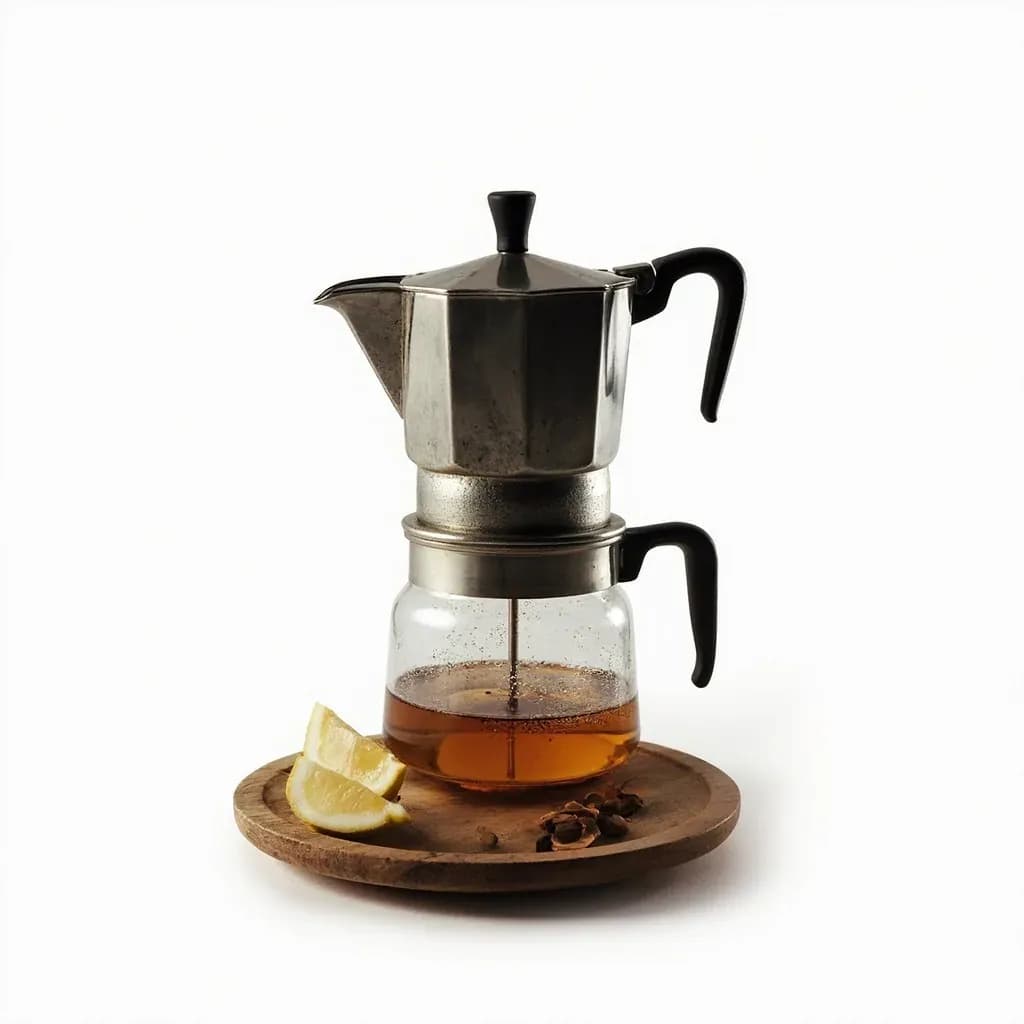
A two-tier electric kettle (Turkish çaydanlık) that brews strong tea over boiling water.
An electric tea maker, like the Turkish çay makinesi, stacks a brewing pot atop an electric kettle base. The lower vessel boils water while strong tea steeps in the upper pot, and you blend the two to the strength you like when serving. It automates the traditional double-teapot method for continuous tea throughout the day.
An electric tea maker, in the sense used across Turkish, Azerbaijani, and Iranian kitchens, is the electrified descendant of the çaydanlık — a two-tier kettle built to brew strong tea by steam rather than full immersion. A wide lower pot boils water on a concealed heating element while a smaller lidded upper pot (the demlik) nests into its rim, filled with loose black tea. As the lower water boils, steam and hot vapor rise through and around the demlik, slowly extracting a dense, almost syrupy concentrate over ten to twenty minutes. The result is not a finished cup of tea but a base that each drinker thins with hot water from the lower kettle to taste.
This concentrate-and-dilute method is the defining feature, not a quirk of tradition. Turkish black tea — Rize çayı, named for the northeastern coastal region where nearly all of the country's tea grows — is graded for astringency and body rather than delicacy, and the two-tier brewer coaxes out the tannins and deep mahogany color that the small, tulip-shaped ince belli glasses are designed to show off. The same hardware handles herbal tisanes, sage, linden flower, or any loose blend that benefits from gentle, sustained heat without submersion.
In practice the appliance behaves like a hybrid between a kettle and a slow brewer and is largely hands-off once filled: the lower chamber cuts off automatically when the water boils, and the demlik does its work unattended on top. Strength is controlled by the ratio of leaf to demlik volume, the length of the steam steep, and at the glass, the proportion of concentrate to plain hot water poured from below. For cooks used to Western steeping, the key adjustment is that 'done' is judged by color in the demlik, not by minutes on a clock.
Alternatives
Types & varieties
The standard stovetop form: a wide lower kettle and a lidded upper pot that nests into the rim. Works on gas and electric stoves, and is the design basis for every electric version.
Lower pot is a corded electric kettle with its own concealed heating element and boil-dry auto shutoff; the demlik sits on top and brews from the rising steam.
Adds a small second heater in the demlik well or a wrap-around element so the upper pot brews faster and stays hot independently of the lower chamber.
Russian-inspired tall single body with a spigot and a small top teapot; not a true two-tier but performs the same concentrate-and-dilute function with a smaller footprint.
Two clear glass chambers on an electric base; visually show the tea color but more fragile and prone to thermal shock if heated dry.
Higher-end units with a keep-warm plate, a ready-light for the demlik, and sometimes a timer; common in Turkish, Azerbaijani, and Iranian kitchens where tea is kept available through the day.
Anatomy and vocabulary
Two terms recur in any serious discussion of the appliance. Çaydanlık is the whole two-tier kettle and is sometimes used loosely to mean either chamber; demlik refers specifically to the smaller upper pot where the leaves steep. In Turkish homes the lower chamber is often called simply the su ısıtıcı (water heater) or kettle, and the upper is always the demlik. Knowing the distinction matters when reading recipes and when buying replacement parts, since the demlik is the chamber that takes the most wear: it stains, it holds tannin residue, and it is the piece you swap out if a glass lid cracks.
The concentrate-and-dilute method: koyu, orta, açık
Turkish tea is almost never poured ready-to-drink. The demlik produces a dense concentrate called koyu çay; the drinker then tops it in the glass with hot water drawn from the lower kettle to one of three strengths. Koyu is mostly concentrate, dark and bracing. Orta is roughly half and half, the everyday default. Açık ('light') is mostly hot water with just a blush of concentrate, suited to children, dessert, or late-evening drinking. Pouring concentrate first and water second in each glass — rather than thinning a whole pot — is the practical reason the two-tier design exists: it lets every guest at the table set their own strength without brewing a second batch.
Choosing and using loose-leaf Rize çayı
The tea designed for these machines is a broken, fully oxidized Black Sea black tea sold loose as Rize çayı or Türk çayı. It looks coarse and uneven compared with Western breakfast teas, which is exactly what you want: small pieces give up color and tannin quickly under steam, while still leaving enough body to read through milk in a small glass. Avoid fannings and tea bags — they sit in the demlik without room to expand and produce a thin, papery cup. A heaped teaspoon per demlik is a sensible starting ratio; raise it for koyu drinkers, lower it for açık, and adjust by color rather than by clock, since leaf freshness and humidity both change the extraction speed.
Care and descaling
Scale on the lower heating element is the single most common real-world problem with electric çaydanlık. In hard-water areas a chalky element steams unevenly, drags the boil time up, and mutes the tea with a flat, mineral note. Descale monthly by filling the lower chamber with a solution of about two tablespoons of citric acid or white vinegar per liter of water, bringing it to a boil, and letting it stand for thirty minutes before rinsing thoroughly. The demlik itself does not need descaling, but it should be hand-washed after every use — tannins polymerize into a brown film that, once set, becomes the kitchen equivalent of a tea-stained old pot. Store both chambers dry with lids slightly ajar so residual moisture does not turn musty.
Common uses
Tips & pitfalls
- Fill the lower chamber only to its marked max line; overfilling spits boiling water up into the demlik and over-extracts the leaves.
- Use loose tea rather than bags — bags lack room to expand in the demlik and produce a thin, dusty brew.
- Rinse the kettle and demlik with hot water before brewing to stabilize the temperature and reduce the chance of cracking a glass demlik in cold weather.
- Judge the brew by the color in the demlik rather than by time; pull it off the heat when the liquor reaches a deep amber-mahogany, not when it looks black.
- Pour concentrate into the glass first, then top with hot water from the lower kettle, so each guest controls their own koyu, orta, or açık strength.
- Descale the lower element monthly in hard-water areas; a chalky element steams unevenly and the tea tastes flat and mineral.
- Never run the lower kettle dry — even with auto-shutoff, a forgotten empty boil will scorch the element and shorten the life of the unit.
- Choose a model with a wide lower base on a separate corded stand if you plan to lift the demlik off and on repeatedly; tight-fitting domed lids make mid-brew removal awkward and a burn risk.
Good to know
- Origin
- Turkey; the two-tier brewing method (çaydanlık + demlik) became standard in Turkish homes from the early-to-mid 20th century, after tea cultivation spread through the Rize region on the Black Sea coast.
- Core design
- Two stacked chambers. The larger lower pot boils water; a smaller upper pot (demlik) holds loose tea leaves and sits directly on the lower pot, steeping in rising steam and hot vapor.
- Typical capacity
- About 1.5–2.5 L combined; the lower kettle is usually 1.2–2 L and the upper demlik 0.4–0.8 L.
- Common materials
- Stainless steel (most common for electric models); some have porcelain or enamel-on-steel upper chambers; borosilicate glass versions exist but are fragile.
- Power
- Typically 1,500–2,200 W on 220–240 V in European and Turkish markets; North American imports usually 1,100–1,500 W on 120 V.
- Brewing ratio
- Roughly 1 heaped teaspoon (about 5 g) of loose tea per demlik, brewed into 0.5–0.7 L of concentrate, then diluted with hot water from the lower chamber to taste.
- Brewing time
- 10–20 minutes of gentle steam infusion once the lower water is boiling; longer steeps yield a stronger, more tannic cup.
- Cleaning
- Hand-wash both chambers; descale the lower element monthly in hard-water areas with citric acid or white vinegar.
Also called
Çay Makinesi · Turkish tea maker · electric çaydanlık · samovar tea maker
Related

Stovetop
The everyday burners where most cooking actually happens

Oven
Enclosed dry heat for roasting, baking, and braising

Grill
Live-fire or gas grates for char, smoke, and high heat

Smoker
Low, slow heat and wood smoke for barbecue and brisket

Air Fryer
Countertop convection that crisps with little or no oil

Slow Cooker
Set-and-forget low heat for stews, beans, and braises

Pressure Cooker
Sealed steam pressure that cooks tough food in a fraction of the time

Rice Cooker
Foolproof, perfectly steamed rice every single time