Appliances & Heat
Enrobing Machine
A confectionery machine that coats centers in a smooth, even layer of tempered chocolate.
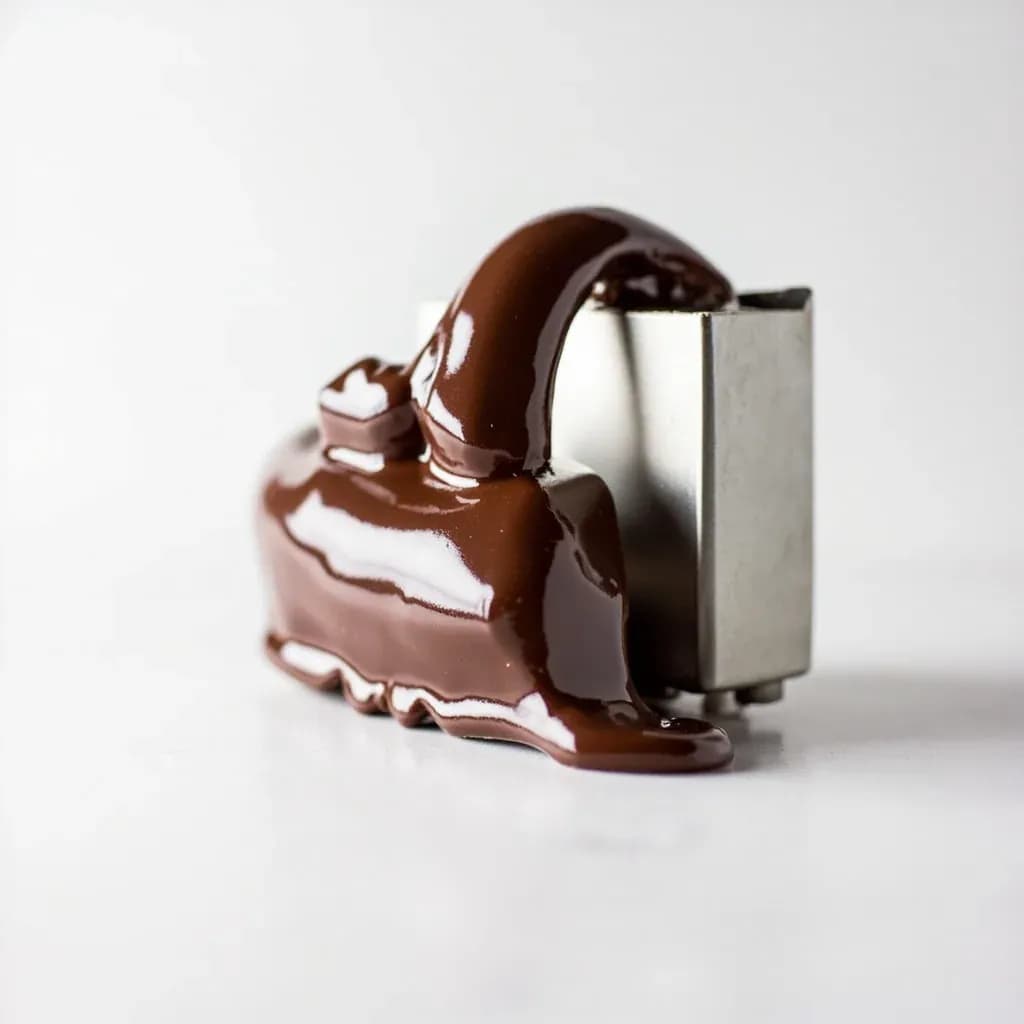
An enrobing machine carries chocolate or candy centers on a mesh belt through a curtain of flowing tempered chocolate, coating them on all sides. Excess drips off, a blower evens the shell, and the pieces pass through a cooling tunnel to set with a glossy finish. It gives uniform, professional coatings on bars, truffles, and bonbons at scale.
An enrobing machine is the confectionery answer to a paint shop: a thin, continuous curtain of tempered chocolate falls over a moving wire-mesh belt, and whatever rides the belt emerges fully (or partially) coated in a uniform shell. Mechanically it is a small system with big consequences — a heated jacketed tank holds chocolate at working temperature, a pump or auger moves it to a flow former, and a slotted weir overflows to create the falling sheet. A blower section and a vibrating baffle strip off the excess, a decorating wheel sprinkles nuts or nonpareils on the wet underside if desired, and the piece continues into a cooling tunnel where the shell sets. Three variables govern the final shell thickness: chocolate viscosity, belt speed, and the aggressiveness of the blower. Master those and the rest of confectionery production gets dramatically easier.
Enrobing matters because hand-dipping with a fork gives a noticeably thick, uneven shell that looks rustic and tends to crack or flake at the bite. A properly tuned enrober lays down a shell roughly 1 to 3 mm — thin enough to snap cleanly, thick enough to protect a soft center, and even on every face. That uniformity is what allows a ganache truffle, a caramel bar, or an ice cream stick to behave predictably at room temperature, on a shop shelf, and on a long shipping route. For any production beyond a few dozen pieces a day, the enrober replaces tedious, inconsistent hand work and turns chocolate coating from a craft bottleneck into a repeatable step.
The trade-off is that an enrober is only as good as the chocolate and the room around it. The chocolate must be properly tempered before it ever reaches the tank, the center must be pre-cooled so the shell snaps on contact, and the workspace should sit around 16–20 °C with humidity in the 50–60% range. Ignore any of those and the machine rewards you with bloom, streaking, fat separation, or cracked shells. Paired with a tempering machine upstream and a cooling tunnel downstream, an enrober becomes the centerpiece of a real confectionery line.
Alternatives
Types & varieties
The standard design; centers pass through the chocolate curtain and are completely enveloped on all sides — the workhorse for truffles, pralines, and bars.
Two narrow belts carry items under a curtain so only the top and a band on the sides are coated — used for cookies, wafer bars, and ice cream sandwiches.
Applies chocolate from below to leave a clean, uncoated top — typical for biscuits and certain candy bars.
Chocolate overflows a slotted weir to form a thin, even falling sheet, in the classic Savane/Sollich style.
Often built into or paired with the enrober; a rotating wheel or vibrating pan sprinkles nuts, coconut, sugar, or nonpareils onto the still-wet underside.
Enrober mated directly to a multi-zone cooling tunnel for continuous, high-volume production.
Small-footprint units from Chocolate World, ChocoVision, and similar makers aimed at pastry shops, with manual loading trays.
Heavy-duty machines from Aasted, Bühler Bindler, Sollich, Chocotech, Latour, Dedy, and Savage Bros, built for around-the-clock operation.
How the three controls shape the shell
An enrober looks like a small waterfall on a conveyor, but the relationship between the operator and the machine is really a triangle of three dials: chocolate viscosity, belt speed, and blower pressure. Once you understand which knob moves which variable, you can tune a clean shell for almost any product.
- Chocolate viscosity, not temperature, is what determines how much chocolate clings to the piece as it leaves the curtain. Thinner chocolate (more cocoa butter) picks up a thinner shell; thicker chocolate lays down more. Aim for roughly 800–1500 cP for dark, 900–1600 cP for milk on a curtain machine.
- Belt speed controls dwell time under the curtain and how long the piece spends under the blower. Slow the belt for thin chocolate (to add pickup) and speed it up for thick chocolate (to shed excess before the shell gets heavy).
- The blower/vibrator is the finishing pass: it shears off the bottom 'foot' of pooled chocolate. Too aggressive and it punctures the wet shell; too gentle and you get thick, heavy chocolate puddles on the bottom of every piece.
- Center temperature is the hidden fourth variable. A cold center (4–10 °C) snaps the shell on contact and resists slumping; a warm center lets the shell sag, run, and bloom within hours.
Setting up for a new product
Before running a batch, every enrober session is really a small calibration exercise. Work through these checks in order and most problems vanish before they start.
- Confirm chocolate is in temper with a knife test or a small sample on a tile — never trust the dial alone.
- Measure chocolate temperature in the tank with a calibrated thermometer; thermostat drift of even a degree ruins a run.
- Pre-cool centers to target temperature and let them equilibrate — centers pulled directly from a -18 °C freezer will crack the shell.
- Run a few test pieces through, examine the shell on a cooled sample for thickness, coverage, and 'feet', and adjust blower, speed, or viscosity before committing the batch.
Common uses
Tips & pitfalls
- Temper the chocolate before it reaches the tank, not in it — under-tempered chocolate gives a thick, bloomy shell; over-tempered chocolate is too viscous and streaks.
- Check the chocolate in the tank with a thermometer, not the thermostat dial; thermostat drift is a common, invisible source of bad shells.
- Adjust viscosity with cocoa butter to thin and additional chocolate to thicken, rather than chasing it with temperature changes that disturb temper.
- Pre-cool centers to 4–10 °C: too cold and the chocolate cracks on contact, too warm and the shell is thick, slow-setting, and prone to fat bloom.
- Keep the room at 16–20 °C with humidity in the 50–60% range; above that, you will see immediate sugar bloom as water condenses on the cold shell.
- Tune the blower conservatively — a too-aggressive blower punches holes in the wet shell, while a too-gentle one leaves thick chocolate 'feet' on the underside of every piece.
- Scrape and recycle catch-tray chocolate continuously; chocolate that sits in the open air and re-circulates can lose temper and seed the whole tank with bad crystals.
- Disassemble and wash the tank, pump, flow former, and mesh belt at the end of every shift — hardened chocolate in a pump voids the shell and ruins the next batch.
- When switching from dark to milk or white, run a purge of the new chocolate through the system for several minutes to avoid streaks and cross-color contamination.
- For half-coated products, use a double-belt or bottom-only setup; trying to half-coat on a standard curtain enrober gives ragged, inconsistent edges.
Good to know
- Primary function
- Coats centers with a thin, even shell of tempered chocolate delivered by a falling chocolate curtain and a wire-mesh conveyor
- Core components
- Heated jacketed tank, pump or auger, slotted flow former (weir), wire-mesh conveyor, blower/vibrator section, optional bottoming/decorating wheel, downstream cooling tunnel
- Belt widths (typical)
- From about 200 mm on bench/artisan units to 1500 mm or wider on industrial lines
- Throughput range
- Benchtop units: a few hundred pieces per hour; industrial lines: several thousand pieces per hour, designed for around-the-clock operation
- Chocolate state required
- Properly tempered: about 31–32 °C for dark, 30–31 °C for milk, 29–30 °C for white, held steady in the tank
- Working ambient
- 16–20 °C with 50–60% relative humidity, to prevent fat bloom and condensation on the wet shell
- Center temperature
- Pre-cooled centers at 4–10 °C set the shell rapidly on contact with the curtain
- Origin
- Mechanized enrobing developed alongside industrial chocolate production in late-19th- and early-20th-century Europe; Sollich and Chocotech in Germany are leading makers, with Savage Bros (US, founded 1887) a parallel pioneer
Also called
chocolate enrober · enrober
Related

Stovetop
The everyday burners where most cooking actually happens

Oven
Enclosed dry heat for roasting, baking, and braising

Grill
Live-fire or gas grates for char, smoke, and high heat

Smoker
Low, slow heat and wood smoke for barbecue and brisket

Air Fryer
Countertop convection that crisps with little or no oil

Slow Cooker
Set-and-forget low heat for stews, beans, and braises

Pressure Cooker
Sealed steam pressure that cooks tough food in a fraction of the time

Rice Cooker
Foolproof, perfectly steamed rice every single time