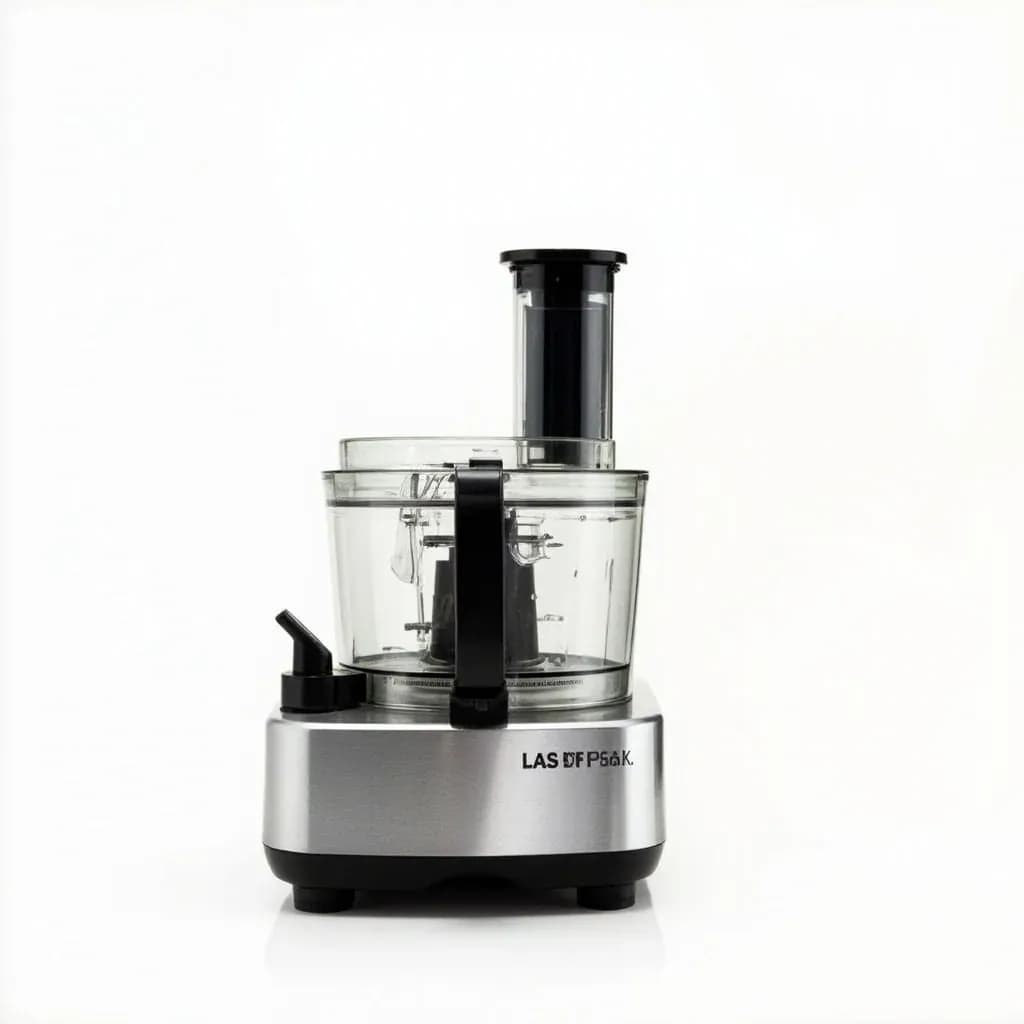
Appliances & Heat
Commercial Food Processor
A heavy-duty motorized processor that chops, slices, shreds and purees large volumes fast.
A commercial food processor is a powerful, high-capacity machine built for restaurant volume, with a strong motor and interchangeable blades and discs for chopping, slicing, shredding, grating and pureeing. Continuous-feed models push a steady stream of produce through a chute, while bowl-style units batch-process larger loads. They are sturdier and faster than home processors and are made to run repeatedly throughout service.
The commercial food processor is the workhorse that sits between the blender and the mandoline. For liquids and aeration, the blender wins; for paper-thin precision slices, the mandoline wins; for everything else — chopping, shredding, dicing, emulsifying, grinding — the processor is faster than any human knife and far more consistent across a long service. Robot-Coupe introduced the format in France in 1960 as a vertical cutter-mixer built to mechanize restaurant mise en place, and the basic architecture — motor base, work bowl, S-blade, and interchangeable discs on a lid-mounted shaft — has remained the template ever since.
What separates a commercial unit from a home model is capacity, motor durability, and attachment breadth. Commercial motors run 1–2 HP (high-volume batch units reach 3 HP), bowls range from 2.5 qt on countertop prep models to 14+ qt on production units, and the machine is engineered to run for minutes at a time across an entire service rather than 30-second bursts. Most run on 208–240 V three-phase power; smaller countertop units plug into standard 120 V outlets. The S-blade sits at the bottom of the bowl for chopping and puréeing; discs mount on the lid shaft for slicing, shredding, julienning, and dicing. Learning which blade does what — and which architecture to choose — is the single biggest factor in getting good results.
Two design philosophies cover almost every professional need. Bowl-style batch processors are closed systems optimized for wet work and chopping: pestos, purées, doughs, emulsions, coarse vegetable chops. Continuous-feed processors are open-hopper machines optimized for high-volume slicing and shredding, with product fed through a tube and exiting a chute while the machine runs. Many mid-size operations run one of each; combination units merge both functions on a single motor base and are the most versatile choice for varied restaurant prep.
Alternatives
Types & varieties
The workhorse: closed bowl with S-blade and interchangeable discs. Examples: Robot-Coupe R2 / R3 / R4 / R5, Waring WFP11/14/16, Hobart FP41/61/81, Sammic CK series.
Open hopper on top, no bowl; product exits a chute while running. Built for high-volume slicing and shredding of vegetables, cheese, and bread. Examples: Robot-Coupe CL50/CL60, Hobart FP150.
Hybrid with both a batch bowl and a continuous-feed attachment on the same motor base. Most versatile for varied restaurant prep. Examples: Robot-Coupe R502/R602, Hobart FP350/FP400.
Bowl-only machines from 5–14 qt optimized for heavy wet work: purées, pâtés, sausage emulsions, doughs, ground meats. Examples: Robot-Coupe R6/R8/R10, Hobart VCM series.
Continuous-feed-only, purpose-built for high-volume produce. The format Robot-Coupe brought to market in 1966, still represented by the CL25 / CL30 family.
2.5–3.5 qt, 120 V plug-in models for low-volume prep stations, coffee shops, and bars. Examples: Robot-Coupe R 301 Dice, Waring WFP14.
Three-phase, large-batch units for central kitchens, commissaries, and catering. Examples: Hobart FP1000 series, Robot-Coupe R8 V.V.
Continuous-feed units that integrate slicing, shredding, dicing, juicing, and sometimes a french-fry grid in one head. Examples: Robot-Coupe CL60, Sammic CA series.
S-Blade vs. Discs: Which Tool Does What
Every commercial processor ships with two fundamentally different cutting systems, and confusing them is the most common source of bad results. The S-blade is a curved, two-pronged blade that sits flat on the bottom of the bowl. It is for chopping and puréeing — anything where you want the blade to move through a pile of food. Smooth S-blades are general purpose; serrated S-blades grip breads and fibrous vegetables without pushing them around the bowl. Discs mount on a shaft in the lid and spin on a horizontal plane; they only work when food is fed down through the feed tube against the spinning disc. Slicing discs, shredding discs, julienne discs, and dicing grids all live in this category.
- Smooth S-blade: pestos, herb purées, hummus, nut butters, coarse chopping of mirepoix, doughs, emulsions.
- Serrated S-blade: bread crumbs, fibrous vegetables (celery, fennel), cooked meats for pâté.
- Slicing disc: even rounds or ovals of potatoes, cucumbers, tomatoes, onions, citrus; choose thickness by intended use.
- Shredding/grating disc: cabbage for slaw, cheese for service, potatoes for hash browns, carrots for salad.
- Julienne disc: firm vegetables only — carrots, zucchini, turnip, kohlrabi. Skip for soft items like tomatoes.
- Dicing kit: a slicing disc paired with a perpendicular grid that cubes the output. The single most underrated attachment; worth prioritizing when speccing a unit.
Choosing the Right Size and Format
Bowl capacity and machine format matter more than peak horsepower in daily use. A 3 qt bowl is genuinely limiting for mirepoix prep at a busy service; a 6 qt batch processor with a continuous-feed attachment can replace a full prep cook's knife work on produce. As a rule of thumb, usable working volume is about 60–70% of stated bowl capacity — overfilling leaves the bottom of the food untouched and overloads the motor. For a 60–80 seat restaurant with varied menus, a combination unit (batch bowl plus continuous-feed attachment, 4–6 qt) is the most flexible single purchase. Add a separate continuous-feed slicer only when produce volume justifies the counter space.
- Under 30 covers / single bar: 2.5–3.5 qt bench-top compact, 120 V plug-in.
- 30–80 covers / varied menu: 4–6 qt combination processor with continuous-feed attachment.
- 80+ covers / central prep: 6–8 qt batch plus a dedicated continuous-feed slicer/shredder.
- Heavy wet work (sausage, large-batch purées, doughs): add a dedicated large VCM (8–14 qt) to the lineup.
- Catering commissary: floor-model three-phase, 8+ qt batch plus continuous-feed slicer.
Common uses
Tips & pitfalls
- Always cut food to fit the feed tube before processing — forcing oversized pieces is the most common cause of stalled motors and damaged drive shafts.
- Use the pusher, never fingers or a spoon, in the feed tube; commercial processors bite hard and fast.
- Apply steady, even pressure with the pusher; pushing harder does not improve the cut and can bog the motor.
- Match blade to job: smooth S-blade for wet purées, serrated S-blade for breads and fibrous vegetables, slicing disc for round or oblong items, julienne only for firm produce.
- Pulse for control — running the machine to a stop gives you purée every time, even when you wanted a rough chop.
- Do not overfill the bowl; most manufacturers cap usable volume at 60–70% of stated capacity for even processing.
- Let the motor rest — a 1–2 minute pause every few minutes of continuous use dramatically extends motor life under heavy service.
- A dull shredding disc tears instead of cuts, stalls the motor, and ruins output — sharpen or replace discs regularly.
- Lay the S-blade in the bowl first, then add food on top; starting with food under the blade makes it spin dry and grind.
- Hard pits, bones, and frozen-solid blocks are off-limits — they will chip blades and can shatter the polycarbonate bowl.
- Pre-chill the bowl and blade in the freezer for 20 minutes when processing fats (butter, lard) or pastry dough — prevents smearing.
- Clean the motor base shaft and the bowl drive socket after each shift; food residue here is the most common cause of slippage and wear.
- A commercial food processor is not a blender: small-volume smoothies belong in a blender, not a food-processor bowl.
- In continuous-feed mode, feed items in a steady stream rather than dumping; a steady stream means consistent cuts and less motor strain.
Good to know
- Origin
- Commercial food processors trace to the Robot-Coupe, introduced in France in 1960 by Pierre Verdun to mechanize chopping for restaurant mise en place.
- Common capacities
- Commercial bowls range from about 2.5 qt on countertop prep models to 14+ qt on production units; 4–6 qt is the most common mid-size in restaurant kitchens.
- Motor power
- Typical commercial motors run 1–2 HP (roughly 750–1500 W); high-volume batch processors reach 3 HP, continuous-feed units often 1.5–2 HP.
- Power source
- Hardwired 208–240 V three-phase in most pro kitchens; smaller countertop units run on standard 120 V 15–20 A circuits.
- Standard attachments
- S-blade (smooth and serrated), slicing disc, grating/shredding disc in multiple grades, julienne disc, dicing kit (slicing disc + grid), and continuous-feed attachment with feed tube and pusher.
- Speed range
- Most commercial processors offer 1–3 speeds plus pulse; newer variable-speed models run roughly 300–3500 rpm at the blade.
- Duty cycle
- Manufacturers typically recommend 2–4 minutes continuous run with equal rest; continuous-feed models are rated for much longer duty cycles.
- Cleaning
- Bowl, lid, pusher, and most discs are top-rack dishwasher safe; the motor base is wiped only. Blades are extremely sharp — use a brush, never fingers.
Also called
Commercial Food Processor · Buffalo Chopper
Related

Stovetop
The everyday burners where most cooking actually happens

Oven
Enclosed dry heat for roasting, baking, and braising

Grill
Live-fire or gas grates for char, smoke, and high heat

Smoker
Low, slow heat and wood smoke for barbecue and brisket

Air Fryer
Countertop convection that crisps with little or no oil

Slow Cooker
Set-and-forget low heat for stews, beans, and braises

Pressure Cooker
Sealed steam pressure that cooks tough food in a fraction of the time

Rice Cooker
Foolproof, perfectly steamed rice every single time