Appliances & Heat
Gas Range
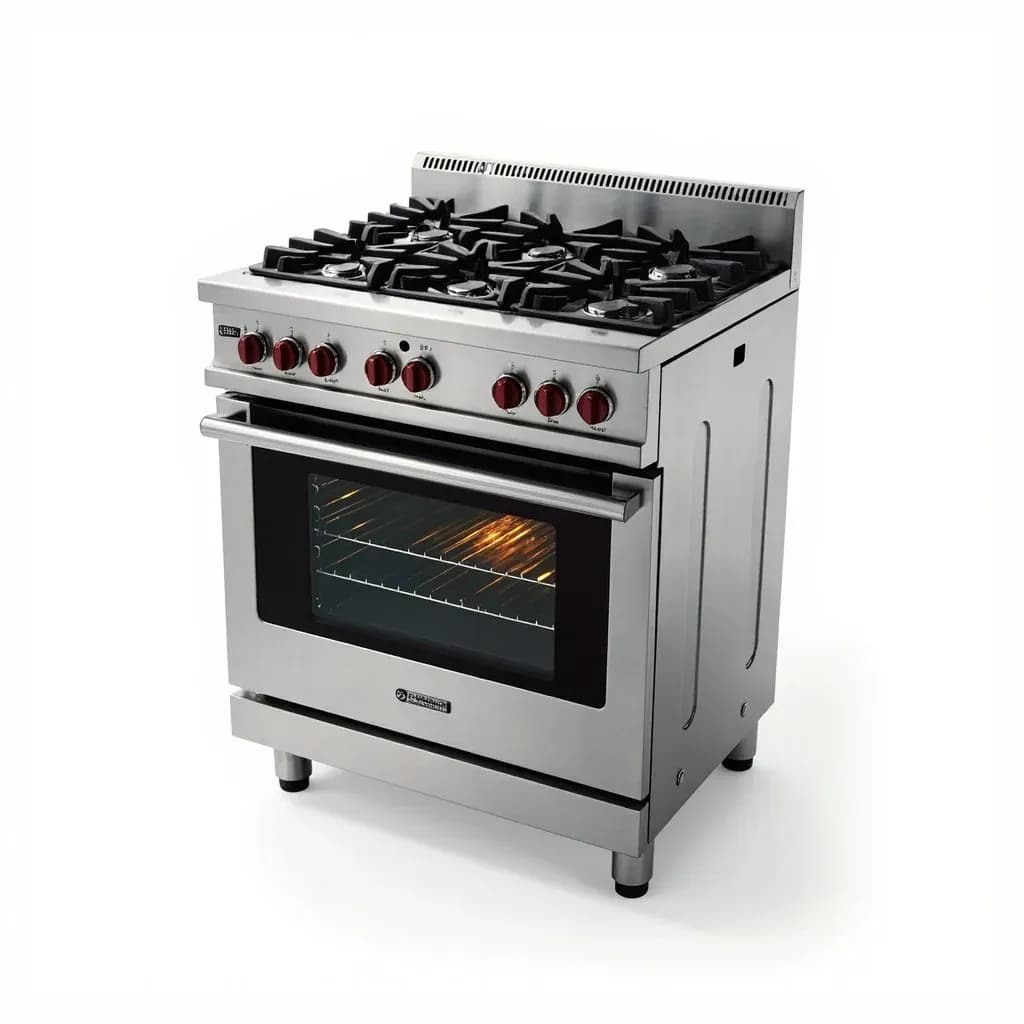
A freestanding unit combining a gas cooktop on top with a gas oven below in one body.
A gas range bundles open burners and an enclosed oven into a single appliance, letting a cook fry on top while baking or roasting underneath. Home versions typically have four to six burners; commercial ranges add high-output burners and a large oven for restaurant volume. Marine versions are gimballed so the cooktop stays level as a boat rolls.
A gas range marries an open-flame cooktop to a gas-fired oven in a single body, and the flame itself is its whole personality. Unlike an induction or radiant-electric surface, a gas burner responds the instant you turn the knob — flame up, flame down, flame out — and you can see exactly how much heat is reaching the pan. That visual, real-time control is the reason restaurant kitchens and most serious home cooks default to gas, even when electric ovens have closed the gap in baking precision.
Beneath the cooktop, the gas oven behaves a little differently from its electric cousin. Combustion releases water vapor along with heat, so a gas oven tends to run a touch more humid and is typically cooler in the corners farthest from the bake burner. That moisture is welcome for crusty bread, braised short ribs, and custards that want gentle, even heat, and it can complicate the kind of shattering, dry-heat roast that electric convection handles effortlessly. The broiler is fierce — a true top-down flame — making it superb for finishing steaks, blistering tomatoes, and browning gratins.
The trade-offs are practical: a gas range needs a fuel line (natural gas or propane) and proper outdoor-rated ventilation to carry away combustion byproducts, and switching between fuel types is a real conversion, not a simple swap. None of that is a deal-breaker for most cooks, but it is worth knowing what you are signing up for when a gas range is the right tool for the way you cook.
Alternatives
Types & varieties
Self-contained unit with finished sides; sits between cabinets or stands alone; the most common affordable style in the US.
Sits flush with countertop and cabinetry, no finished sides, built-in look; controls usually on the front.
Sits in a custom platform or base cabinet with top-mounted controls; less common today.
Gas cooktop paired with an electric (often true-convection) oven for more even baking.
36–60 in wide; higher BTU; heavy grates; often includes a griddle, grill, or French top.
Burner cap sits flush with the cooktop so spills do not drip into the burner box; standard on most modern models.
Restaurant-style; flames make direct contact with the pan; very responsive but harder to clean.
Fan circulates hot air for even heat; recipes typically bake at roughly 25°F (15°C) lower than the standard setting.
Dedicated center burner, often 15,000–20,000+ BTU, sized to cradle a 14-in wok.
Sizing the flame to the pan
The single biggest performance mistake on a gas range is letting the flame run wider than the pan. Gas heats the pan primarily where the flame touches; flame that licks up the sides or shoots past the base is wasted fuel, scorching handles and crowding the burner with hot combustion gases. Match the burner ring to the pan base, and turn the flame down once the pan is hot — a high flame on an empty burner is fine for a moment, but sustained oversize flames glaze the inside of a carbon-steel wok and blacken stainless handles.
- A 10-in skillet belongs on a medium or large burner, not the small one — too little flame leaves a cold spot in the center.
- Woks are the exception: an oversized flame ring is correct, because the wok is intentionally heated unevenly to push food up the slopes.
- When simmering, look for the smallest ring of blue flame that keeps the liquid gently bubbling; bigger flames just waste gas and erode the pan's seasoning over time.
The gas oven's quirks
A gas oven is not just an electric oven with a different plug. Combustion adds water vapor to the air, so browning is gentler and baked goods stay a bit moister — wonderful for bread, less ideal for shatter-crisp roast chicken skin. Heat also radiates unevenly from the bake burner at the bottom of the box, with the back corners typically running coolest.
- Rotate sheet pans front-to-back (and swap racks top-to-bottom) about two-thirds of the way through a bake to even out hot spots near the bake burner.
- When you switch a recipe to convection bake on a gas range, drop the temperature by about 25°F (15°C) and start checking 5–10 minutes early.
- The broiler is a true top-down flame, typically hotter than a standard electric broiler — great for finishing steaks and browning gratins, but easy to scorch, so leave the door cracked and watch closely.
Ventilation and fuel conversion
Two practical matters decide whether a gas range is a pleasure in your kitchen. First, ventilation: a gas cooktop releases real combustion products, not just water vapor, so a hood that vents to the outside (not just a recirculating filter) is the right match. Second, fuel conversion is a hardware change, not a knob flip — orifice jets and sometimes the regulator pressure must be swapped to switch between natural gas and propane, and the change should be recorded on the rating plate.
- Choose a hood rated for the full width of the cooktop and vented outdoors; recirculating hoods do not remove combustion gases.
- When moving a range between homes with different gas supplies, or converting a propane range to natural gas, use the manufacturer's conversion kit and have the work done or inspected by a qualified technician.
- If you ever smell gas when no burner is lit, shut the supply valve, ventilate the room, and call the gas utility — do not use the range until the leak is found.
Common uses
Tips & pitfalls
- Match burner size to pan base — a flame licking past the pan bottom wastes gas and burns handles.
- Clean burner caps and ports regularly; clogged ports cause yellow flame tips and uneven heat.
- Choose continuous cast-iron grates so you can slide heavy pans between burners without lifting.
- In a gas oven, rotate sheet pans front-to-back about two-thirds of the way through a bake to compensate for hot spots near the bake burner.
- For convection-bake recipes, drop the temperature by about 25°F (15°C) and start checking 5–10 minutes early.
- A blue flame is correct; persistent yellow or orange tips mean a dirty burner, a bad air–gas mix, or a partially blocked port — not a feature.
- Install a properly vented range hood (vented outside is strongly preferred) because gas combustion adds moisture and combustion gases to the kitchen.
- If switching between natural gas and propane, use the manufacturer's conversion kit; do not improvise with off-the-shelf orifices.
Good to know
- Power source
- Natural gas (NG) or liquid propane (LP); specified at install and convertible only with a manufacturer kit
- Standard residential width (US)
- 30 in (76 cm); pro-style models run 36, 48, or 60 in (91–152 cm)
- Burner BTU range
- Roughly 5,000–15,000 BTU/h on residential models; pro/commercial burners reach 25,000+ BTU/h
- Typical burner count
- 4–6 on residential ranges; up to 8 on pro-style models
- Key materials
- Cast-iron grates; porcelain-enameled or stainless body; brass or aluminum burner heads
- Oven temperature range
- Approximately 150–500°F (65–260°C); broiler typically 550–600°F (288–315°C)
- Ignition types
- Electronic spark (most common today), hot surface, or standing pilot (largely phased out for efficiency)
- Combustion byproducts
- Water vapor, CO₂, and small amounts of NOₓ; requires mechanical ventilation to the outside
- First patented gas stove
- 1826, by James Sharp in London
- Flame signal
- A blue flame is correct; persistent yellow or orange tips indicate a dirty burner, a bad air–gas mix, or a partially blocked port
Also called
Six-Burner Range · Commercial Range with Oven · Gas Range Cooktop · Marine Gimballed Range · Range
Related

Stovetop
The everyday burners where most cooking actually happens

Oven
Enclosed dry heat for roasting, baking, and braising

Grill
Live-fire or gas grates for char, smoke, and high heat

Smoker
Low, slow heat and wood smoke for barbecue and brisket

Air Fryer
Countertop convection that crisps with little or no oil

Slow Cooker
Set-and-forget low heat for stews, beans, and braises

Pressure Cooker
Sealed steam pressure that cooks tough food in a fraction of the time

Rice Cooker
Foolproof, perfectly steamed rice every single time