Appliances & Heat
Glass-Ceramic Cooktop
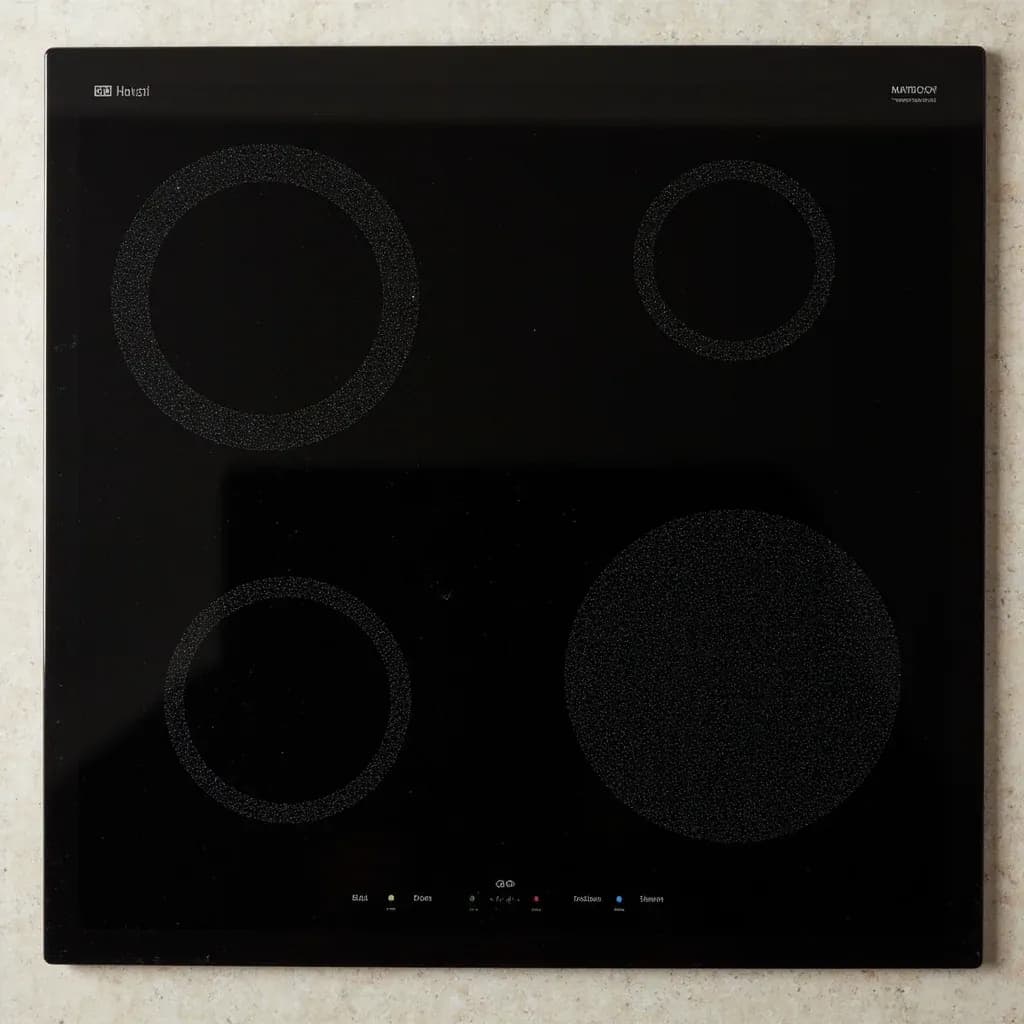
A smooth glass-ceramic surface with electric radiant elements that heat cookware from below.
A glass-ceramic cooktop is a flat, sealed panel of heat-resistant ceramic glass with radiant or halogen elements glowing beneath marked cooking zones. The seamless surface is easy to wipe clean and heats cookware by conduction, though it cools and responds more slowly than gas or induction. Known in German as a cerankochfeld, some models add steam or zone-flexible heating.
A glass-ceramic cooktop is a smooth, flat cooking surface made from a specially formulated low-expansion ceramic — most commonly Schott's Ceran, with EuroKera and Nippon Electric Glass as competitors — beneath which sit electric radiant heating elements. The ceramic's near-zero thermal expansion is what lets it survive direct contact with a glowing 1,500 °F element without cracking, and what allows the cooktop to deliver a sealed, wipe-clean surface that traditional coiled electric ranges cannot. In a domestic kitchen, it is the 240 V radiant workhorse that sits visually between a vintage coil range and a modern induction top.
In practice, the glass-ceramic top behaves more like a traditional electric range than a sleek induction surface. Heat travels by radiation from the element through the transparent glass and into the pan, then conducts back down into the glass itself, which is why the cooking surface can reach roughly 700 °F over an active burner and why a hot-surface indicator stays lit well after the knob is off. Response time is the cook's main complaint: the glass and element together hold a lot of thermal mass, so a boil-down takes longer to stop and a sear takes longer to recover than on gas or induction. That same thermal mass, however, makes radiant glass-ceramic excellent for steady simmering, holding food warm, and finishing a sauce on residual heat.
The cooktop's practical sweet spot is its cookware flexibility. Unlike induction, which demands ferromagnetic pans, a glass-ceramic top heats any flat-bottomed pan — clad stainless, cast iron, aluminum, copper — as long as the base sits flush against the glass. It costs less to buy and install than induction, looks cleaner than a coil range, and rewards a cook who matches pan to element, lifts rather than slides pots, and cleans sugar spills before they fuse to the surface. Treat the glass like a hot stovetop, not a kitchen counter, and it will perform for a decade or more.
Alternatives
Types & varieties
Metal resistance ribbon beneath the glass; slowest to respond and most common in entry-level models.
Halogen lamp that glows orange and cycles on/off for visibly faster response; often paired with a coil.
Halogen lamp in the center surrounded by a coil; combines instant heat with steady simmering.
One fixed wattage zone, usually 6 in. or 8 in. diameter.
Switches between a small inner ring and the full outer ring to match pan size.
Expands to roughly 12 in. for griddles, paella pans, and large stockpots.
Links two adjacent elements into one oblong zone for griddles or oblong roasters.
Same technology; the panel is either dropped into a counter cutout or integrated into a range deck.
How it heats
Electric current passes through a resistance element beneath the glass — either a coiled metal ribbon, a halogen lamp, or a hybrid of both. The element glows red-hot, typically 1,000–1,500 °F internally, and radiant energy passes through the transparent glass-ceramic to heat the pan sitting on top. The glass itself gets hot mainly by conduction back from the pan and by radiation from the element, which is why an active burner area can reach 700 °F. Because the element is well insulated from the glass, the surface never gets hotter than the element above it, and it is residual heat, not the element, that continues to cook food after you turn the knob off. Halogen elements cycle visibly for faster response; coil elements hum along underneath for steady, even simmering.
Cookware compatibility
Any flat-bottomed pan will work, but materials differ in how well they conduct heat into the food. Clad stainless steel and cast iron are the most popular choices for even heating and durability; aluminum heats quickly but can leave gray metallic streaks on the glass that are tedious to remove. Copper is thermally excellent but its residue can fuse permanently to the surface if overheated. Glass, ceramic, and stoneware are out — they scratch and can shatter from thermal stress. Warped or pebbled bases should be retired: they create hot spots and scratch the glass.
- Best: clad stainless steel, cast iron, enameled cast iron, smooth-based carbon steel
- Acceptable: hard-anodized aluminum, tri-ply
- Avoid: bare copper, raw aluminum, glass, ceramic, stoneware, and any warped or rough-based pan
Cleaning and care
Daily wipe-down with a damp cloth handles most messes. For burned-on residue, apply a ceramic cooktop cleaner such as Cerapol, Weiman, Bar Keepers Friend Cooktop Cleanser, or Bon Ami with a non-abrasive scrubbing pad — never Comet, Ajax, or steel wool, which will haze the glass. A razor scraper held flat is the right tool for stuck food and can be used while the surface is still slightly warm (not hot). Polish dry with a microfiber cloth to avoid streaks. Avoid spray-on glass cleaners, which can leave a film that burns on and permanently discolors the surface.
- Use only cooktop-specific cleaners or a paste of baking soda and water
- Wipe pan bottoms before every use
- Address sugar, syrup, or jam spills while still warm, before they harden and pit the glass
- Replace any pan whose base has gone rough or pebbled
Common uses
Tips & pitfalls
- Match pan size to element diameter — a 10 in. skillet on a 6 in. element heats slowly and wastes energy, while a 6 in. saucepan on a 10 in. element scorches the handle and wastes heat.
- Use only flat-bottomed pans; warped or concave bases create poor contact and uneven heating.
- Lift, never slide, heavy pots and pans across the glass — grit caught under the base acts like sandpaper.
- Wipe the bottom of every pan before placing it on the cooktop, especially cast iron and skillets stored stacked.
- Clean sugar, syrup, or jam spills while they are still warm, not hot — once sugar cools and burns onto the glass it can permanently pit the surface.
- Clean only after the surface has cooled enough to touch; thermal shock from cold water on a hot element can crack the panel.
- Never use glass, stoneware, or ceramic cookware — it can scratch the glass or fuse to it.
- Finish dishes on residual heat after turning the element off; the glass holds a lot of thermal energy and will keep cooking food for several minutes.
- If a crack appears in the glass, stop using the cooktop immediately and have the panel replaced — moisture can enter the element cavity and cause a short circuit.
Good to know
- Material
- Glass-ceramic, typically a lithium aluminosilicate such as Schott Ceran, with near-zero thermal expansion
- Heat source
- Electric radiant elements — metal resistance coils, halogen lamps, or a combination — mounted beneath the glass-ceramic panel
- Surface temperature
- Up to ~700 °F (370 °C) over an active element
- Response time
- Slower to heat and cool than gas or induction because of the thermal mass of the element and glass
- Element wattage
- Typically 1,200–3,000 W per element; dual/triple rings step down to ~700 W on the inner zone
- Voltage
- 240 V in North American residential installations (some portables run on 120 V)
- Hot-surface indicator
- Residual-heat light stays on while the surface exceeds roughly 150 °F (65 °C)
- Cookware
- Accepts any flat-bottomed pan — ferrous or non-ferrous — unlike induction, which requires magnetic cookware
Also called
Ceramic Glass Cooktop · Cerankochfeld · Ceramic Cooktop · Steam Cooktop
Related

Stovetop
The everyday burners where most cooking actually happens

Oven
Enclosed dry heat for roasting, baking, and braising

Grill
Live-fire or gas grates for char, smoke, and high heat

Smoker
Low, slow heat and wood smoke for barbecue and brisket

Air Fryer
Countertop convection that crisps with little or no oil

Slow Cooker
Set-and-forget low heat for stews, beans, and braises

Pressure Cooker
Sealed steam pressure that cooks tough food in a fraction of the time

Rice Cooker
Foolproof, perfectly steamed rice every single time