Appliances & Heat
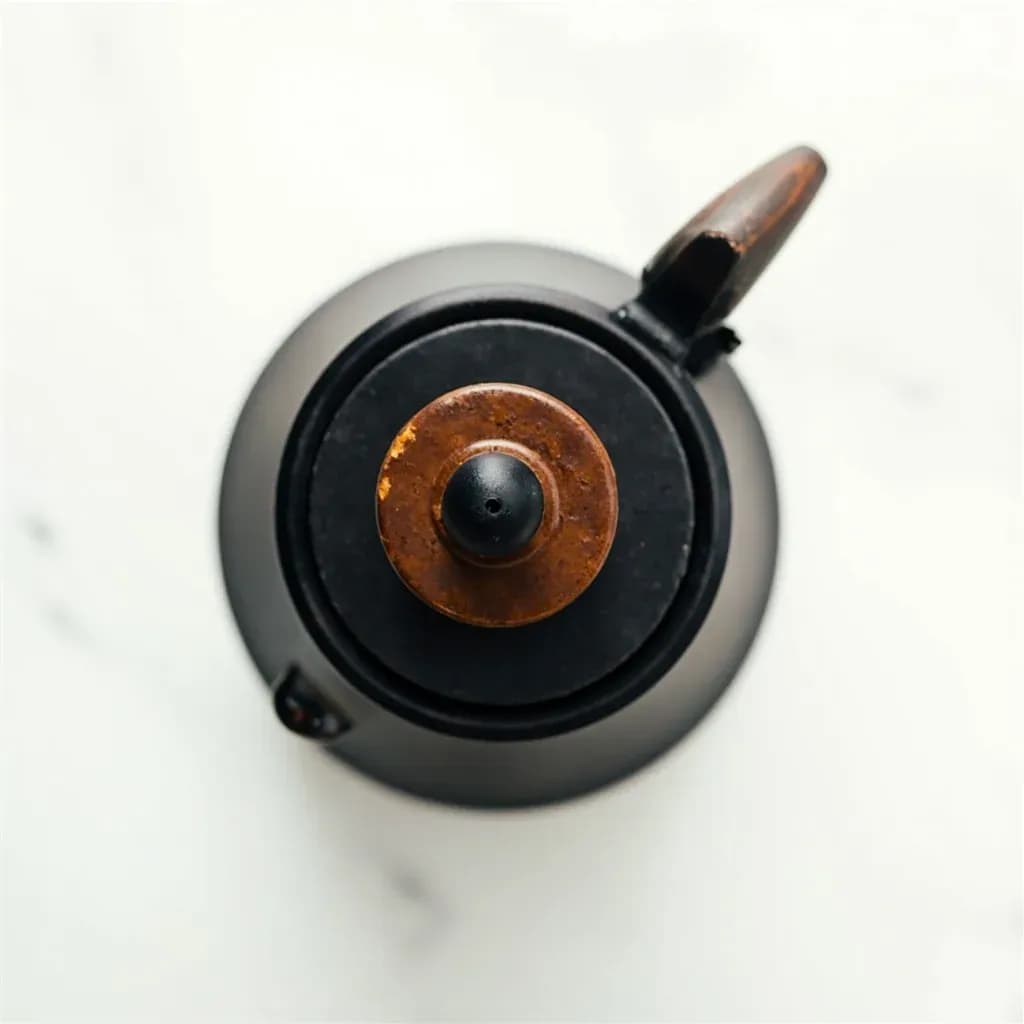
Gooseneck Kettle
A kettle with a long curved spout that delivers a slow, precise stream for pour-over coffee and tea.
A gooseneck kettle has a tall, narrow curved spout that gives precise control over the flow and placement of hot water. It is the standard tool for pour-over coffee, letting the brewer saturate grounds evenly in slow, deliberate circles. Many are electric with variable temperature settings for matching different coffees and teas.
A gooseneck kettle is defined by its spout, not its capacity. The long, narrow, curved neck — a thin tube bent upward at roughly 60–70 degrees — decouples pour rate from pour height, which is the whole point of the design. Tilting the body controls flow through a small exit orifice (typically 5–9 mm across), so the user can deliver water in a thin, predictable stream rather than a sloshing dump. This matters most in pour-over coffee, where bloom timing, saturation, and agitation shape extraction, and in precise loose-leaf tea work, where exact temperature and pour control protect delicate leaves.
Goosenecks come in two broad families. Stovetop versions are simple vessels heated on a burner, relying on an external thermometer or a variable-temperature base for precision. Electric versions integrate a heating element with PID-style temperature control, a display, and often a hold mode, so the brewer can dial in 92 °C for a light-roast pour-over or 80 °C for a sencha without guesswork. Material — usually stainless steel, sometimes copper — affects heat retention and induction compatibility more than it affects the pour itself.
A gooseneck is not a faster way to boil water, and it adds little to immersion methods like French press where water is dumped in all at once. Its value is control, and that control is what makes modern pour-over recipes reproducible cup after cup.
Alternatives
Types & varieties
Heated on gas, electric, or induction; lighter, cheaper, and free of electronics; relies on a separate thermometer or a variable-temperature base for precise control.
Built-in heating element with PID-style control, LCD target dial, and often a hold mode; examples include the Fellow Stagg EKG, Brewista Artisan, and Bonavita.
Premium material prized for fast, even heating and high heat retention; usually induction-incompatible unless clad with a magnetic base.
Durable, dishwasher-safe workhorse; induction-compatible when fitted with a clad magnetic base.
Compact size matched to single-cup or 1–2 cup recipes; lower mass means the water temperature drops faster during extended pours.
Smaller capacity, sometimes with an infuser basket; sized and angled for gongfu or precise single-cup steeping rather than large-batch coffee.
Choosing a spout tip
The exit diameter of the spout is the single most important variable for pour feel. A narrower tip, around 5–6 mm, gives a fine, pencil-thin stream ideal for slow concentric pours on a Hario V60 or Kalita Wave, where the goal is even saturation without disturbing the bed. A wider tip, 8–9 mm or more, pours faster and is better suited to larger Chemex or batch brews where total brew time would otherwise drag. The spout's upward curve should also be evaluated: spouts that bend up sharply encourage a more vertical pour useful for narrow drippers, while shallower curves favor the angled, side-to-side pour used on wide flat-bottom drippers.
- Narrow tip (~5–6 mm): fine stream, slow spirals, V60/Kalita Wave
- Wide tip (~8–9 mm): faster flow, better for Chemex and 4+ cup batches
- Steeper upward bend: more vertical pour for narrow drippers
- Shallower curve: angled pour for flat-bottom drippers
Pour mechanics
The gooseneck only earns its keep when the wrist is trained. Aim for a pour rate of about 4–8 grams per second and keep the spout within a few centimeters of the grounds — high pours add turbulence, drive fines into the bed, and can cause channeling. For a standard V60 brew, start in the center and spiral outward to the edge, then back to center, maintaining a steady stream rather than a pulse. The bloom (the first 30–60 g of water) should be poured gently and the brewer should wait 30–45 seconds for the bed to degas before resuming the main pour.
Care and descaling
The narrow spout clogs easily if mineral scale is allowed to build up, and scale also reduces the efficiency of electric heating elements. A monthly descale with citric acid (about 1–2 tablespoons per liter of water, brought to a brief boil and rested for 20–30 minutes) or a single boil with a splash of white vinegar keeps the orifice clear. Rinse thoroughly afterward — citric acid is preferable to vinegar in electric kettles because it leaves less residual flavor and is gentler on seals and heating elements.
Common uses
Tips & pitfalls
- Preheat the kettle with hot water before brewing; pouring from a cold vessel can drop the brew temperature by 5–10 °F and stall extraction in the first minute.
- Keep the spout close to the bed of grounds — within a few centimeters. High pours add turbulence, can channel the bed, and cool the water further as it falls through air.
- Practice a steady wrist rather than a fixed hold: pour rate (around 4–8 g/s) matters more than spout height for repeatable extraction.
- Match kettle capacity to batch size. A half-empty gooseneck raises the pour start point, changes the angle at which water leaves the spout, and makes fine control harder.
- If brewing on induction, choose stainless or copper kettles with a clad magnetic base; pure copper will not register on an induction cooktop.
- Descale monthly with citric acid to keep the narrow spout from clogging; vinegar is fine for stovetop models but can leave residue in electric heating elements.
- For electric models, let the element cool briefly after boiling before pouring to protect seals and electronics from repeated thermal shock.
- Don't confuse a short dribble-pitcher spout — a beak-like pour on a standard kettle — with a true gooseneck. Only the long curved spout gives the slow, predictable stream that pour-over recipes assume.
Good to know
- Defining feature
- Long, narrow, curved (gooseneck) spout that decouples pour rate from pour height for a thin, predictable stream
- Typical capacity
- 0.8–1.2 L (27–40 oz) for general use; 0.4–0.6 L for single-cup pour-over
- Common materials
- Stainless steel (workhorse), copper (premium heat retention), enameled steel; induction-compatible versions use a clad magnetic base
- Power source
- Stovetop on gas, electric, or induction, or electric with built-in heating element and PID temperature control
- Spout geometry
- Curved spout angled upward at roughly 60–70° from horizontal; spout exit diameter typically 5–9 mm
- Brew temperature targets
- 195–205 °F (90–96 °C) for coffee; 70–85 °C for green and white tea; 85–95 °C for oolong; 95–100 °C for black tea
- Notable makers
- Hario (Buono), Fellow (Stagg EKG/Studio), Kalita, Brewista Artisan, Bonavita, Ratio
- Price range
- Stainless stovetop from about $30; copper or feature-rich electric models $100–$200+
Also called
Pour-Over Kettle · Drip Kettle
Related

Stovetop
The everyday burners where most cooking actually happens

Oven
Enclosed dry heat for roasting, baking, and braising

Grill
Live-fire or gas grates for char, smoke, and high heat

Smoker
Low, slow heat and wood smoke for barbecue and brisket

Air Fryer
Countertop convection that crisps with little or no oil

Slow Cooker
Set-and-forget low heat for stews, beans, and braises

Pressure Cooker
Sealed steam pressure that cooks tough food in a fraction of the time

Rice Cooker
Foolproof, perfectly steamed rice every single time