Appliances & Heat
Batch Grain Dryer
Powered drying unit that lowers the moisture of harvested grain so it stores without spoiling.
A batch grain dryer is a machine that circulates heated air through a holding bin of harvested grain to bring its moisture down to a safe storage level. It is used after harvest to prevent mold and spoilage before grain is milled or stored. Batch models dry one load at a time, which suits smaller farms and craft producers compared with continuous-flow industrial dryers.
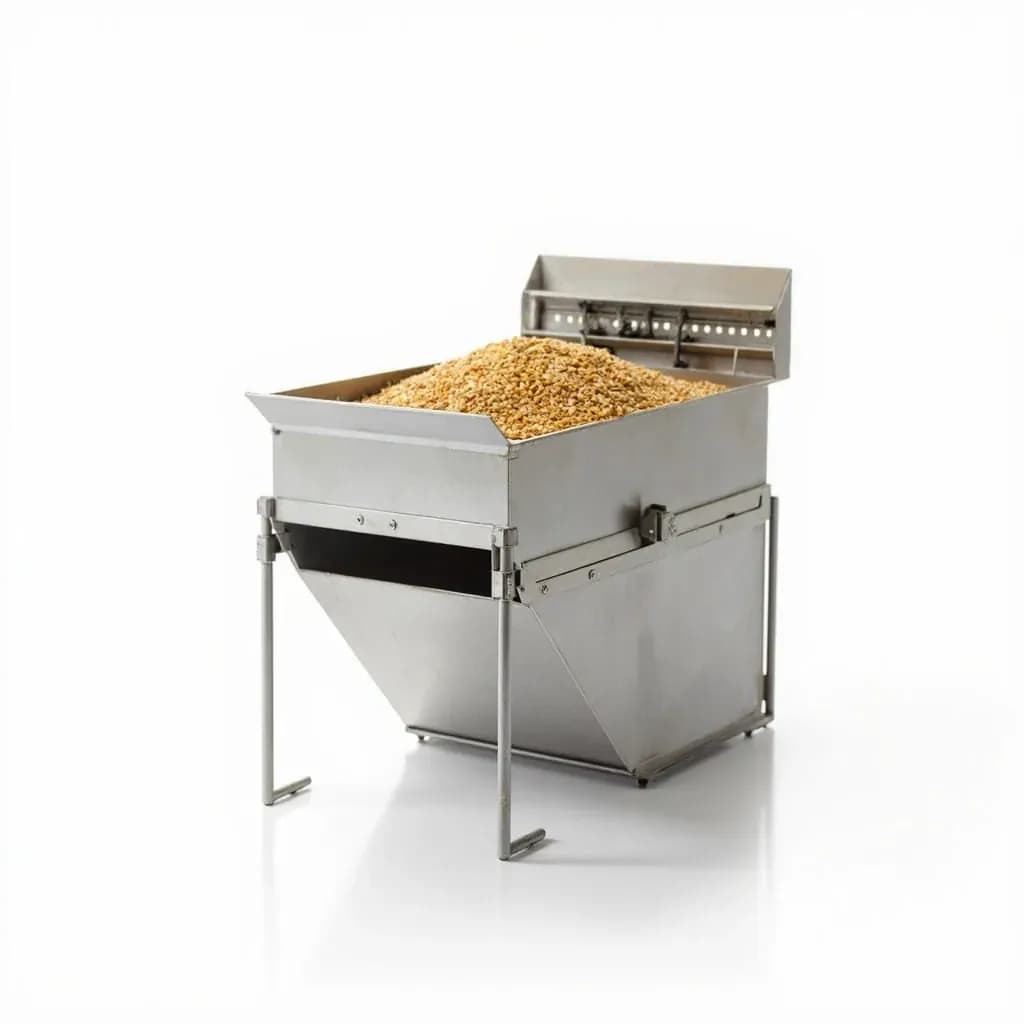
A batch grain dryer is a powered unit that takes a fixed quantity of freshly combined grain and forces heated air through it until moisture drops to a level safe for long storage. Every kernel sits in the bin for the full cycle, so the operator controls exactly when the batch is done. The unit is essentially a perforated bin or tall column paired with a centrifugal fan and a propane or natural gas burner; the fan pushes warm air through the grain bed and carries water vapor out the top. From the cook's perspective, the dryer is the reason a wheat berry, a malted barley kernel, or a dried corn kernel arrives at the mill or brewery with stable moisture, intact starch, and, in the case of seed or malt grain, living enzymes.
Why the dryer matters in a cooking context comes down to two numbers: the final moisture and the temperature used to reach it. Millers, maltsters, and bakers all quote moisture figures — wheat at 13–14%, malting barley at 12–13.5%, corn at 13–15% — because moisture sets storage life, milling yield, dough water absorption, and how cleanly malt modifies. A high-temperature batch dryer (140–220°F) drops moisture fast but damages protein, kills germination, and stress-cracks kernels, which then shatter in the mill and absorb water unevenly. A low-temperature batch dryer (80–110°F) runs longer with higher airflow and preserves the qualities a baker or brewer actually cares about: enzyme activity, malt extract, vitreousness in durum, and clean, non-burnt flavor. Sourcing grain that was low-temperature dried is one of the quieter ways a serious baker or maltster protects quality before the dough ever comes together.
Alternatives
Types & varieties
Grain sits on a perforated floor in a round bin with a central duct or stirator. Simple, low cost, slow; common on small farms and for seed lots where gentle drying matters most.
In-bin design with a vertical auger that continuously stirs the bed as it dries, evening moisture across the column and giving higher throughput than a flat-floor bin.
Grain held between perforated metal sheets in a tall column; hot air flows across the bed for high airflow per bushel and fast drying. The classic mid-size farm form.
Self-contained unit on a wagon gear with its own fan and burner, towable between bins or into the field. Favored by smaller operations and custom harvesters.
Plenum 140–220°F, used for feed corn and industrial grain. Fast and high capacity but stress-cracks kernels and kills germination, so unsuitable for seed, malt, or milling wheat.
Plenum 80–110°F with high airflow, often run around the clock. Used for seed corn, malting barley, food-grade soybeans, and identity-preserved grain where viability, protein, and flavor must be protected.
Sweep augers or a series of columns move grain through the hot-air zone and recycle it until target moisture is reached, evening out overdrying at the edges and giving a more uniform final moisture across the batch.
Moisture targets at a glance
These are the moisture ranges a mill, maltster, or grain buyer expects to see on a certificate. Anything well above the top of the range risks mold and hot spots in storage; anything well below loses weight (and money) and damages milling or malt quality.
- Corn: 13–15% for feed, ethanol, or storage; tighten toward 13% for long-term bin storage without aeration.
- Wheat (milling): 13–14%; durum often run slightly tighter for the best semolina yield.
- Malting barley: 12–13.5%; tighter than feed barley to keep modification clean and dormancy stable.
- Oats: 12–13%; lower moisture limits groat shattering in the dehuller.
- Rice: 12–14%; often dried very gently near 100°F to prevent kernel cracking and chalky breakage.
- Soybeans (food grade): 12–13%; higher moisture invites mold and split beans.
- Sorghum, rye, millet, spelt: 12–13%; treat like wheat for milling or seed.
Low-temp vs high-temp: what the cook actually tastes
Plenum temperature sets a ceiling on how much damage the kernel can take. Most grain damage in a batch dryer is invisible until you mill, malt, or bake with it.
- Germination: above roughly 110°F, the embryo begins to die. Seed grain and malt barley must stay low-temp or the lot will fail a germ test.
- Protein: heat above about 130°F begins to denature gluten proteins, weakening dough strength and reducing water absorption in bread flour.
- Stress cracks: fast, hot drying puts micro-fractures in the endosperm. Cracked corn shatters in the grinder, cracked rice breaks in the huller, cracked wheat loses flour yield.
- Flavor: overheated grain picks up a burnt, 'cooked' note that carries through flour and malt; low-temp drying preserves the clean, slightly sweet character a baker or brewer wants.
Common uses
Tips & pitfalls
- Use a calibrated moisture meter, not the dryer's control panel reading, before stopping the batch. Panel sensors drift and the bottom 2–3 feet of grain are routinely wetter than the top.
- Never run seed or malting barley above about 110°F: heat kills germination and denatures the enzymes maltsters rely on. Treat it as a low-temperature batch even if your column is rated for higher.
- After the burner shuts off, run the fan alone for 30–60 minutes to steep and equalize moisture through the kernel and cool the bed. Skipping this cool-down is the single most common cause of spoilage pockets in the bin.
- Do not under-size the fan to save on cost. Low CFM per bushel gives you overdried grain on the bottom, wet grain on top, and ideal conditions for Aspergillus and hot spots.
- Clean the plenum, screens, and bin floor between batches. Fine dust, broken kernels, and chaff are the ignition source for most dryer fires.
- For very wet grain (24%+ moisture in corn), dry in two passes with a temper/steep between them. Removing more than about 20 percentage points of moisture in a single pass badly stress-cracks kernels.
- Plumb a thermostatic cutoff and keep a fire-suppression nozzle or extinguisher at the burner. Batch dryer fires usually start at the burner transition and inside the first foot of grain.
- Match the dryer to your combine capacity. An undersized batch dryer becomes a bottleneck at peak harvest and pushes operators toward unsafe temperatures just to keep the combine moving.
Good to know
- Tool type
- Powered on-farm or commercial dryer that processes a fixed (batch) quantity of grain at a time using heated forced air to lower moisture for safe storage.
- Target moisture by grain
- Corn 13–15%, wheat 13–14%, soybeans 12–13%, malting barley 12–13.5%, oats 12–13%, rice 12–14%, sorghum 12–13%.
- Typical batch size
- Small farm units 100–500 bushels; mid-size 500–1,500 bushels; commercial installations can exceed 2,000 bushels per batch.
- Plenum temperature
- Low-temp bins 80–110°F for seed and malting grain; high-temp columns 140–220°F for feed corn and industrial use; rice usually capped near 100–110°F to limit cracking.
- Airflow (CFM per bushel)
- Low-temp bins 1–2 CFM/bu; high-temp columns 50–150+ CFM/bu; undersized airflow is the most common cause of overdrying and spoilage pockets.
- Heat source
- Almost always propane or natural gas burners; some diesel, biomass, or electric-resistance units exist for off-grid or specialty operations.
- Fire risk
- Real and non-trivial: fine dust, low-airflow corners, and overdried grain can ignite; dust removal and regular bin cleaning are standard safety practice.
Also called
Batch Dryer
Related

Stovetop
The everyday burners where most cooking actually happens

Oven
Enclosed dry heat for roasting, baking, and braising

Grill
Live-fire or gas grates for char, smoke, and high heat

Smoker
Low, slow heat and wood smoke for barbecue and brisket

Air Fryer
Countertop convection that crisps with little or no oil

Slow Cooker
Set-and-forget low heat for stews, beans, and braises

Pressure Cooker
Sealed steam pressure that cooks tough food in a fraction of the time

Rice Cooker
Foolproof, perfectly steamed rice every single time