Appliances & Heat
Stone Grain Mill
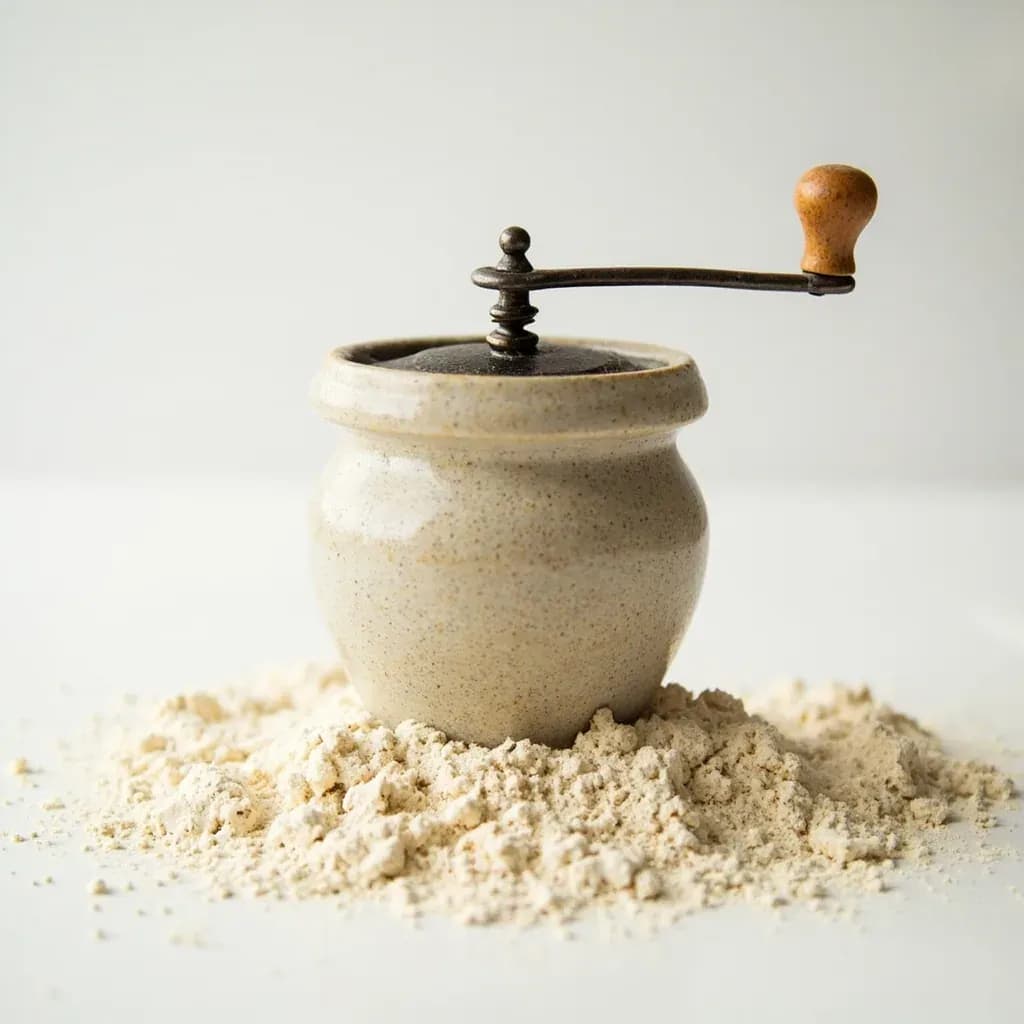
A mill that grinds whole grains, nuts, or cacao into flour, meal, or paste between stones or burrs.
A grain mill crushes grains, legumes, nuts, or cacao nibs into flour, meal, or smooth paste using rotating stones, burrs, or impact hammers. Bakers grind fresh whole-grain flour for fuller flavor and nutrition, while chocolate makers run a stone melanger for hours to refine cacao into smooth chocolate. Stone burrs grind slowly and keep temperatures low, preserving aroma and oils, while electric impact mills are faster but heat the flour more.
A stone grain mill grinds by shearing whole grain between two abrasive surfaces — usually a fixed lower stone and a rotating upper stone, fed through a central hole and expelled at the perimeter as flour or meal. Unlike impact mills, which pulverize grain by hammering it, stone mills cut and abrade the kernel gradually, which keeps the working temperature low and avoids the angular, heat-stressed particles that high-speed mills tend to produce.
That cool, gentle grinding is the mill's main virtue. Whole grain carries its germ oils, enzymes, and aroma compounds right up to the moment of milling; heat and friction degrade them. A home stone mill running below roughly 40–45 °C preserves much of that character, so the flour you bake with an hour after milling tastes noticeably different from flour that was milled weeks earlier. It is also why "stone-ground" remains a recognized traditional designation on commercial flour, with rules of identity in some countries.
In practice, a countertop stone mill handles a kilogram or two of grain per session, producing everything from coarse cracked wheat to fine pastry flour depending on how the gap is set. It will not handle oily seeds like sesame or flax without clogging, and it is slower than an impact mill by an order of magnitude, but the trade-off is texture, aroma, and a flour that behaves more like what a neighborhood baker would have been working with a century ago.
Alternatives
Types & varieties
Natural granite stones, common in traditional European mills (e.g., Osttiroler, Diamant). Cool-running with a slightly textured flour prized for bread.
Hard, consistent, food-safe synthetic burrs used in most modern electric stone mills (e.g., KoMo, Mockmill); hold their grind profile well.
Slower, no electricity required, suitable for off-grid or small-batch use; classic Diamant and Osttiroler hand mills are in this class.
Some stone mills integrate a flaker or roller for rolled oats on the same base.
Horizontal stone wheels driven by water, wind, or motor; used by artisan bakeries (e.g., Meadows, Osttiroler commercial lines).
Dialing in the grind
Start on a coarse setting the first time you run a new grain, then step finer in half-turns while the mill is running. Most electric stone mills are adjusted with a spring-loaded knob at the top of the hopper — tighten to reduce the gap, loosen to open it — and adjusting while the motor is running lets the stones self-center for an accurate reading. Three useful ranges for a home baker sit along that arc:
- Coarse / cracked: gap roughly 1.5–2.0 mm — for cracked wheat, porridge grain, coarse cornmeal, and kibbled rye for sourdough.
- Medium / meal: roughly 0.8–1.2 mm — for quick breads, pizza, polenta, and rustic batter breads.
- Fine / pastry: under 0.5 mm — for sandwich loaves, brioche, cakes, and cookies; needs a tight, precise setting and may take two passes.
What a stone mill is not for
Stone mills are the wrong tool for oily seeds (sesame, flax, sunflower) and very oily nuts — they smear and clog the gap rather than shearing cleanly, and the residue can turn rancid on the stone faces. For those ingredients use an impact mill or a blade grinder. They are also slow: a hand-cranked mill grinds at a small fraction of an electric mill's pace, and even a 1,500-watt electric gives you roughly a cup of fine flour per minute, so a stone mill is a small-batch tool, not a commercial one.
Common uses
Tips & pitfalls
- Run a small amount of grain through before your first real batch and discard it — manufacturing residue can affect flavor.
- Never run the mill completely empty for extended periods; a starved mill accelerates stone wear.
- Adjust the grind setting while the mill is running, not stopped, for accurate results on most models.
- Keep grains very dry (below ~14% moisture) — damp grain clogs stones and can promote mold growth in the hopper.
- Switch to a clean-out pass (or a separate mill) if you move between gluten and gluten-free grains to avoid cross-contamination.
- Stone burrs are not ideal for oily seeds (sesame, flax) — they smear and clog; use an impact or blade mill for these.
- After milling, sift or cool the flour before sealing; freshly ground flour releases residual heat and moisture.
- Tighten the burrs slightly finer every few months as stones wear in; very fine pastry-grade flour needs a tight, precise setting.
Good to know
- Type
- Kitchen tool / appliance for grinding whole grains, legumes, nuts, and cacao
- Grinding mechanism
- Two abrasive surfaces (stones or burrs) shear grain between them, rather than impacting or crushing it
- Heat output
- Generally stays below ~40–45 °C / 105–115 °F, preserving germ oils and enzymes compared to high-speed impact mills
- Throughput
- Roughly 60–150 g/min (about 1 cup of flour per minute) on electric stone mills; hand-cranked mills are much slower
- Grind range
- Coarse cracked grain down to fine pastry flour, set by the gap between the stones
- Power options
- Manual (hand-cranked), electric (mains), and a few treadle/attachment-driven designs
- Cleaning
- Brush or vacuum between batches; some models allow a small amount of dry rice to be run through to purge
Also called
Stone Melanger · Melanger · Countertop Electric Flour Mill · Hand-Crank Grain Mill · Hand Grain Mill · Hand Grain/Nut Mill · Flour Mill · Impact (Hammer) Mill · Roller Mill
Related

Stovetop
The everyday burners where most cooking actually happens

Oven
Enclosed dry heat for roasting, baking, and braising

Grill
Live-fire or gas grates for char, smoke, and high heat

Smoker
Low, slow heat and wood smoke for barbecue and brisket

Air Fryer
Countertop convection that crisps with little or no oil

Slow Cooker
Set-and-forget low heat for stews, beans, and braises

Pressure Cooker
Sealed steam pressure that cooks tough food in a fraction of the time

Rice Cooker
Foolproof, perfectly steamed rice every single time