Appliances & Heat
Granita Machine (Mantecatore)
A chilled machine that scrapes and freezes flavored syrup into coarse, flaky granita.
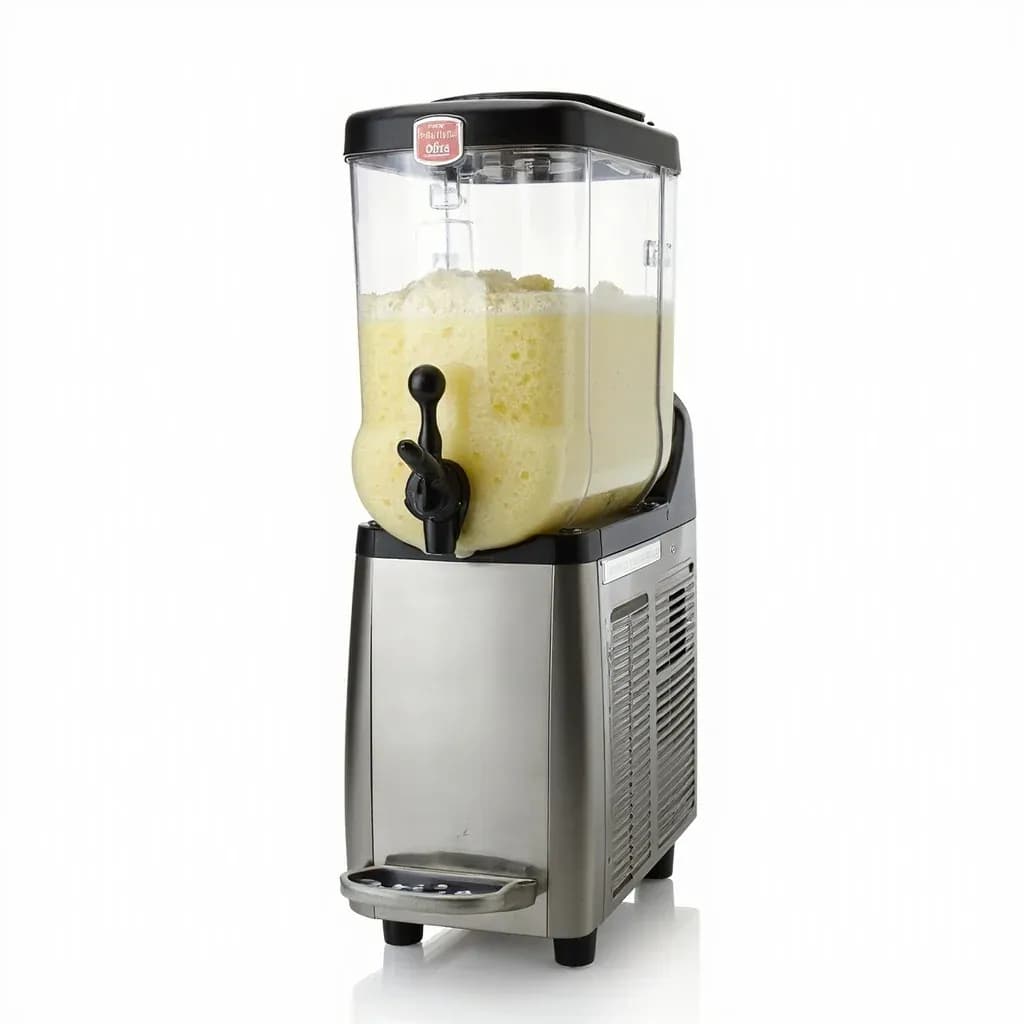
A granita machine, or mantecatore, freezes a sweetened fruit or coffee syrup against a cold cylinder while a scraper blade shaves it into the crystalline, slushy texture that defines granita. It is used in Italian cafes and gelaterias to produce a steady supply of granita through the day. The continuous scraping keeps the ice from setting into a solid block, leaving it spoonable.
A mantecatore — sometimes called a granitore — is the Sicilian machine that turns flavored syrup into proper granita. Inside it sits a refrigerated horizontal drum (traditionally copper, now often stainless steel) held at a deliberately mild cold, roughly -2 to -5 °C, warmer than a gelato batch freezer. As the syrup is fed in, a slow-turning paddle scrapes the thin film of ice that forms on the wall and folds it back through the liquid. The result is a soft, semi-frozen mass of flaky, snow-like crystals suspended in a creamy syrup — the texture Sicilians call granita and the rest of the world usually can't quite replicate with a spoon and a freezer tray.
The machine matters because texture in granita is everything. Too cold and the mix freezes into a solid block; too warm and it collapses into flavored water. A mantecatore holds that narrow window steady, and its continuous scraping is what produces crystals small enough to feel velvety on the tongue but coarse enough to eat with a fork or a piece of soft Sicilian brioche. A gelato machine, by contrast, runs much colder and whips more air in; the textures are cousins, not twins. Bras, founded in Catania, is the brand most often credited with the modern design and is still the machine behind the granita served in many historic Sicilian bars.
For the home cook, the same logic applies: a pre-chilled syrup, very cold metal, and frequent scraping. The freezer-and-fork method imitates the principle, but the ice crystals end up noticeably larger and icier than what a real mantecatore puts out.
Alternatives
Types & varieties
The Sicilian benchmark; horizontal copper bowl with a slow-rotating scraper, the machine most associated with classic Catania-style granita.
Italian-made commercial machines used in many bars and pasticcerie; same horizontal-bowl design as Bras, widely available in professional kitchens.
Primarily gelato machines, but some Sicilian makers run them at a warmer setpoint to imitate granita texture.
Small electric units (1–2 L) sold for home use; simpler plastic or steel bowls, less consistent crystal size, but produce a credible granita.
Common in cafés for fruit slushes; technically different — no scraper, just chilled and stirred — and produce a smoother, icier result than true granita.
Mantecatore vs. Gelato Batch Freezer
The two machines look superficially similar — a chilled bowl, a turning paddle, syrup in, frozen dessert out — but they are tuned to opposite ends of the frozen-dessert spectrum. A gelato batch freezer runs the bowl at roughly -8 to -10 °C and beats the mix harder, which incorporates air and produces a dense, smooth, plastic texture. A mantecatore is intentionally warmer and gentler: the paddle scrapes a thin, brittle ice film off the wall and barely folds the mass, leaving the crystals loose and the syrup visibly wet. Running a granita recipe in a gelato machine gives you a cross between sorbetto and a slushie; running a gelato recipe in a mantecatore gives you sweet soup. The machine, in other words, is part of the recipe.
- Bowl temperature: mantecatore -2 to -5 °C; gelato batch freezer -8 to -10 °C.
- Agitation: mantecatore scrapes lightly; gelato machine whips and incorporates air.
- Texture target: flaky, wet crystals vs. dense, smooth, scoopable paste.
- Batch time: granita is usually ready in 15–30 minutes; gelato closer to 25–45 minutes from a similar base.
Why Sugar Ratio Matters So Much
Sugar in a granita machine is not just sweetness — it is the lever that controls freezing point. A syrup with too little sugar has a higher freezing point, so it solidifies on the bowl walls as clear, hard ice that the paddle cannot break into fine crystals. A syrup with too much sugar has its freezing point pushed so low that the mix never quite reaches it at the machine's operating temperature, leaving the bowl full of flavored liquid. The traditional Sicilian range of 20–28% sugar by weight is the window where the scraper can do its work and the finished granita holds its shape in a chilled glass for the length of a breakfast service.
- Too little sugar (under ~18%): mix freezes to a hard block, large clear ice plates form on the wall.
- Too much sugar (over ~30%): mix stays slushy, never sets, and loses its snowy body.
- Acid (lemon juice, coffee) lowers freezing point further; compensate with the upper end of the sugar range.
- Fat-rich granitas (almond, pistachio) need slightly less sugar because nut solids and fat also soften the freeze.
Home Workarounds
Without a mantecatore, the closest texture comes from a pre-chilled wide, shallow metal tray set in the freezer, with the syrup scraped with a fork every 20–30 minutes. The crystals will be larger and more irregular than a machine's, and the mix will not hold its texture as long at room temperature, but the principle — keep it just below freezing and keep scraping — is the same. Freezing in a standard ice cube tray and then crushing in a food processor gives shards, not crystals, and should be avoided.
- Pre-chill the syrup thoroughly in the fridge before any freezing step.
- Scrape, don't stir — a fork dragged across the bottom lifts the ice film the way a paddle does.
- Work in a shallow layer; deep trays freeze unevenly and develop an icy core.
- Serve straight from the freezer; granita texturally only has a few minutes at room temperature before it starts to weep.
Common uses
Tips & pitfalls
- Always pre-chill the syrup to 2–4 °C before pouring it in; warm liquid drops the bowl temperature and lengthens the cycle, producing a coarser, icier texture.
- Keep the machine running continuously once you start loading syrup — stop-and-start cycles let thick ice plates form on the wall and ruin the crystal size.
- Dose sugar carefully against the machine's setpoint: too little and the mix freezes into a hard block, too much and it stays slushy and never sets.
- Add syrup in a steady thin stream once the scraper is already turning, not in one big pour, so the crystals form gradually instead of in one frozen lump.
- If you see clear, glassy ice plates on the bowl wall partway through a batch, the mix was either too cold or too low in sugar; scrape them loose by hand and adjust the next batch.
- Clean the bowl and scraper between flavors, especially when switching from dairy or coffee to lemon or almond — fat and aroma carryover will muddy a delicate citrus or floral granita.
- Do not confuse a mantecatore with a gelato batch freezer: the gelato machine runs colder, whips more air, and produces a denser, smoother product; the granita machine is deliberately warmer and drier.
- Leave the lid off during a batch if your unit allows it and taste at 15 minutes — the difference between perfect, scoopable crystals and an over-frozen block can be a minute or two.
Good to know
- Italian name
- Mantecatore (also called granitore)
- Origin
- Sicily, Italy; mechanized versions emerged in the 20th century to industrialize the traditional hand-scraped granita, originally made using snow from Mount Etna
- Operating temperature
- Holds the mix at roughly -2 °C to -5 °C (28–23 °F), deliberately warmer than a gelato batch freezer
- Mechanism
- Refrigerated horizontal cylindrical bowl with a slow-rotating scraper/agitator that continuously shaves ice off the wall and folds it through the syrup
- Bowl material
- Traditionally copper for fast, even heat transfer; modern commercial and home units often use stainless steel
- Typical batch time
- Roughly 15–30 minutes from chilled syrup to finished granita
- Output texture
- Soft, semi-frozen, flaky crystals suspended in a creamy syrup — wetter and coarser than Italian gelato or sorbetto from a batch freezer
- Key syrup ratio
- Traditional Sicilian granita syrup runs about 200–280 g sugar per liter of liquid (roughly 20–28% by weight) to keep the texture scoopable rather than rock-hard
- Typical capacities
- Countertop bar units run 2–5 L; floor-standing commercial units 6–15 L; small domestic machines 1–2 L
- Cleaning
- Bowl and scraper must be wiped between batches and fully disassembled and washed daily; syrup residue freezes onto the cold wall and becomes very hard to remove once set
Also called
mantecatore · granita maker · slush machine
Related

Stovetop
The everyday burners where most cooking actually happens

Oven
Enclosed dry heat for roasting, baking, and braising

Grill
Live-fire or gas grates for char, smoke, and high heat

Smoker
Low, slow heat and wood smoke for barbecue and brisket

Air Fryer
Countertop convection that crisps with little or no oil

Slow Cooker
Set-and-forget low heat for stews, beans, and braises

Pressure Cooker
Sealed steam pressure that cooks tough food in a fraction of the time

Rice Cooker
Foolproof, perfectly steamed rice every single time