Appliances & Heat
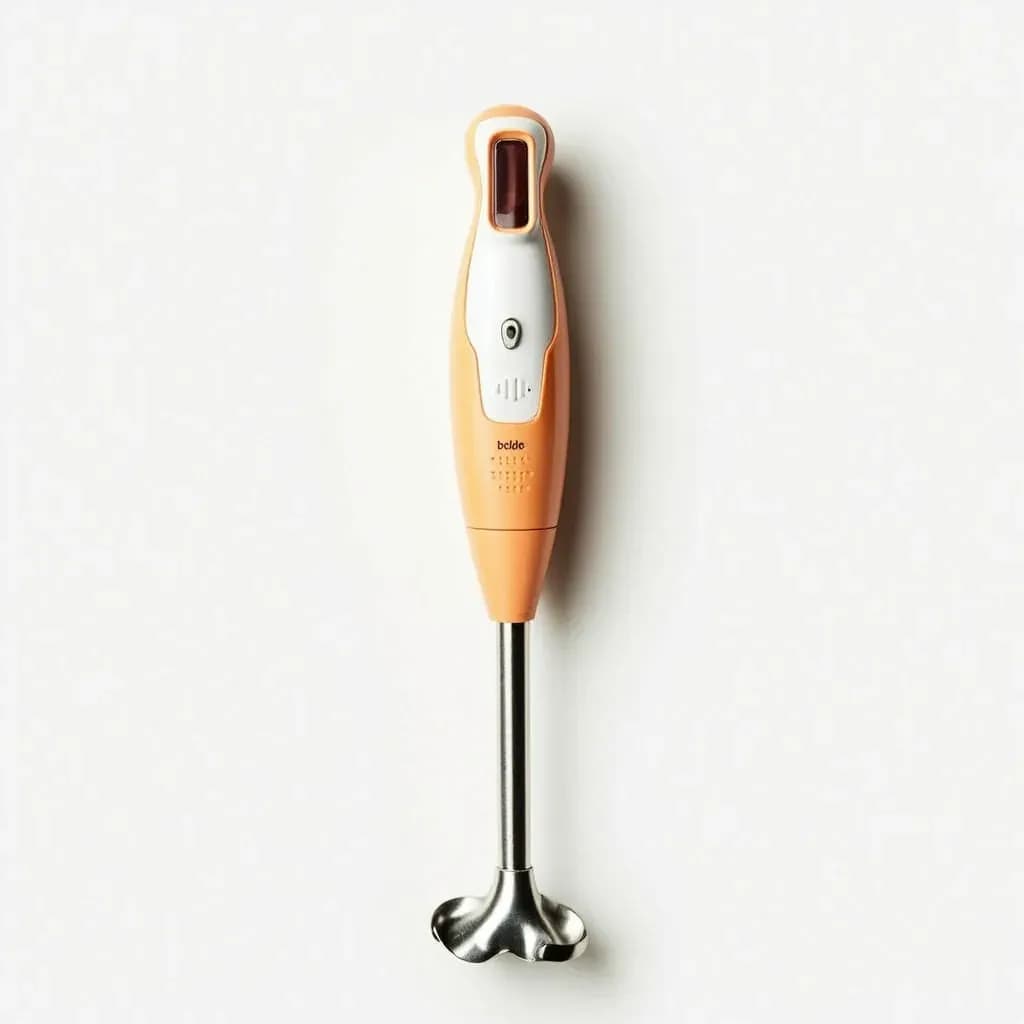
Immersion Blender
A handheld stick blender that purees soups and sauces directly in the pot.
An immersion blender is a handheld electric device with a blending wand and small blade at the tip, used to puree, emulsify, and blend foods right in the container they cook in. It is ideal for smoothing soups in the pot, making mayonnaise, or whipping up sauces and smoothies without transferring hot liquid to a jug blender. Many come with whisk and chopper attachments for added versatility.
An immersion blender is a hand-held motor unit driving a vertical shaft that ends in a small, rapidly spinning blade head. The shaft is lowered directly into the pot, jug, or bowl and the food is puréed in place. There is no jug to load, no lid to seal, and no hot liquid to ladle in batches; the whole tool is built to be picked up, guided, and put down again in seconds.
Its real advantage over a countertop blender or food processor is that puréed foods — most importantly soups and pan sauces — never have to leave the cooking vessel. You simmer, then drop the shaft in and finish the dish where it sits, which means less heat loss, no boiling liquid splashed into a plastic pitcher, and one fewer piece of equipment to wash. For emulsions like mayonnaise, aioli, or hollandaise, the same tool can build a stable sauce in a beaker in under a minute.
How it behaves in liquid is the thing to understand before buying or using one. The blade pulls food down toward it, creating strong suction and a vortex that circulates the contents. The classic bell-guard head (the original 1950 Bamix design) keeps liquid flowing up and around the blade with less cavitation, while the cheaper open-sickle blade tends to seal flat against the bottom of a pot and scratch non-stick coatings. For most home cooks, a 300–600 W corded model with a detachable stainless-steel shaft is the practical sweet spot; cordless units are convenient but still trail on sustained power.
Alternatives
Types & varieties
Single-purpose: just a blending shaft. The simplest and most common form.
Detachable shaft plus attachments — typically a whisk, a mini chopper bowl, and sometimes a masher or beaker.
Battery-powered for portability; lower torque and shorter run time than corded units.
Two or more speed settings, often with a momentary turbo button for a burst of power.
Domed bell around the blade (the original Bamix design) that prevents the blade from sealing flat against the bottom of a pot and limits suction.
Exposed curved blade typical of most consumer stick blenders; cheaper to make, more prone to suction, and more likely to scratch non-stick pans.
Longer shaft, more powerful motor, all-metal construction; the standard in restaurant kitchens.
Some include a plastic guard or a tall beaker to contain splashing during shallow blending.
In the pot: technique that actually works
The physics of an immersion blender are simple — the spinning blade pulls food downward and the resulting vortex circulates the rest. Most home-cook problems (splashing, suction, uneven texture) come from fighting that physics rather than working with it. A few small habits will reliably produce a smoother result with less mess.
- Insert the head into the liquid before switching on and let it settle for a second; trapped air otherwise erupts as bubbles and splatter.
- Tilt the shaft a few degrees off vertical and move it in slow, lazy circles — this breaks the suction seal and keeps the contents circulating.
- For hot liquids, never fill a jug or pot more than about two-thirds full; steam expands quickly and a full container will vent it violently.
- Move the head up and down through the depth of the pot rather than parking it at the bottom; food near the surface is what stays lumpy otherwise.
- Stop and scrape down the sides with a spatula once or twice during a long purée; the vortex does not always reach the perimeter of a wide pot.
Common uses
Tips & pitfalls
- Use a tall, narrow vessel (a measuring jug or the pot itself) rather than a wide bowl — it cuts splashing dramatically and keeps the blade submerged.
- Always keep the blade fully submerged before pressing the power button; lifting it out of the liquid while running is the single most common cause of splatter.
- For very hot soups, hold a folded kitchen towel over the top and start on the lowest speed to vent steam safely — never fill the vessel more than two-thirds full.
- To stop the blade sucking flat against the bottom of a pot, work the head in slow circles and lift it a centimetre or two off the base rather than holding it still.
- Never submerge the motor housing; on most models only the shaft and blade head are sealed, and the joint where shaft meets handle is the failure point.
- Avoid the bare blade in non-stick or enamel-lined pots — it will scratch the coating. Use a stainless saucepan or work in a separate jug.
- If the motor stalls, slows, or smells hot, stop immediately, unplug, and clear the blade; a jammed motor that keeps drawing current is the fastest way to burn out the windings.
- Choose a stainless-steel shaft rather than plastic if you regularly purée hot liquids; plastic shafts discolour, absorb odours, and can warp over time.
Good to know
- Inventor
- Roger Perrinjaquet, a Swiss engineer
- Year patented
- 1950
- Original commercial brand
- Bamix (still manufactured in Switzerland)
- Also known as
- Stick blender, wand blender, hand blender
- Typical power
- 200–1200 W corded; lower for rechargeable cordless models
- Shaft length
- Roughly 20–25 cm (8–10 in) on most home models
- Drive
- Electric motor in the handle turning a vertical shaft down to a multi-pronged blade head
Also called
Hand Blender · Stick Blender · Batedora de Braç
Related

Stovetop
The everyday burners where most cooking actually happens

Oven
Enclosed dry heat for roasting, baking, and braising

Grill
Live-fire or gas grates for char, smoke, and high heat

Smoker
Low, slow heat and wood smoke for barbecue and brisket

Air Fryer
Countertop convection that crisps with little or no oil

Slow Cooker
Set-and-forget low heat for stews, beans, and braises

Pressure Cooker
Sealed steam pressure that cooks tough food in a fraction of the time

Rice Cooker
Foolproof, perfectly steamed rice every single time