Appliances & Heat
Hand Grinding Mill (Chigayo)
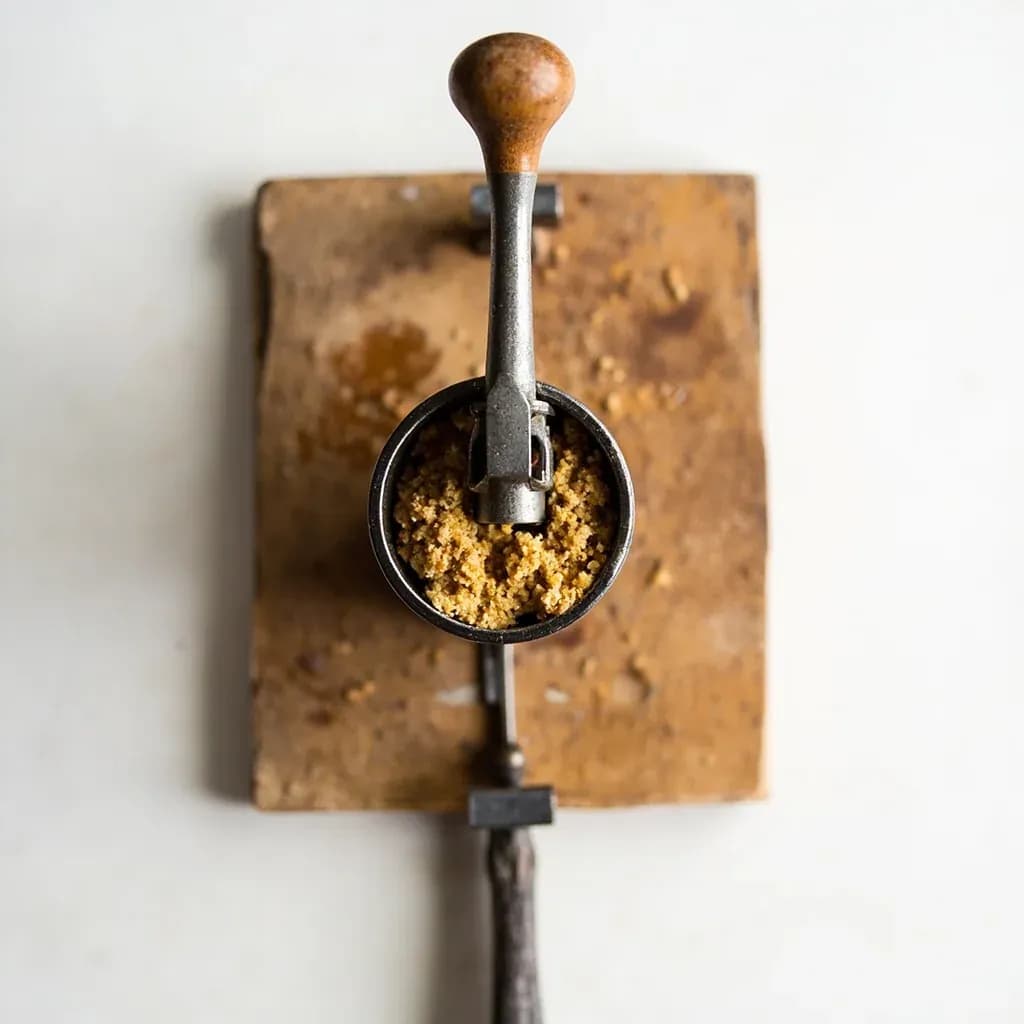
A powered or hand-cranked mill that grinds maize, grains and dried legumes into flour or meal.
A grinding mill, called chigayo in much of southern Africa, reduces dried maize, sorghum, millet or pulses to flour and meal. Hammer-mill versions are motor-driven while smaller domestic units are hand-cranked, and they are central to staples like nshima or ugali. Adjusting the plates or screen controls how coarse or fine the resulting flour is.
The chigayo is the everyday grinding workhorse of the southern African maize kitchen, descended from the pre-colonial saddle quern (guyo) and the mortar-and-pestle (muhuri). It is a plate mill: a cast-iron or pressed-steel housing containing two abrasive surfaces — a stationary lower plate and a rotating upper plate, the runner — between which dried grain is crushed into flour or meal. Hand-cranked and small-motorized versions sit side by side across Zimbabwe, Zambia, Malawi, Mozambique and the Democratic Republic of the Congo, and the act of "going to the chigayo" simply means taking a sack of maize to be milled.
What makes the chigayo distinctive is the gap it occupies between a hand grinding stone and an industrial roller mill. It is faster and finer than stone grinding, slower and rougher than a commercial hammer mill, and — crucially — independent of the electricity grid. The hand-cranked model is the classic off-grid household tool; the motorized ½–2 HP version is the small-business grinding mill that serves entire neighbourhoods. Output depends entirely on how the operator sets the burrs: a wide gap yields coarse samp for bean stews, a medium gap yields the meal for sadza and nshima, and a tight gap yields fine white flour for breads and batters.
In practice the chigayo is a functional tool rather than a decorative one, and most of what a cook needs to know comes down to three things: keeping the maize dry, adjusting the burrs in small steps, and cleaning the mill thoroughly between uses so that residual flour does not turn rancid or draw weevils in tropical heat.
Alternatives
Types & varieties
Side-mounted flywheel with handle, no motor; suited to off-grid households and small daily batches; quiet and inexpensive but physically demanding.
Small electric motor (½–2 HP) bolted directly to the mill body; the dominant urban and small-shop style — fast, consistent and the most widely produced version.
Larger mill fitted with a 3–5 HP single-cylinder petrol or diesel engine; the village grinding mill that serves a whole neighbourhood; higher throughput and able to crack nuts and dry cassava.
Interchangeable steel burrs sold in coarse, medium and fine grades; the same mill body can produce samp, mealie-meal or fine flour.
From samp to fine flour: reading the burr gap
The burr gap is the single control that defines what comes out of the mill. Operators learn to read three roughly defined grades and adjust in small turns of the locking nut, testing on a handful of grain before committing a full batch. Going straight from coarse to fine in one adjustment stalls a hand crank and overheats a motor; small, tested changes keep the mill cutting cleanly.
- Coarse — produces samp, a broken-hominy grit that cooks slowly and forms the basis of mielie-rice and bean-and-samp stews.
- Medium — produces mealie-meal, the soft, slightly granular flour used for sadza, nshima, nsima and ugali, the everyday stiff porridges of the region.
- Fine — produces a true flour suitable for mafins (fried buns), fritter batters and enriched breads; reached by passing medium meal through the mill a second time rather than by forcing the burrs together.
- For peanut work, swap the dry-grain burrs for the dedicated plate or attachment — oily seeds clog steel-toothed burrs.
Maize moisture is everything
Maize at the chigayo should be at 12–14% moisture or below. Kernels that dent easily under a fingernail, feel soft between the teeth, or smell faintly musty will smear between the plates instead of fracturing cleanly, producing a gummy paste that clogs the burr throat and overheats the motor. Sun-drying on a raised, ventilated platform for two to four days, depending on climate, is the standard preparation. Cobs and husk fragments must be removed by winnowing before milling — a single stone or cob chip can chip the burr face and contaminate every subsequent batch with metallic grit, and a wet cob will paste up the throat in seconds.
- Test dryness: a kernel should snap cleanly between the teeth rather than smearing.
- Winnow in a breeze or before an electric fan to lift husk and chaff away from the grain.
- If rain threatens, store the drying maize under cover; rewetted grain must be re-dried before milling.
- Never feed freshly picked or green maize through a dry-grain chigayo — it will bind the plates.
Hand-cranked or motorized?
The choice is driven less by taste than by throughput and access to power. Hand-cranked mills suit households milling 5–10 kg per session for daily sadza; they tolerate remote locations, intermittent use and the absence of fuel or electricity. Motorized mills suit small businesses serving a neighbourhood, where 30–80 kg/hour of throughput turns the chigayo into a paying service. The motor — and the cash flow it enables — is the dividing line between a tool for the family table and a tool for the village; the mill body itself is much the same in either case.
- Off-grid or daily home use of under 10 kg: hand-cranked is cheaper, quieter and never breaks for lack of fuel.
- Small business or community use above 20 kg per session: a 1 HP electric plate mill pays for itself in saved labour.
- Beyond 80 kg per hour, look at a hammer mill rather than upsizing the chigayo motor — plate mills lose efficiency at industrial speeds.
- Where electricity is unreliable, a petrol-engine mill is the practical compromise.
Cleaning and long-term care
A chigayo is a simple machine and rewards simple maintenance. Flour left in the hopper or burr throat turns rancid within hours in tropical heat and draws weevils that will infest the next batch and the storehouse around it. The end-of-session routine — empty the hopper, run the mill empty for a few seconds to blow out residue, brush the throat, wipe the burr faces and store the unit in a dry, rodent-free place — is the single biggest determinant of how long the burrs stay sharp and the flour stays clean.
- Grease motorized bearings on the schedule stamped on the housing, not when they start to squeal.
- Re-dress (re-cut) burrs when the mill starts producing coarser flour than the gap setting would suggest.
- Keep a spare set of burrs and the correct spanner with the mill — dull burrs strain both the operator and the motor.
- Run the mill outdoors or fit a dust hood; fine maize dust is a respiratory irritant and a fire risk near hot motors.
Common uses
Tips & pitfalls
- Dry maize thoroughly before milling — wet or soft kernels smear between the plates, clog the burrs and produce a gummy paste rather than a clean flour.
- Decob and dehusk by winnowing before milling; stones, cobs and husk fragments chip the burr face and contaminate the flour.
- Adjust the burr gap in small increments and test on a handful of grain — a gap set too tight stalls a hand crank and overheats a motor.
- Run the mill empty for a few seconds at the start of a session to blow out last use's residue and to clear insects that may have settled overnight.
- Feed the hopper at a steady, modest rate; pushing grain in faster than the burrs can take causes the plates to bind and the motor to stall.
- For finer flour, pass the meal through the mill a second time rather than cramming the burrs together — a tighter gap produces heat and dust, not a cleaner cut.
- Clean the hopper, throat and burrs completely after every use; trapped flour goes rancid in hours in tropical heat and draws weevils.
- Do not attempt to mill oily seeds — fresh peanuts, sunflower, sesame — on dry-grain burrs; they clog the plates. Use a dedicated wet grinder or a hammer-mill attachment.
Good to know
- Also known as
- Chigayo (Shona), maize grinder, hand maize mill; functional analogue of the Latin American Corona mill.
- Origin
- Sub-Saharan Africa, particularly Zimbabwe, Zambia, Malawi, Mozambique and the Democratic Republic of the Congo; evolved from the pre-colonial saddle quern (guyo) and mortar-and-pestle (muhuri).
- Construction
- Cast-iron or pressed-steel housing with two abrasive grinding surfaces: a stationary lower plate and a rotating upper plate (the runner).
- Grinding surfaces
- Steel-toothed burrs for dry grain; some units accept stone plates; interchangeable discs in coarse, medium and fine grades allow different output textures.
- Power source
- Hand-cranked with a side-mounted flywheel handle, or motorized with a ½–2 HP electric motor; larger 3–5 HP petrol or diesel units serve village mills.
- Throughput
- Hand-cranked: roughly 5–10 kg of maize per hour; motorized 1 HP plate mill: 30–80 kg/h, depending on moisture and fineness.
- Maize preparation
- Kernels must be fully dried (ideally 12–14% moisture or less) and free of husk and cob fragments, or the plates clog and grind unevenly.
- Maintenance
- Burrs can be re-dressed or replaced; bearings on motorized units need periodic greasing; the mill must be cleaned and dried between uses to prevent weevil infestation.
Also called
Hammer Mill · Grinding Mill · Chigayo · Grain Mill
Related

Stovetop
The everyday burners where most cooking actually happens

Oven
Enclosed dry heat for roasting, baking, and braising

Grill
Live-fire or gas grates for char, smoke, and high heat

Smoker
Low, slow heat and wood smoke for barbecue and brisket

Air Fryer
Countertop convection that crisps with little or no oil

Slow Cooker
Set-and-forget low heat for stews, beans, and braises

Pressure Cooker
Sealed steam pressure that cooks tough food in a fraction of the time

Rice Cooker
Foolproof, perfectly steamed rice every single time