Appliances & Heat
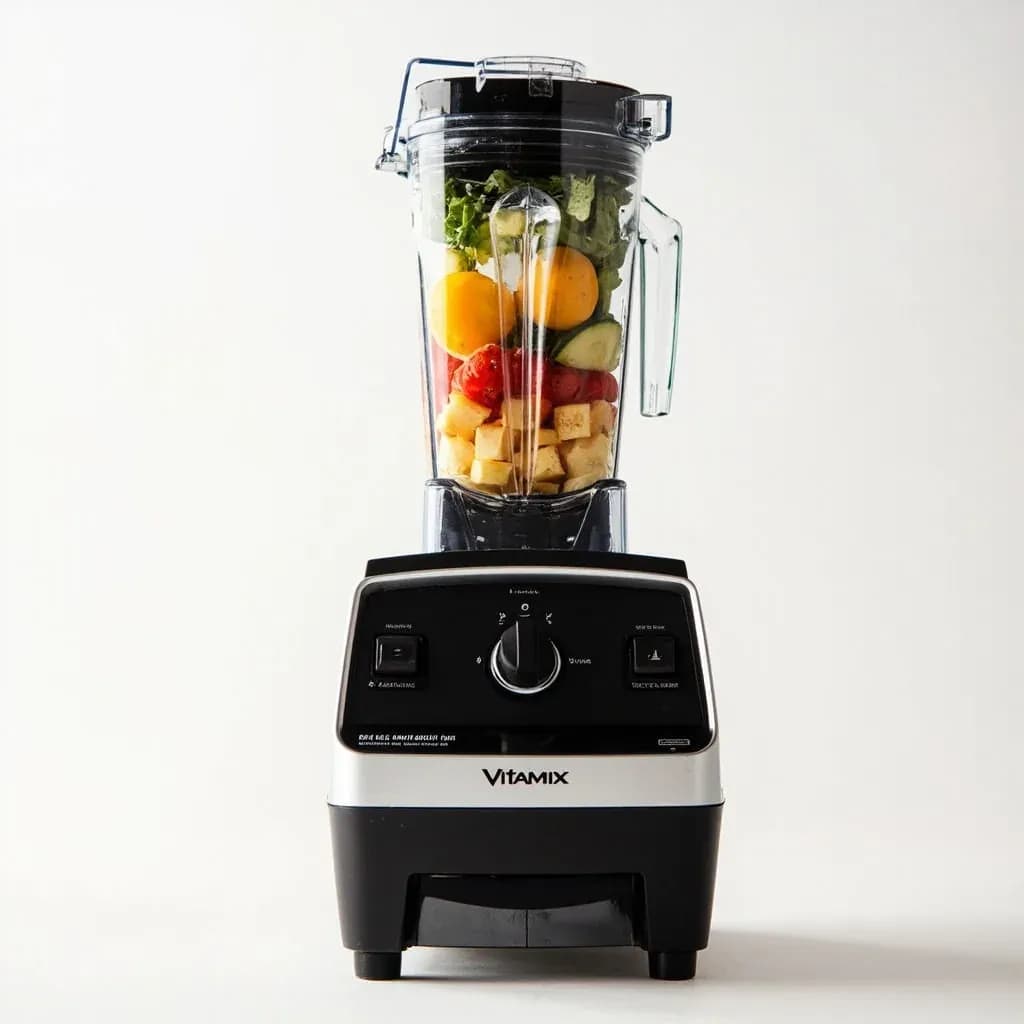
High-Speed Blender (Vitamix)
A powerful countertop blender that pulverizes tough ingredients into ultra-smooth purées, soups, and nut butters.
A high-speed blender uses a strong motor and hardened blades spinning at very high RPM to break down fibrous and hard ingredients far beyond a standard blender. Cooks use it for silky soups, smoothies with raw greens and ice, nut milks and butters, and even grinding grains into flour. Sustained high-speed friction can heat liquids enough to serve soup hot straight from the jar.
A high-speed blender is a category of countertop machine built around an induction motor of roughly two horsepower driving an aggressive aircraft-grade steel blade at tip speeds around 240–280 mph — far beyond what a standard home blender can sustain. Vitamix, founded in Cleveland in 1921 and still assembled in Ohio, is the brand that defines the category and the one most American whole-foods and raw-food cookbooks standardize on. The combination of raw power, a tamper-fed wet container, and blades that actually collide with the food rather than simply stirring it is what lets the machine turn fibrous kale and frozen banana into a drinkable smoothie, raw almonds into pourable butter, and cold chopped vegetables into a steaming bowl of soup — without any external heat.
Where an ordinary blender is good for shakes and a food processor is good for chopping, a high-speed blender is a tool for finishing: emulsifying, puréeing, milling, and heating. It pulls soluble fiber out of vegetables so a butternut squash soup pours glossy and lump-free; it shears nut skins into nut milk that does not need straining through cheesecloth; it aerates and crystallizes frozen fruit into sorbet with a texture closer to soft-serve than to a granita. For a working cook, that means replacing several single-purpose tasks — silky purées, ground nut flours, spice dust — with one footprint on the counter.
There are practical realities to plan around. The machine is loud (roughly 90–100 dB on High), heavy enough that you will not want to store it in a high cabinet, and the friction-heating trick only works when there is enough liquid for the mixture to circulate — a thick purée sitting in the bottom will not warm. Cleaning is genuinely easy — soap, warm water, thirty seconds on High — but the rubber gasket at the base of the blade assembly traps residue and wants a weekly pull-apart. With reasonable care the motor warranty runs seven to ten years, and most home units last considerably longer.
Alternatives
Types & varieties
Entry-level line with a 48 oz low-profile container, 2.0 HP motor, and a 5-year warranty; no wireless or preset programs.
Iconic tall 64 oz container with a toggle-style variable-speed dial and High switch; the model most whole-foods cookbooks standardized on.
Low-profile 64 oz container on a sleeker base, 2.2 HP, 7-year warranty; the design most kitchens fit under standard cabinets.
Self-detecting containers with wireless pairing and a 10-year warranty; A2500 adds programmed cycles, A3500 adds a touchscreen and programmable timer.
Ascent sibling aimed at smoothie shops with three preset programs: smoothie, frozen, and self-clean.
20 oz and 8 oz to-go cups that screw onto a blade base for single-serve blending; tamper is not compatible.
Separate 32 oz container with a different blade base optimized for milling flour, cracking grain, and grinding spices; do not run dry with the standard wet blade.
NSF-certified models (CIA, 7500, 5200 XL) built for professional kitchens with tighter tolerances and heavier motor housings.
The Wet Container vs. The Dry Container
Vitamix ships two distinct blade assemblies and they are not interchangeable. The wet-container blade base, with its four-pronged hammer-mill-style wings, is designed to move a vortex of liquid and to shear soft, wet, or fibrous material into a purée. Running it dry or with very low moisture for long periods overheats the bearing and dulls the blade. The dry-grains container uses a different blade optimized to catch, fracture, and toss hard kernels — wheat berries, dried chickpeas, whole spices — into flour or meal. Keep them separate, label them, and never substitute one for the other.
- Use the wet container for smoothies, soups, sauces, nut butters, and dressings.
- Use the dry container for milling grain into flour, cracking oats, grinding whole spices, and pulverizing dried sugar or salt.
- The 8 oz personal cup uses a small blade base that is also wet-blade only.
Hot Soup Without a Stove
The signature parlor trick — cold chopped vegetables in, steaming soup out — is pure friction. Spinning at 240–280 mph, the blade tip drags against the surrounding liquid fast enough to convert mechanical energy into heat, and the vortex keeps the mixture moving so it cooks evenly rather than burning on the bottom. The catch is that there must be enough liquid for circulation; a paste will not flow, and the bottom will scorch.
- Use enough liquid to keep the mixture flowing freely; a thick paste will not circulate and the bottom will scorch.
- Cut dense vegetables (carrots, squash, beets, potatoes) into roughly 1-inch pieces so they break down in the run time.
- Never fill past the bottom of the vented lid collar; start on Variable 1, ramp up, and hold a folded towel over the cap to vent steam.
- Expect about 5–7 minutes from cold ingredients to a simmer; finish with salt and herbs after the run, not before.
Working with the Tamper
The tamper is not an optional accessory. It is a long plastic plug that fits through the removable cap in the lid and lets you push thick mixtures — frozen fruit, nut butter, dough — back down into the blade zone while the machine is running. Used correctly, it eliminates the air pocket (called cavitation) that forms when the blade spins inside a thick mass faster than food can fall back in. Used incorrectly — with the machine off, or as a substitute when the recipe is simply too dry — it does nothing.
- Keep the machine running while tamping; pause only to check consistency.
- A firm, steady downward pressure works better than rapid stabbing.
- The tamper does not fit the 8 oz personal cup or the 32 oz dry-grains container; thin those mixtures with liquid instead.
Common uses
Tips & pitfalls
- Start every blend on Variable 1 and ramp up; dropping ingredients in on High traps an air pocket around the blade, called cavitation, and the mixture will simply churn in a dry ring.
- Add liquids first, then soft ingredients, then hard or frozen items on top so the vortex forms correctly.
- Use the included tamper through the lid cap to keep thick mixtures moving; never substitute a spatula while the machine is running.
- When blending hot liquids, never fill past the bottom of the vented lid collar, hold a folded kitchen towel over the cap, and start on Low before increasing speed to release steam safely.
- For nut butters, run a full 60–90 seconds; the mixture will go chunky, then clumpy and seemingly stuck, then suddenly loosen and turn glossy smooth — that sudden release is the sign it is done.
- For milling flour, use the dry-grains container; using a wet-blade container dry will clog, overheat the bearing, and dull the blade quickly.
- To self-clean, add 1–2 cups warm water and a drop of dish soap, run on High for 30–60 seconds, rinse, and air-dry the container inverted.
- Let the motor rest a few minutes between back-to-back heavy loads such as nut butters or thick doughs to avoid thermal overload.
- Pre-cut dense vegetables (carrots, squash, beets) into roughly 1-inch pieces; whole large vegetables stall the blade and strain the motor.
- If the machine stalls or smells hot, stop immediately, unplug, remove the container, redistribute the contents, and resume on a lower speed before increasing.
Good to know
- Type
- Countertop high-performance blender
- Motor power
- 2.0–2.2 peak horsepower in consumer models; up to ~3.8 HP in commercial units
- Blade tip speed
- Approximately 240–280 mph at the blade tip
- Blade material
- Laser-cut, hardened aircraft-grade stainless steel
- Container sizes
- 32, 48, and 64 oz low-profile; 64 oz classic tall; 8 oz and 20 oz personal cups
- Speed control
- Variable dial 1–10 plus a separate High setting on most models
- Friction heating
- Cold ingredients reach a steaming hot soup in roughly 5–7 minutes
- Warranty
- 7–10 years on full-size consumer units; 5 years on the Explorian line
Also called
Vitamix Blender · High-Speed Blender · Power Blender
Related

Stovetop
The everyday burners where most cooking actually happens

Oven
Enclosed dry heat for roasting, baking, and braising

Grill
Live-fire or gas grates for char, smoke, and high heat

Smoker
Low, slow heat and wood smoke for barbecue and brisket

Air Fryer
Countertop convection that crisps with little or no oil

Slow Cooker
Set-and-forget low heat for stews, beans, and braises

Pressure Cooker
Sealed steam pressure that cooks tough food in a fraction of the time

Rice Cooker
Foolproof, perfectly steamed rice every single time