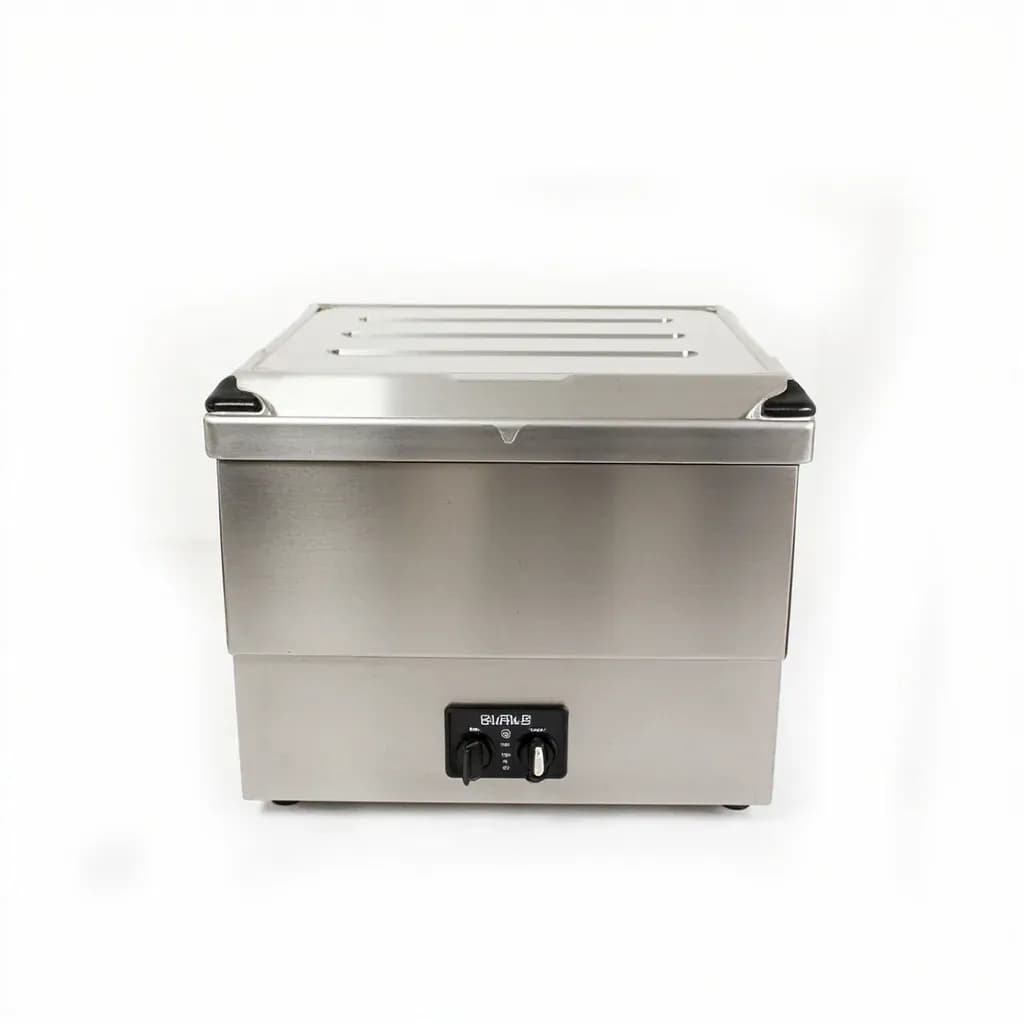
Appliances & Heat
Heated Holding Cabinet (Hot Box)
An insulated heated cabinet that keeps cooked food at safe serving temperature.
A heated holding cabinet, or hot box, is an insulated enclosure with a thermostat and gentle heat (often with humidity control) that keeps already-cooked food hot and ready to serve. Restaurants and caterers use it to hold roasts, plated dishes, and pan-loads of food during service without further cooking or drying them out. Holding food above the safe hot-holding threshold prevents bacterial growth in the danger zone.
A heated holding cabinet — the hot box, in line-cook shorthand — is the unglamorous but indispensable bridge between the cooking equipment and the service line. Its job is narrow but critical: to keep already-cooked food at a safe, ready-to-serve temperature without continuing to cook it. Unlike ovens or steamers that add heat, a holding cabinet maintains a steady thermal environment, typically between 135°F and 180°F (57–82°C), so that roasted meats stay juicy, vegetables stay out of the FDA danger zone, and banquet plate-ups hit the dining room at the same moment.
The technology is deliberately gentle. Forced-convection fans and electric elements, wrapped in foamed-in-place or fiberglass insulation, deliver an even, low-velocity band of warmth rather than the high, dry heat of an oven. Many mid- and high-end models add a water pan or steam injection to control humidity, which is the difference between a sliced roast that emerges moist and one that has crusted over and wept juices onto the pan. Because the cabinet is a holding tool rather than a cooking tool, its design priorities are fast recovery after door openings, even airflow between pans, and food-safe temperature stability rather than browning or crisping.
A holding cabinet shapes how a kitchen times its work. It lets cooks finish proteins and sides in batches, then stage them so the line can plate continuously at service. In banquet and catering settings, the roll-in version — a wheeled rack that rolls directly into an insulated chamber — is what allows hundreds of plated covers to leave the kitchen at once. Knowing what a hot box will not do is just as important as knowing what it will: it will not crisp, will not brown, will not finish an under-roasted item, and will steadily degrade texture on delicate fried or breaded foods the longer they sit.
Alternatives
Types & varieties
Upright, single-door unit with fixed racks sized for sheet pans or hotel pans; the standard back-of-house workhorse.
Wheeled rack rolls directly into the chamber; used in hotels and catering to plate up hundreds of covers at once.
Doors on both kitchen and service sides to reduce cross-traffic and contamination on hot lines.
Compact unit slides under a prep table or into a serving counter; common for tortillas, bread, or plated components.
Single- or multi-drawer unit (Hatco HDW, Vollrath, and similar) for buns, tortillas, vegetables, or finishing.
Combines low-temp cooking (often 200–250°F) with seamless transition to hold mode; Alto-Shaam Halo Heat is the archetype.
Insulated transport cabinet on casters for catering deliveries; some are dual-voltage for vehicle or outlet use.
Dual-mode cabinet with humidity and a lower range (~80–110°F) for proofing bread, then switching to hot hold.
Humidity and texture management
The single biggest variable inside a holding cabinet is moisture in the air, and matching it to the food is what separates a moist, just-cooked result from something that tastes like it was cooked hours ago.
- Low or no humidity is correct for roasted items, fried foods, and anything you want to keep crisp — humidity accelerates sogginess on breaded surfaces and crackling.
- Higher humidity (active steam injection or a full water pan) is correct for sliced meats, cooked vegetables, mashed potatoes, rice, and any sauced item that would skin over or crust.
- Cover pans with lids or foil when humidity is on to prevent surface drying and to keep condensation from dripping onto crisp items above.
- Clean and refill the water pan daily — mineral scale and food residue harbor bacteria and produce stale, off-flavors that transfer to food.
- Probe the densest item, not the cabinet air, when verifying holding temperature; a whole turkey breast can read 10–15°F lower than the air around it during recovery.
Operating discipline
A holding cabinet only protects food if the people using it respect what it is and is not. The most common kitchen failures are timing and loading errors, not equipment problems.
- Pre-heat for 15–20 minutes before loading — putting hot food into a cold box slashes the temperature and lengthens recovery time.
- Leave space between pans; airflow is what keeps food even, and tight packing creates cold spots that food-safety inspectors look for first.
- Label every pan with a start time and discard past 4 cumulative hours; the timer is a legal and quality tool, not optional paperwork.
- Keep the door closed during service; every opening can drop cabinet air 25°F or more and forces the element to recover.
- Set the thermostat 5–10°F above your target food temp to absorb door-open losses and load mass without dipping below the 135°F floor.
Common uses
Tips & pitfalls
- Pre-heat an empty cabinet for 15–20 minutes before loading; a cold box will drop food temperature and stall recovery.
- Leave 1–2 inches of space around each pan — tight packing is the leading cause of cold-spot violations on inspection.
- Verify with a calibrated probe inserted into the densest item, not the cabinet air or thermostat readout; food temperature is what matters.
- Match humidity to the food: off for crispy and roasted items, on for sliced meats, starches, and vegetables.
- Never load raw or undercooked food expecting it to finish in the cabinet — recovery is too slow to count as safe cooking.
- Rotate pans FIFO, label start times, and discard anything past 4 cumulative hours of hot holding, per US Food Code guidance.
- Refresh fried or breaded items under a salamander, in a convection oven, or in a hot fryer for 60–90 seconds before service.
- Set the thermostat 5–10°F above your target food temperature to ride out door openings and large loads.
Good to know
- Purpose
- Maintains cooked food at safe, ready-to-serve hot temperatures, typically 135–180°F (57–82°C).
- FDA Food Code holding minimum
- 135°F (57°C); most operators target 140°F (60°C) for a safety margin.
- Maximum recommended hold time
- No more than 4 cumulative hours of hot holding before discard, per US Food Code guidance.
- Power
- Electric; 120V for small or under-counter models, 208/240V for full-size commercial units.
- Insulation
- Foamed-in-place or fiberglass in walls and doors to retain heat and reduce energy draw.
- Heat source
- Forced-convection fan with tubular electric element; radiant shelf-heated drawers exist at lower cost.
- Door styles
- Full-height hinged, half-height Dutch doors, or pass-through (front and rear) for kitchen-to-service flow.
- Humidity control
- Mid- and high-end models add a water pan or steam injection to keep proteins and starches from drying out.
- Capacity
- Reach-in units hold 12–24 full-size hotel pans (12"×20"); roll-in banquet cabinets hold 30+ pans or a full banquet cart.
- Pioneering brand
- Alto-Shaam (Menomonee Falls, WI) introduced the cook-and-hold concept in the early 1970s and remains the reference brand.
- Plate warming
- Dedicated plate-warming cabinets run 150–180°F (66–82°C) to preheat dishware without overcooking food.
- Crispy-food limitation
- Fried chicken, fried fish, and crispy potatoes soften within 30–45 minutes and need a quick refresh before service.
Also called
Hot-Holding Cabinet · Hot Holding Cabinet · Hot Box · Warming Cabinet
Related

Stovetop
The everyday burners where most cooking actually happens

Oven
Enclosed dry heat for roasting, baking, and braising

Grill
Live-fire or gas grates for char, smoke, and high heat

Smoker
Low, slow heat and wood smoke for barbecue and brisket

Air Fryer
Countertop convection that crisps with little or no oil

Slow Cooker
Set-and-forget low heat for stews, beans, and braises

Pressure Cooker
Sealed steam pressure that cooks tough food in a fraction of the time

Rice Cooker
Foolproof, perfectly steamed rice every single time