Appliances & Heat
Honey Extractor (Centrifuge)
A spinning drum that flings honey out of comb frames without destroying the wax.
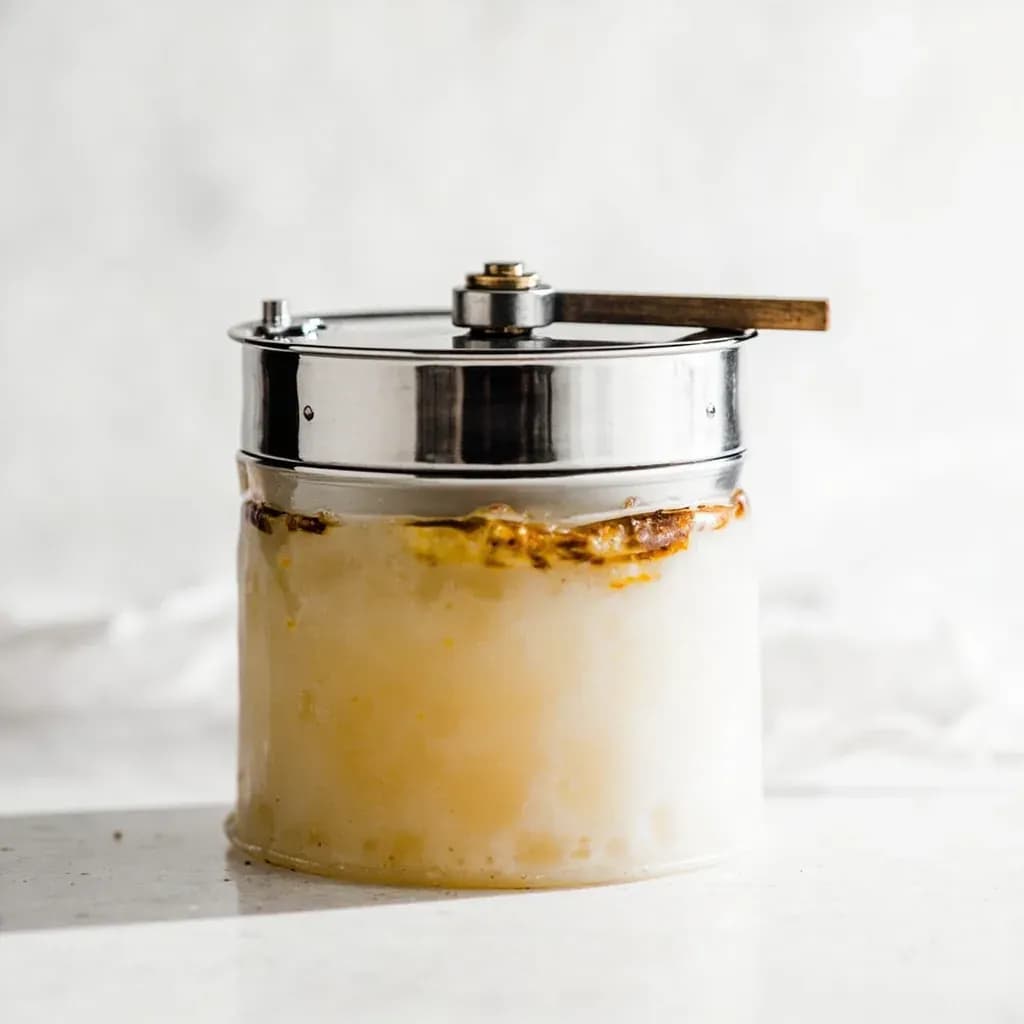
A honey extractor holds uncapped honeycomb frames and spins them so centrifugal force throws the honey against the drum wall, where it drains to the bottom. Beekeepers use it during harvest to recover honey while keeping the comb intact for reuse. Models range from hand-cranked two-frame units to motorized radial extractors holding many frames.
A honey extractor is a centrifugal drum that strips liquid honey from uncapped wax comb by spinning frames fast enough to fling the honey outward against the drum wall, where it pools and drains out a gate at the bottom. Invented in 1865 by the Austrian-Italian beekeeper Major Franz von Hruschka, the device transformed honey harvesting in serious apiaries because it leaves the wax comb intact — the frames go straight back to the hive for the bees to refill, saving the colony the enormous energy of rebuilding fresh comb. That single advantage is what makes the extractor the standard tool for moving honey from hive to pantry in liquid form.
The extractor sits in the middle of a small honey-processing line, between the uncapping station (where wax cappings are sliced or scratched off each cell) and the settling and filtering tank that clarifies the spun honey before bottling. In a home setup, a single 4- or 9-frame machine in a garage or shed is enough to process a backyard's worth of hives in an afternoon; in commercial operations, radial drums holding 60 frames or more run continuously with motorized drives and inline filtration.
The two real design choices are tangential versus radial baskets, and hand-crank versus electric drive. Tangential baskets are cheaper and accept a wider range of frame sizes, but they only empty one side of the comb at a time, so frames must be flipped mid-spin. Radial baskets — the modern standard — arrange frames like spokes of a wheel so both faces extract simultaneously, and they let a beekeeper load the drum, run a cycle, and remove the frames without flipping wet comb. Either way, the wax survives extraction, which is the entire point: drawn comb is a far more valuable resource to the bees than honey alone.
Alternatives
Types & varieties
Frames sit with one face of the comb toward the outside of the basket. Only that side empties per pass, so frames must be flipped (and often reversed again) to clear both sides. Cheaper and more common in small units.
Frames are arranged like spokes of a wheel so both faces of the comb face outward. Centrifugal force clears both sides simultaneously, no flipping required, gentler on comb. The modern standard for mid- to large-sized equipment.
A gear and crank handle drive the basket. Affordable, quiet, and dependable, but slower and more labor-intensive — well suited to 1–5 hives.
A motor (often variable-speed) drives the basket. Essential for larger apiaries; many include programmable controllers for slow ramp-up that protects soft comb.
Smallest practical size, almost always tangential. Fine for a single hive or a trial season; expect to flip each frame partway through every run.
The most common backyard-beekeeping range. Available in both tangential and radial configurations; pairs naturally with 8- or 10-frame Langstroth hives.
Holds 20–60+ frames radially, always motorized, and may include a sump, pump, and inline filtering train for continuous processing.
Tangential vs Radial
The choice between these two basket designs shapes the entire extraction experience and dictates how long a harvest takes.
- Tangential baskets are cheaper, shorter, and accept a wider range of frame sizes, but require flipping every frame mid-run to clear both sides of the comb
- Radial baskets are taller (frames stand vertically in a ring), cost more, and reward you by extracting both faces in a single run with no flipping
- A 4-frame tangential covers 1–3 hives comfortably; a 9-frame radial covers 4–10 with far less operator time
- Soft or newly drawn comb tends to survive a radial cycle better than a tangential one because radial extraction eliminates the need to flip wet, fragile comb mid-spin
The Extracting Workflow
A complete extraction runs in five stages, and each one affects yield and clarity.
- Uncap: a heated uncapping knife, fork, or roller shaves the thin wax caps the bees put over ripe honey
- Extract: load frames into the extractor, ramp speed up gradually, and spin until the bulk of the honey has left the comb
- Coarse strain: honey flowing from the gate passes through a coarse sieve that catches wax cappings and large debris
- Settle: honey rests in a tank or bottling bucket for 24–48 hours so fine particles and trapped air bubbles rise to the surface
- Fine filter: a fine nylon or stainless mesh polishes the honey to the clear, jewel-bright state most people expect on the table
- Keep frames and honey warm throughout the process (around 30–35°C / 85–95°F) — warm honey flows freely and extracts more completely
Common uses
Tips & pitfalls
- Start slow: ramp the speed up over the first minute, especially with fresh or soft foundation; spinning at full speed immediately can blow comb out of the frames and into the drum walls.
- Balance the load: in a tangential extractor, place frames of similar weight opposite each other; an unbalanced basket throws the drum, damages comb, and stresses the drive.
- Uncap cleanly first: missed caps leave pockets of honey trapped in the comb and force you to re-run frames; an uncapping fork for low spots and a heated knife for the broad faces both work well.
- Flip frames at the right moment in a tangential extractor: stop when about two-thirds of one side is empty, flip and finish the second side, then flip back to clear the heavier side fully — flipping too early can collapse the wet side.
- Warm your frames if possible: honey flows freely at 30–35°C (85–95°F); cold, thick honey reduces yield, lengthens spin time, and leaves more of the crop in the comb.
- Never open the lid while the drum is spinning or still coasting — the load is unbalanced and a stop takes time, and the lid can be flung open by vibration.
- Drain honey promptly after each load: leaving a heavy pool sitting in the drum stresses the bearings and can leak past the gate seal.
- Skip the dish soap when cleaning: residue is hard to rinse fully and will flavor the next batch; warm water, a soft brush, and an occasional rinse of diluted vinegar or a beekeeping-specific cleaner are all you need.
- If you are starting out, a 4-frame tangential hand-crank is the cheapest entry point; once you keep more than 3–4 hives, a 9-frame radial electric unit pays for itself quickly in time saved.
Good to know
- Invented
- 1865 by Major Franz von Hruschka, an Austrian-Italian beekeeper
- Principle
- Centrifugal force — spinning frames in a drum flings honey out of the cells without rupturing the wax comb
- Primary material
- Food-grade stainless steel for the drum, basket, and gate; some hobbyist lids are clear plastic
- Capacity range
- From 2-frame hobby units up to 60–120 frame commercial extractors
- Power source
- Hand-crank (manual) or electric motor with variable-speed control on larger units
- Typical output
- A 4-frame tangential extractor handles roughly 8–14 kg (20–30 lb) of honey per load
- Comb reuse
- Yes — the wax comb survives extraction and is returned to the hive for the bees to refill
- Cleaning
- Rinse with warm water only; avoid soap, which leaves residue that taints the next batch
Also called
honey extractor · honey centrifuge · honey spinner
Related

Stovetop
The everyday burners where most cooking actually happens

Oven
Enclosed dry heat for roasting, baking, and braising

Grill
Live-fire or gas grates for char, smoke, and high heat

Smoker
Low, slow heat and wood smoke for barbecue and brisket

Air Fryer
Countertop convection that crisps with little or no oil

Slow Cooker
Set-and-forget low heat for stews, beans, and braises

Pressure Cooker
Sealed steam pressure that cooks tough food in a fraction of the time

Rice Cooker
Foolproof, perfectly steamed rice every single time