Appliances & Heat
Honey Warming Cabinet
A gently heated cabinet that liquefies crystallized honey without scorching it.
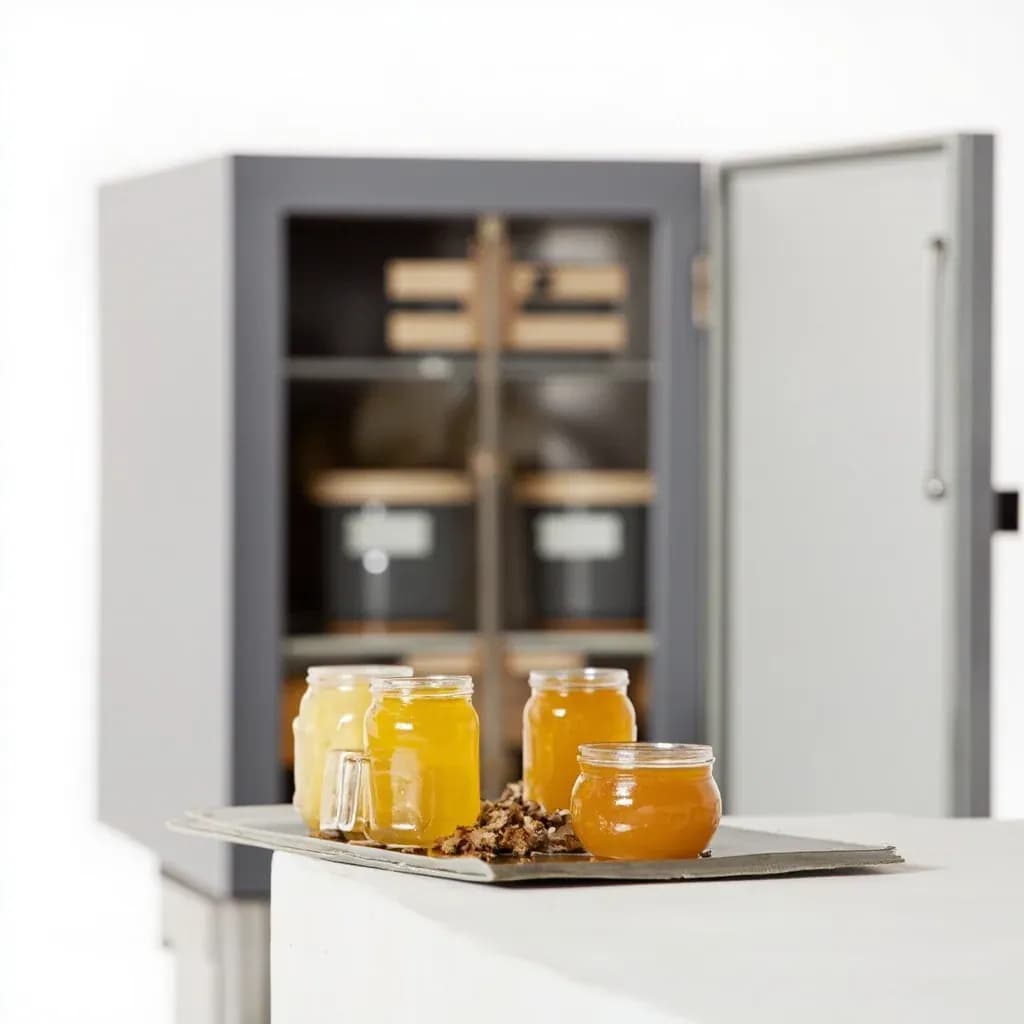
A honey warming cabinet holds buckets or jars at a low, controlled temperature to melt crystallized honey back to a pourable state. Beekeepers use it before bottling or blending to make granulated honey flow again while preserving its delicate aroma and enzymes. Keeping the heat gentle, usually well below 45 C, avoids the off-flavors and color darkening that come from overheating.
A honey warming cabinet is a low-temperature holding oven engineered around one stubborn problem: honey crystallizes. Raw honey, especially varietals high in glucose such as clover, dandelion, and cotton, naturally solidifies in the jar within weeks or months, and the only graceful way to return it to a pourable liquid is gentle, sustained heat. The cabinet's job is to hold honey in a narrow band — typically 95–104 °F (35–40 °C) — for many hours, slowly redissolving the glucose crystals without ever pushing the sugars or enzymes past their thermal limits. Unlike a microwave, stovetop, or improvised warm-water bath, a dedicated cabinet delivers even, controlled warmth across every jar on every shelf, which is why serious beekeepers, honey packers, and anyone who buys honey in volume eventually graduates to one.
What makes the design distinct from a regular warming drawer is the discipline of low temperatures. Honey is viscous and a poor conductor of heat, so any quick, hot method creates scorched spots that darken the honey, degrade aromatic compounds, and destroy the heat-sensitive enzymes — diastase, invertase, glucose oxidase — that raw-honey enthusiasts prize. A cabinet trades speed for control: it accepts that liquefying a one-pound jar of solid honey will take six to twelve hours, and that a five-gallon pail may need a day and a half, in exchange for a uniform, enzyme-safe result across the whole batch.
For most home cooks, a small countertop unit holding a few jars is plenty; some people assemble a workable version from an insulated box and a seedling or reptile heat mat. Commercial beekeepers and packers step up to water-jacketed or multi-shelf cabinets that can run through an entire bottling day, holding honey at pouring temperature so fillers and bottles move smoothly down the line.
Alternatives
Types & varieties
Small (1–5 lb capacity), single-shelf plug-in unit sized for the home kitchen
Freestanding multi-shelf cabinet holding pails or cases of jars, designed to run through a bottling shift
Heated water reservoir inside the walls gives exceptionally even, drift-free temperature
Dual-zone unit that also softens beeswax blocks, candles, or propolis tins at a similar low temperature
Built-in or under-counter drawer form factor for retail counters and packaging rooms
Common home workaround pairing a seedling or reptile heat mat inside a well-insulated container
Why Honey Crystallizes in the First Place
Honey is a supersaturated solution of sugars, mostly fructose and glucose, in a small amount of water. Glucose is the less soluble of the two, so when a jar sits quietly on a shelf, glucose molecules gradually leave the solution and lock together into crystals, eventually turning the honey from a clear, pourable liquid into a thick, opaque, granular solid. This is not spoilage; it is the natural behavior of unprocessed honey, and many people actually prefer the spreadable texture for toast. When a pourable honey is wanted again, the crystals must be redissolved by warming — slowly, and at a temperature low enough to leave the enzymes and delicate floral aromatics intact.
The Enzyme-Safe Heat Band
Raw honey contains living enzymes — diastase, invertase, glucose oxidase, and others — that contribute to its flavor, texture, and the antibacterial activity prized by raw-honey drinkers. These enzymes begin to denature around 104–105 °F (40 °C), and hydroxymethylfurfural (HMF), a marker of heat damage, climbs sharply above that line. The cabinet's narrow operating range exists to keep honey inside the safe band: warm enough to redissolve glucose, cool enough to leave the chemistry alone. This is also why a microwave, which can spike interior temperatures past 150 °F in seconds, is a poor tool for anything beyond an emergency spoon-softening.
- Diastase and invertase begin losing activity above 104 °F (40 °C)
- HMF formation accelerates with both higher temperature and repeated heat-cool cycles
- Honey's poor thermal conductivity means even a 'low' setting on a microwave creates internal hot spots
- Sustained 100 °F warmth is gentler than brief bursts of 140 °F heat
Setting Up a Warming Routine at Home
If you buy honey by the case from a farm or beekeeper, a small cabinet pays for itself in saved jars and preserved flavor. The key is to think of warming as an overnight process, not an on-demand one. Set a few jars in the cabinet before bed; by morning they are liquid and ready to pour, decant, or use. For larger pails, dedicate a corner of a cool pantry and plan a 36 to 48 hour warming window before a bottling session.
- Stir once or twice with a clean dry spoon to even out heat and break up stubborn crystals
- Avoid opening the door repeatedly; each opening costs recovery time and stretches the run
Common uses
Tips & pitfalls
- Hold the thermostat at or below 104 °F (40 °C); above this, diastase and invertase activity drops and HMF levels rise quickly
- Verify the actual interior temperature with a separate probe thermometer — analog dials on budget cabinets can drift 5–10 °F
- Plan ahead: a solidly crystallized 1 lb jar needs roughly overnight at 100 °F, not a quick blast on high
- Avoid repeated heat-cool cycles; warming the same honey two or three times accelerates darkening and HMF formation — warm only what you will use soon
- Leave lids loose or slightly cracked so pressure does not build as the honey warms and expands
- Wipe up drips before the next run; crystallized honey on a warm shelf hardens into a stubborn glaze that is unpleasant to clean later
- Reserve the cabinet for honey only; cross-use with savory items will flavor-taint every future batch
Good to know
- Operating temperature
- 95–104 °F (35–40 °C); held below the threshold where honey enzymes degrade
- Primary purpose
- Reversing natural glucose crystallization in honey without scorching or cooking it
- Liquefaction time
- 6–12 hours for a fully crystallized 1 lb jar; 24–48 hours for a bulk pail
- Construction
- Food-grade stainless interior; powder-coated steel or food-safe ABS shell
- Heat source
- Low-wattage electric element, often paired with a water jacket or radiant panel for even distribution
- Controls
- Analog or digital thermostat; many models include a ready light and adjustable set-point
- Typical capacity
- Countertop units hold 1–5 lb jars; commercial cabinets hold several gallons across pails or cases
- Comparison to alternatives
- Warmer and more uniform than a microwave, double boiler, or stovetop simmer; safer for enzymes than direct heat
Also called
warming cabinet · honey liquefier · decrystallizer cabinet
Related

Stovetop
The everyday burners where most cooking actually happens

Oven
Enclosed dry heat for roasting, baking, and braising

Grill
Live-fire or gas grates for char, smoke, and high heat

Smoker
Low, slow heat and wood smoke for barbecue and brisket

Air Fryer
Countertop convection that crisps with little or no oil

Slow Cooker
Set-and-forget low heat for stews, beans, and braises

Pressure Cooker
Sealed steam pressure that cooks tough food in a fraction of the time

Rice Cooker
Foolproof, perfectly steamed rice every single time