Appliances & Heat
Hot Liquor Tank
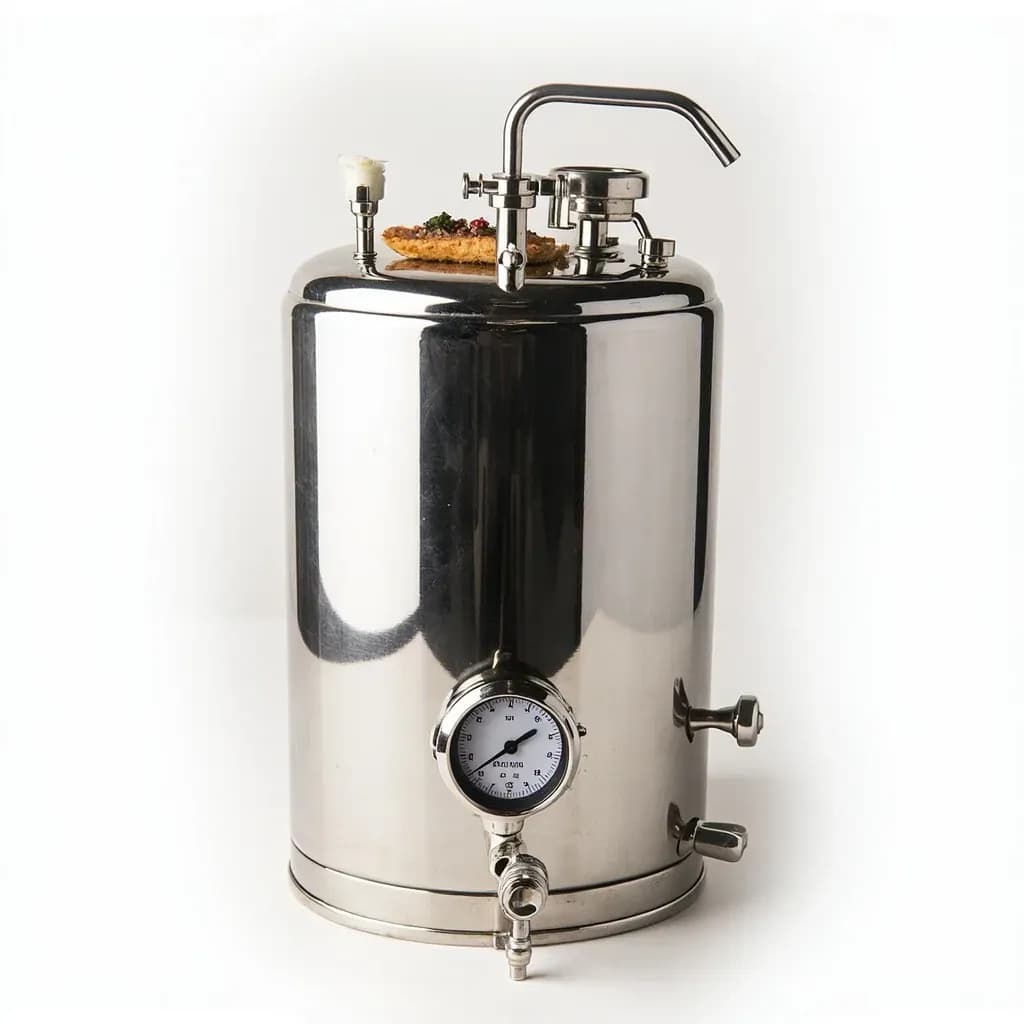
A heated tank that holds hot brewing water (liquor) at a set temperature for mashing and sparging.
A hot liquor tank, or HLT, heats and holds water at a precise temperature for use in brewing and large-scale cooking. Brewers draw from it to strike the grain mash and to sparge, rinsing sugars from the grain bed. Many tanks include a thermostat and a coil or element so a steady reserve of hot water is always ready.
A Hot Liquor Tank (HLT) is a heated vessel dedicated to preparing and holding brewing water — what brewers call "liquor" — at precise temperatures before it ever touches grain. In an all-grain brew day the HLT supplies two distinct jobs: the strike water that mixes with the crushed malt to start enzymatic conversion, and the sparge water that rinses sugars from the finished mash. Because mash enzymes work in a narrow temperature window and grain husks release harsh tannins when rinsed too hot, the tank's real purpose is not just heating water but holding it within a couple of degrees of a target for an hour or more while you work.
The HLT sits at the top of the classic three-tier gravity brewery, feeding the Mash Tun below and ultimately the Boil Kettle at floor level. Most home setups achieve this with a converted keg, a stockpot, or a purpose-built kettle fitted with a heating element, ball valve, and thermometer; commercial breweries scale the same idea up to steam-jacketed or glycol-jacketed stainless vessels. In a HERMS (Heat Exchange Recirculating Mash System) the HLT doubles as the temperature-control hub of the whole brewhouse, with wort from the mash tun recirculated through a coil immersed in the tank.
Alternatives
Types & varieties
Propane or natural gas burner beneath a kettle; fast heating, popular in classic three-tier home setups.
Built-in electric heating element, often controlled by a PID for tight temperature holding; common in single-tier electric systems.
An off-the-shelf kettle fitted with a 'heat stick' style immersion element through the wall; the easy DIY route for homebrewers.
Hot liquor tank fitted with a copper or stainless coil that recirculates wort from the mash tun, turning the HLT into the mash temperature-control point.
Commercial-scale vessel with a steam-filled outer jacket; even, controllable heat suited to large batches.
A converted picnic cooler holding pre-heated water with no active heat source; technically only a liquor tank, not a true hot liquor tank.
Found in pro breweries; uses a heated glycol/water loop to hold water at exact temperatures across an entire brewing shift.
Strike water versus sparge water
The HLT has to do two different jobs in a single brew day, and they want different temperatures. Strike water — the first infusion that meets the grain — typically lands between 148 and 162 °F (64–72 °C), with the higher end used for very dextrinous mashes and the lower end for more fermentable profiles. Brewers aim a few degrees above the eventual mash rest because cold grain and the cool metal of the mash tun will pull the temperature down on contact; a 5–10 °F boost is normal.
Sparge water, used later to rinse sugars from the grain bed, is held hotter — usually 168–170 °F (75.5–77 °C). It needs to stay above mash temperature to keep the lautering flow brisk, but it must stay under roughly 175 °F or the husks start to give up tannins and the finished beer turns astringent. The HLT's role during sparging is essentially thermal storage: it has to deliver dozens of gallons at a steady 170 °F over an hour or more of runoff.
- Strike water hits the grain once; sparge water is delivered gradually over the entire lautering step.
- Acid or salt adjustments go into the strike water so they mix evenly through the grain bed.
- An uninsulated HLT can drop out of sparge range during a long runoff, stalling the lautering process.
Common uses
Tips & pitfalls
- Aim strike water 5–10 °F above your target mash temperature to absorb the chill from cold grain and a cool mash tun — heating only to the resting temp is a common first-timer mistake that produces a thin, under-converted mash.
- Keep sparge water at or below 170 °F; above about 175 °F you start pulling astringent tannins from the husks and the finished beer will taste harsh and tea-like.
- Dissolve brewing salts in the HLT before mashing in rather than sprinkling them on top of the grain — dry salts create low-pH pockets that affect conversion unevenly.
- Insulate the tank with a neoprene jacket or closed-cell foam; an uninsulated HLT can drop 10 °F or more over a 60-minute rest and leave you scrambling to reheat mid-sparge.
- Use a PID controller on electric setups rather than relying on the element's on/off thermostat, which will overshoot and oscillate around the target by several degrees.
- Mount the thermometer at mid-height in a thermowell, not at the surface — surface water reads hot while the bulk of the tank is still cooler, a common source of under-temperature mashes.
- Sanitize the HLT interior, valve, and any ports with the same no-rinse sanitizer you use on the boil kettle; it sits on the 'hot side' of the brewhouse but wort still passes through it via HERMS or transfers.
Good to know
- Category
- Brewing equipment (all-grain beer brewing)
- Common abbreviation
- HLT
- Strike water target
- 148–162 °F (64–72 °C), adjusted higher to compensate for grain and tun thermal mass
- Sparge water target
- 168–170 °F (75.5–77 °C)
- Common materials
- Stainless steel (304 grade most common), aluminum, occasionally copper or enameled steel
- Typical homebrew sizes
- 5–15 gallons (19–57 L), matched to boil kettle and mash tun volume
- Typical commercial sizes
- 30 barrels to several hundred barrels; often steam-jacketed or gas-fired
- Heating methods
- Direct gas burner, internal electric element, weldless immersion heater, steam jacket, or (rarely) induction on ferritic steel
- Insulation
- Often wrapped in closed-cell foam or a neoprene jacket to hold temperature and improve efficiency
- System role
- One of three vessels in a classic three-tier brewery, alongside the Mash Tun and Boil Kettle
- Etymology
- 'Liquor' is traditional British and German brewing terminology for water, predating the modern sense of distilled spirits
- Related systems
- Both HERMS and RIMS (Recirculating Infusion Mash System) use the HLT as the temperature-control vessel
Also called
HLT · hot water tank · brewing liquor tank
Related

Stovetop
The everyday burners where most cooking actually happens

Oven
Enclosed dry heat for roasting, baking, and braising

Grill
Live-fire or gas grates for char, smoke, and high heat

Smoker
Low, slow heat and wood smoke for barbecue and brisket

Air Fryer
Countertop convection that crisps with little or no oil

Slow Cooker
Set-and-forget low heat for stews, beans, and braises

Pressure Cooker
Sealed steam pressure that cooks tough food in a fraction of the time

Rice Cooker
Foolproof, perfectly steamed rice every single time