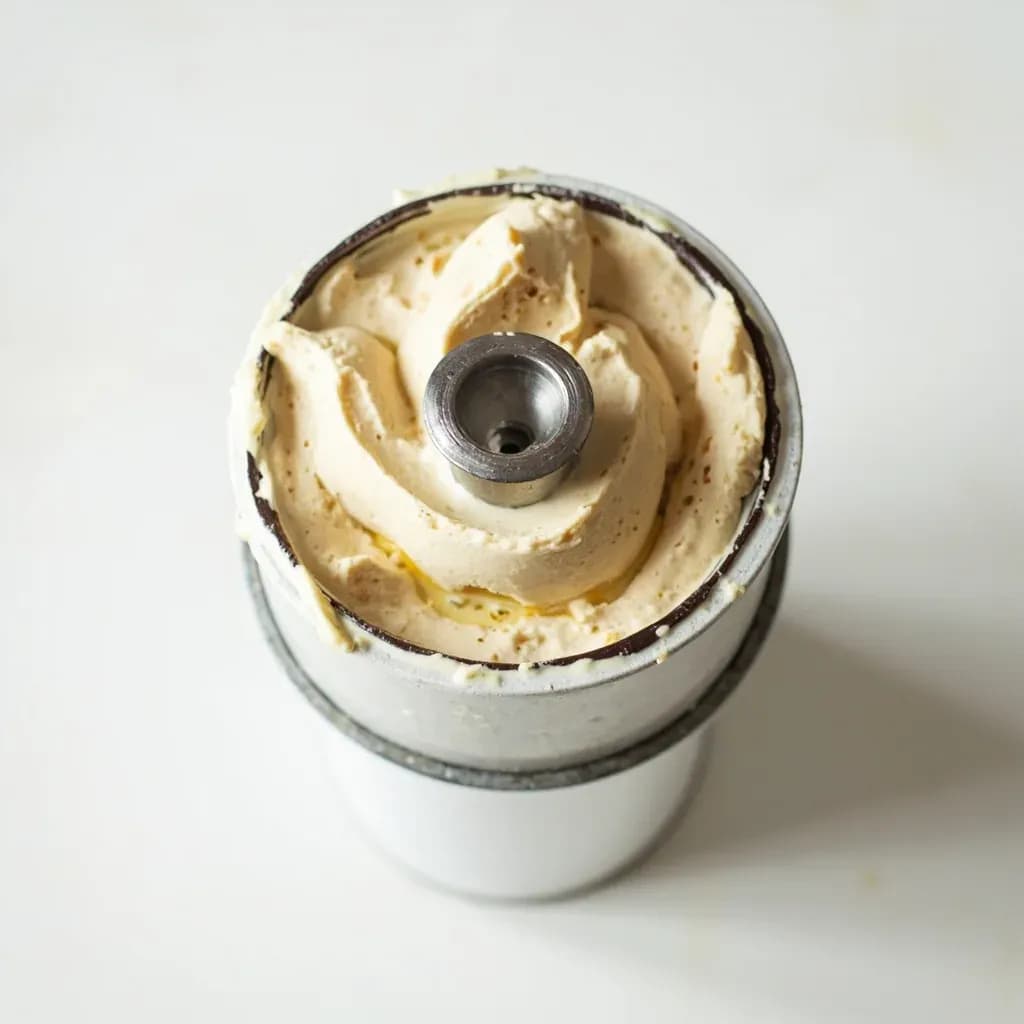
Appliances & Heat
Gelato / Ice Cream Churner
A machine that simultaneously freezes and stirs a base into smooth ice cream or gelato.
An ice cream churner chills a sweet dairy or fruit base while continuously paddling it, incorporating air and preventing large ice crystals. Used to make ice cream, gelato, and sorbet at the end of dessert prep, after the base has been cooked and chilled. The constant agitation during freezing is what gives the finished product its creamy, scoopable texture.
A churner is the only traditional home appliance that does two things at once: it freezes a sweetened base while a rotating paddle (the dasher) keeps the mixture in constant motion. That combination is what separates ice cream and gelato from a no-churn custard. As the base drops in temperature, water wants to lock into hard ice crystals, and the dasher prevents them from growing large by scraping the forming ice off the cold walls of the cylinder and folding it back into the liquid. At the same time, the same paddle whips in air. That trapped air, called overrun, is what gives finished ice cream its soft, scoopable body. Without a churner, neither the small crystals nor the aeration can happen, and the result is a dense, icy block.
Mechanically, every churner is built around four parts: a cold cylinder or bowl, a motor-driven dasher, a lid with a feed opening for pouring in the base, and a drive housing. The cold surface is supplied in one of two ways. The most affordable home machines use a double-walled aluminum bowl filled with a sealed propylene-glycol or salt-solution coolant that you store in your kitchen freezer for 16–24 hours before churning. Self-refrigerating (compressor) models, common in both prosumer kitchens and pastry shops, have a built-in refrigeration circuit that chills the cylinder on demand, so the machine is ready whenever you are and can run batch after batch.
The mechanical principle is old: Nancy Johnson patented the first hand-cranked dasher inside a metal canister surrounded by an ice-and-salt bucket in 1843. Modern electric churners simply replace the hand crank with a motor and the salt-ice bath with either a frozen bowl or a compressor. That small shift is what moved ice cream from an occasional summer project into a year-round staple of the home kitchen and the pastry counter.
Alternatives
Types & varieties
The most common home style. The bowl lives in the freezer; the machine provides only the dasher and motor. Affordable and quiet, but you must plan 16–24 hours ahead and are limited to one or two batches per freeze.
A built-in refrigeration unit chills the cylinder on demand. Heavier and more expensive, but it is always ready, holds temperature precisely, and can run back-to-back batches without re-freezing.
A freezer-bowl unit that fits the drive hub of a stand mixer (e.g., KitchenAid). Saves counter space and uses the host motor, so output depends on the mixer you own.
The traditional wooden or plastic bucket with a metal canister, dasher, and crank. Surrounded by rock salt and crushed ice, the salt-ice bath drops the canister below 0 °C. Slow, arm-tiring, but produces excellent ice cream and a hands-on experience.
A professional horizontal or vertical cylinder with a heavy dasher that turns at only a few RPM. The slow speed minimizes overrun and produces the dense, elastic texture characteristic of true gelato.
An industrial machine that freezes and extrudes ice cream in a steady stream for high-volume production; the basis of every commercial pint and soft-serve cone.
A different approach: the base is frozen solid in a single-serve pint, then a spinning blade shaves and aerates it on demand. Not a traditional churner, but functions similarly for the home cook who wants single servings without planning ahead.
How a churner actually works
Two physical processes happen inside the cylinder at the same time, and understanding them explains almost every rule of ice-cream making.
The first is heat transfer. The cold walls of the bowl or cylinder pull heat out of the base; the dasher keeps the cold liquid in contact with the walls by constantly scraping and folding. A stationary base would form a frozen skin on the wall and an icy core in the middle. The second is air incorporation. As the dasher turns, it drags surface air down into the mixture and traps it in a network of tiny bubbles stabilized by milk fat and proteins. That network is the overrun. More churn time at higher speed equals more air, and that is the single mechanical difference between American ice cream (light, billowy) and gelato (dense, elastic).
Because the dasher is doing both jobs, anything that slows it down — too-warm a base, too much sugar, too much fat, or a stalled motor — will change the texture. The fastest path to a smoother, more scoopable result is to give the machine a colder, properly balanced base and to let it run until the dasher begins to labor. That resistance is the signal that the ice is set.
- Overrun is volume gained from air: 1 liter of base can yield 1.2 L of gelato or up to 2 L of American ice cream.
- Ice crystals smaller than ~50 µm read on the palate as smooth; crystals larger than that read as icy, which is exactly what the dasher prevents.
- Mix-ins stay suspended because the partially frozen base thickens enough to hold them; the dasher distributes them evenly when they are added in the last 2–3 minutes of churning.
Gelato versus American-style ice cream
The dessert itself is the same family — a frozen, churned mixture of dairy, sugar, and flavor — but the churner settings, the base composition, and the serving temperature all shift. Gelato uses less cream and more milk (lower fat), less air (20–35% overrun versus 50–100%), and is served warmer, around –10 to –12 °C, so the flavors hit the palate before the cold does. American ice cream is richer, airier, and served colder, around –15 °C, which is why it sits in the display case and scoops cleanly.
At home, you can approximate gelato by using a lower-speed machine, by chilling the base more aggressively before churning, and by pulling the batch at soft-serve consistency and serving it within an hour rather than hard-packing it. You will not replicate a commercial gelato batch freezer, but the difference is noticeable.
Choosing and living with a churner
Most home cooks are well served by a $70–$130 freezer-bowl machine, with the bowl stored permanently in the freezer so it is ready on a weeknight. The two constraints are capacity (1.5–2 quarts is the common sweet spot) and the discipline of pre-freezing the bowl long enough. A compressor machine is the upgrade for serious dessert cooks and small pastry businesses: it removes the planning step, holds a precise temperature, and lets you churn a sorbet, hard-pack it for an hour, and churn a second batch without rewarming anything.
- Pick a capacity that matches how much ice cream your household actually eats — most people overestimate.
- Pre-frozen-bowl machines are quieter and lighter; compressor machines are considerably heavier (typically 10–15 kg / 22–33 lb) and need counter or floor space with ventilation.
- Hand-crank models are still worth owning for the experience and for cooks without reliable electricity, but expect 20–30 minutes of cranking per batch.
- Look for a removable dasher; it is the only part that touches the food, and a sealed dasher makes cleanup harder.
- Match the cylinder shape to your typical batch: wide and shallow freezes faster; tall and narrow freezes more evenly but takes longer.
Common uses
Tips & pitfalls
- Chill the custard base to 4 °C / 40 °F or colder for at least 4 hours — overnight is better. A warm base slows the churn, lets large crystals form, and can stall the motor on bowl machines.
- Never fill the canister more than two-thirds full. The mixture expands as air is whipped in, and a full bowl will foam out through the lid and around the dasher shaft.
- Pre-freeze the bowl for a full 16–24 hours, not just an overnight in a marginal freezer. The bowl should feel rock-hard and visibly frosted; a half-frozen bowl is the most common reason a batch never sets.
- Add chunky mix-ins (chocolate pieces, cookie crumbles, frozen fruit) only in the last 2–3 minutes of churning, or they sink and can stall the dasher against the wall.
- If your freezer-bowl machine stalls mid-churn and the motor labors, the base is likely too warm, too high in sugar, or too high in fat — all three lower the freezing point and push the work onto the machine. Dilute slightly with milk or chill longer next time.
- Salt the ice bath generously when using a hand-crank model — roughly 1 part rock salt to 8 parts crushed ice by volume. Undersalted ice will not drop the canister below freezing and you will churn forever without setting.
- After churning, transfer to a chilled, airtight container and press a piece of plastic wrap directly onto the surface before sealing. The exposed surface is where ice crystals form first in the home freezer.
- Clean the dasher and lid immediately. Hardened base that has dried onto the paddle is far harder to remove than the soft residue you get right after churning, and a stuck dasher is the most common reason a machine gets retired early.
Good to know
- Primary function
- Simultaneously freezes and agitates a sweetened dairy or fruit base into a semi-frozen dessert (about –5 °C / 23 °F at the soft-serve stage).
- Core components
- A cold freezing surface (pre-frozen bowl or refrigerated cylinder), a rotating dasher, a drive motor, and a lid with an ingredient feed.
- Typical churn time
- 20–40 minutes from a chilled base to soft-serve consistency, depending on batch size and the machine.
- Hard-pack stage
- Transfer churned ice cream to a lidded container and freeze 2–4 more hours for a scoopable, firm texture.
- Overrun (ice cream)
- American-style ice cream: 50–100% air incorporation; gelato: 20–35%. Dasher speed controls the difference.
- Pre-freeze requirement (bowl models)
- Bowl must be stored at –18 °C / 0 °F for 16–24 hours before churning; the bowl should feel rock-hard and frosty.
- Bowl construction
- Double-walled aluminum canister filled with a sealed propylene-glycol or salt-solution coolant.
- Origin of the mechanical churner
- Nancy Johnson patented the first hand-cranked ice cream freezer in the United States in 1843.
- Price range (home)
- Freezer-bowl models $50–$150; self-refrigerating compressor models $250–$700+.
Also called
ice cream maker · gelato machine · ice cream churn
Related

Stovetop
The everyday burners where most cooking actually happens

Oven
Enclosed dry heat for roasting, baking, and braising

Grill
Live-fire or gas grates for char, smoke, and high heat

Smoker
Low, slow heat and wood smoke for barbecue and brisket

Air Fryer
Countertop convection that crisps with little or no oil

Slow Cooker
Set-and-forget low heat for stews, beans, and braises

Pressure Cooker
Sealed steam pressure that cooks tough food in a fraction of the time

Rice Cooker
Foolproof, perfectly steamed rice every single time