Appliances & Heat
Induction Cooktop
Electromagnetic cooktop that heats the pan directly for fast, precise, flameless cooking.
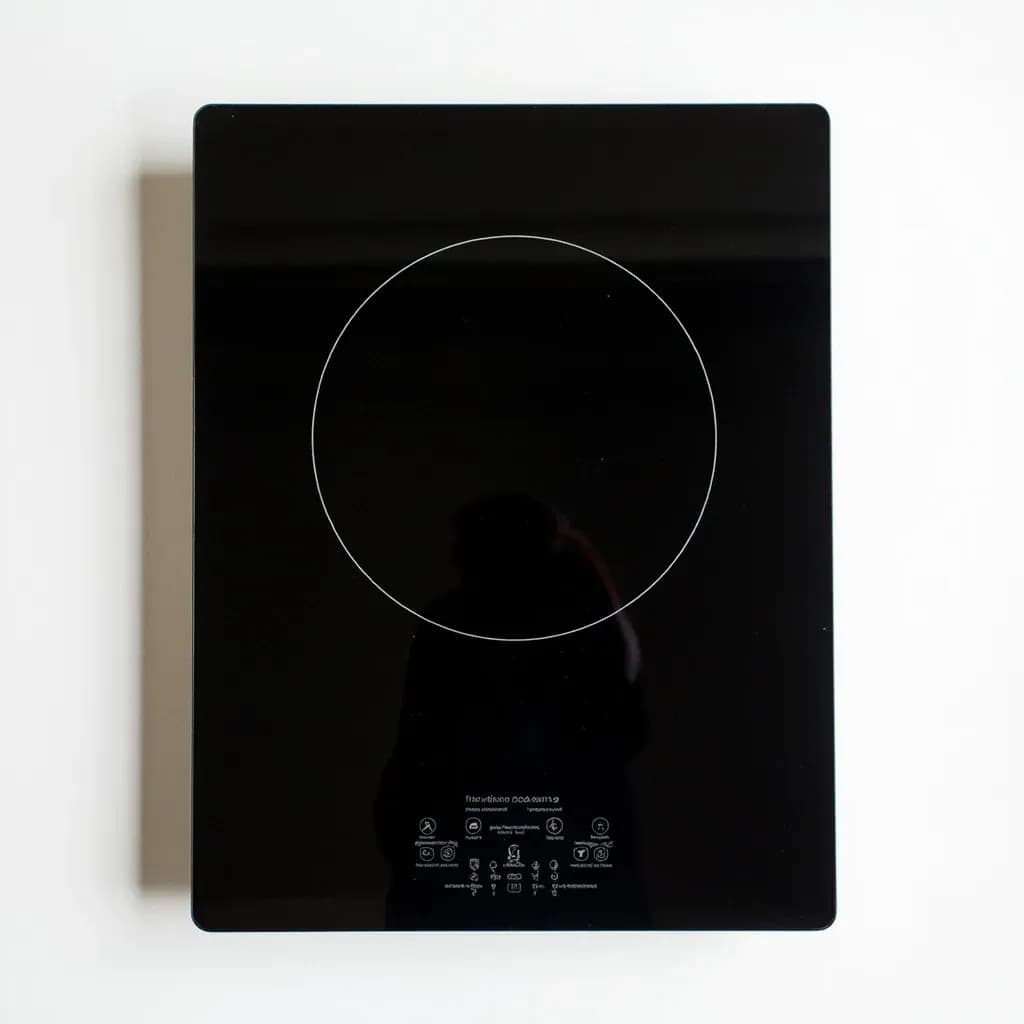
An induction cooktop uses an electromagnetic field to induce heat directly in compatible ferrous cookware, leaving the glass surface itself relatively cool. It heats faster than gas or radiant electric, offers very fine and instant temperature control, and is energy-efficient and easy to clean. It requires magnetic-bottomed pots such as cast iron or magnetic stainless steel.
An induction cooktop cooks the pan, not the air around it. Beneath the glass-ceramic surface sits a coil of copper wire that pulses with high-frequency alternating current, producing a magnetic field. When a ferromagnetic pan is set on the burner, that field induces swirling eddy currents inside the pan's own metal — and those currents are what generate the heat. The glass top stays relatively cool; only the small area under the pan warms up, mostly by conduction back from the pan itself.
That physics gives induction three practical edges over gas and radiant electric. First, response: a power change reaches the food in roughly a second, much closer to gas than to the slow ramp of a radiant coil. Second, efficiency — roughly 84 percent of the electricity drawn ends up in the food, against about 40 percent for an open gas flame and 70 to 75 percent for a smooth-top radiant element. Third, safety and comfort: no flame, no glowing coil, and the surface cools within a couple of minutes of the pan coming off, which makes kitchens cooler and considerably less hazardous.
The catch is cookware. Induction only works with magnetic metals — cast iron, enameled cast iron or steel, and most stainless-steel pans with a magnetic layer in the base. Aluminum, copper, glass, and ceramic don't respond unless the maker has bonded a steel plate to the bottom. The classic test is simple and worth committing to muscle memory: if a refrigerator magnet doesn't grip the base firmly, the pan won't heat. Once that constraint is satisfied, induction is the fastest, most controllable, and most energy-thrifty cooking surface available to a home cook.
Alternatives
Types & varieties
Drop-in unit, 30 in / 36 in / 45 cm widths, 2–5 zones; the most common residential form.
Single- or double-burner; useful for small kitchens, dorms, RVs, or as an auxiliary burner.
Narrow (15–30 cm) units that combine with gas, electric, or other modules in the same countertop cutout.
Full-size range with induction cooktop and oven; slide-in versions are common in new builds.
Downdraft vents built into the cooktop itself, useful where overhead hoods aren't possible.
Higher wattage per zone, reinforced glass, continuous-duty electronics; used in restaurants and pro kitchens.
Concave high-power burner shaped to cradle a round-bottom wok with a flat induction-compatible base.
Cookware compatibility in practice
Most modern cookware sold today carries a small induction-spiral stamp or a label, but the magnet test is faster and more reliable. Strong grip = good. A weak, sliding grip means the steel layer is too thin and the pan will heat slowly or not at all. All cast iron works, including enameled cast iron — Le Creuset, Staub, and similar Dutch ovens are excellent on induction. Among stainless, look for clad pans with a magnetic outer layer (All-Clad Stainless, Demeyere Proline, Tramontina Tri-Ply Clad); the cooking surface may be non-magnetic, but the base is engineered for induction. Vintage aluminum and copper pans need a steel interface disk, which works but adds thermal mass and slows response. Note that a warped base will not sit flat on the glass, and induction's tight contact means you will hear a buzz and see uneven heating — the disk is also an easy fix here.
- Cast iron and enameled cast iron are ideal — flat, heavy, fully magnetic.
- Three-ply stainless with a magnetic outer layer is the standard for serious home cooks.
- Aluminum, copper, glass, and ceramic only work with a bonded steel plate in the base.
- A refrigerator magnet is the fastest field test; weak grip = weak heating.
- An induction interface disk lets non-magnetic pans work, but slows response noticeably.
Where induction falls short
Induction is not a perfect substitute for every other cooking method. Round-bottom carbon-steel woks need either a concave induction zone or an induction wok adapter to perform traditional stir-frying; even then, you sacrifice much of the intense heat at the pan walls that gives wok hei its characteristic sear. Long home-canning boils can also be tricky — induction's rapid on/off cycling may interrupt a rolling boil in jars at low settings, which many canners find unsettling enough that they prefer gas or a smooth-top electric for very long boils. And because the electronics generate heat internally, induction always needs proper ventilation; do not assume a flameless cooktop means no hood is required. Steam, grease vapors, and the heat coming off the food itself still need to be exhausted.
- Round-bottom woks lose much of their high-heat performance without a concave zone.
- Very long, low boils (some home-canning sessions) may cycle on and off.
- Internal cooling fans require clear airflow under the unit — check clearances during install.
- Hood ventilation is still required for steam and grease, despite the absence of combustion gases.
Common uses
Tips & pitfalls
- Test pans with a refrigerator magnet before buying — if it doesn't grip firmly, the pan won't heat.
- Match pan diameter to the printed zone circle; pans that are too small lose efficiency, oversized pans waste heat at the edges.
- Use flat-bottomed pans — warped bases cause buzzing, uneven contact, and power cycling.
- Don't preheat an empty pan on boost; induction can overheat a pan faster than gas or radiant, and dry cast iron can climb to dangerous temperatures within minutes.
- Expect a faint hum, buzz, or clicking during use — it's the cooling fan and the pan's metal layers vibrating at high frequency, not a defect.
- Keep pan undersides clean; burnt-on residue on the base can fuse to the glass surface and become very difficult to remove.
- Clean only with a ceramic/glass cooktop cleaner and a soft scraper; abrasive powders, SOS pads, and steel wool will scratch the surface.
- Lift, don't slide, heavy pans across the glass to prevent scratches; cast iron in particular can leave metal marks that are hard to buff out.
- Start at 5 or 6 of 10 instead of max — induction's bottom-end output is usually much higher than radiant electric's, so the same setting cooks faster.
- Use the boost setting sparingly; most units cycle off after a few minutes to protect the coil, so don't rely on it for steady cooking.
Good to know
- Cooking principle
- Electromagnetic induction — a coil beneath the glass generates an alternating magnetic field that induces eddy currents in ferromagnetic cookware, heating the pan itself.
- Cookware required
- Magnetic-base pans: cast iron, enameled steel, and magnetic-grade stainless steel. A magnet must stick firmly to the base.
- Cookware that won't work
- Aluminum, copper, glass, ceramic, and most non-magnetic stainless steel unless they have a bonded magnetic plate.
- Energy efficiency
- Roughly 84% of input energy reaches the food, vs. ~40% for gas and ~70–75% for radiant electric.
- Response time
- Heat change is nearly instantaneous — closer to gas than to radiant electric.
- Typical zone power
- 1.4–2.6 kW standard, 3.0–3.7 kW on boost in consumer models; commercial units run higher.
- Pan-size detection
- Most units auto-shutoff if no pan is present or the pan is too small (typically under ~4–5 in / 10–12 cm diameter).
- Surface temperature
- Glass-ceramic top stays relatively cool; only the area under the pan gets hot, mostly via pan-conducted heat.
- First modern home unit
- General Electric demonstrated a countertop induction cooker at the 1971 National Home Equipment Show; production consumer models followed in the 1970s.
Also called
Induction Hob · induction burner · IH cooktop · electric induction cooktop · Placa d'Inducció
Related

Stovetop
The everyday burners where most cooking actually happens

Oven
Enclosed dry heat for roasting, baking, and braising

Grill
Live-fire or gas grates for char, smoke, and high heat

Smoker
Low, slow heat and wood smoke for barbecue and brisket

Air Fryer
Countertop convection that crisps with little or no oil

Slow Cooker
Set-and-forget low heat for stews, beans, and braises

Pressure Cooker
Sealed steam pressure that cooks tough food in a fraction of the time

Rice Cooker
Foolproof, perfectly steamed rice every single time