Appliances & Heat
Jar Sterilizer / Oven
Equipment that heat-sterilizes glass jars and lids before canning and preserving.
A jar sterilizer uses dry oven heat or boiling water to kill microbes on jars and lids before they are filled with preserves, pickles, or sauces. Home and commercial canners use it as a critical safety step so put-up foods keep without spoiling. Jars are typically heated until hot and kept warm right up to filling to avoid thermal shock.
A jar sterilizer is the piece of equipment that turns a clean glass preserving jar into a microbiologically safe, ready-to-fill container for home canning. Whether the job is done by an electric countertop steam unit, a boiling-water bath canner, a tall stockpot, or simply a home oven, the goal is twofold: kill residual yeasts, moulds, and bacteria on the glass surface, and bring the jar up to temperature so it can accept a hot fill without cracking. This matters because the standard two-piece Mason-style lid — a single-use flat disc with a rubber or plastisol gasket and a reusable screw band — only forms a reliable vacuum seal if the jar rim is clean, unchipped, and warm food is poured in hot. The sterilizer is the prerequisite step; the seal happens later as the jar cools.
The four practical home methods each have a different personality. Oven dry-heat is the most accessible — every kitchen has one — but is the slowest and least energy-efficient. Boiling-water bath in a canner or stockpot is the North American default because the same vessel both sterilizes empty jars and then processes the filled jars of high-acid food. Electric steam sterilizers, common in the UK and Europe, hold six to nine jars per cycle and finish in about ten minutes, which is ideal when you are making several batches of jam in an afternoon. The dishwasher sterilize cycle is convenient but does not reliably reach validated sterilization temperatures on every machine, so treat it as a hot-wash-plus-warm rather than a true sterilize.
A note on what sterilizing actually does, and does not do, for you. The USDA's Complete Guide to Home Canning states that full heat-sterilization of empty jars is only required for recipes processed in a boiling-water bath for less than ten minutes; for anything else, a hot, soapy wash followed by a hot rinse and keeping the jars warm is sufficient, because the later water-bath or pressure processing finishes the job. Sterilization also does not replace processing: filling a sterilized jar with, say, raw carrots and sealing the lid will not make a safe shelf-stable pickle. Think of the sterilizer as preparing the glass, not preserving the food.
Alternatives
Types & varieties
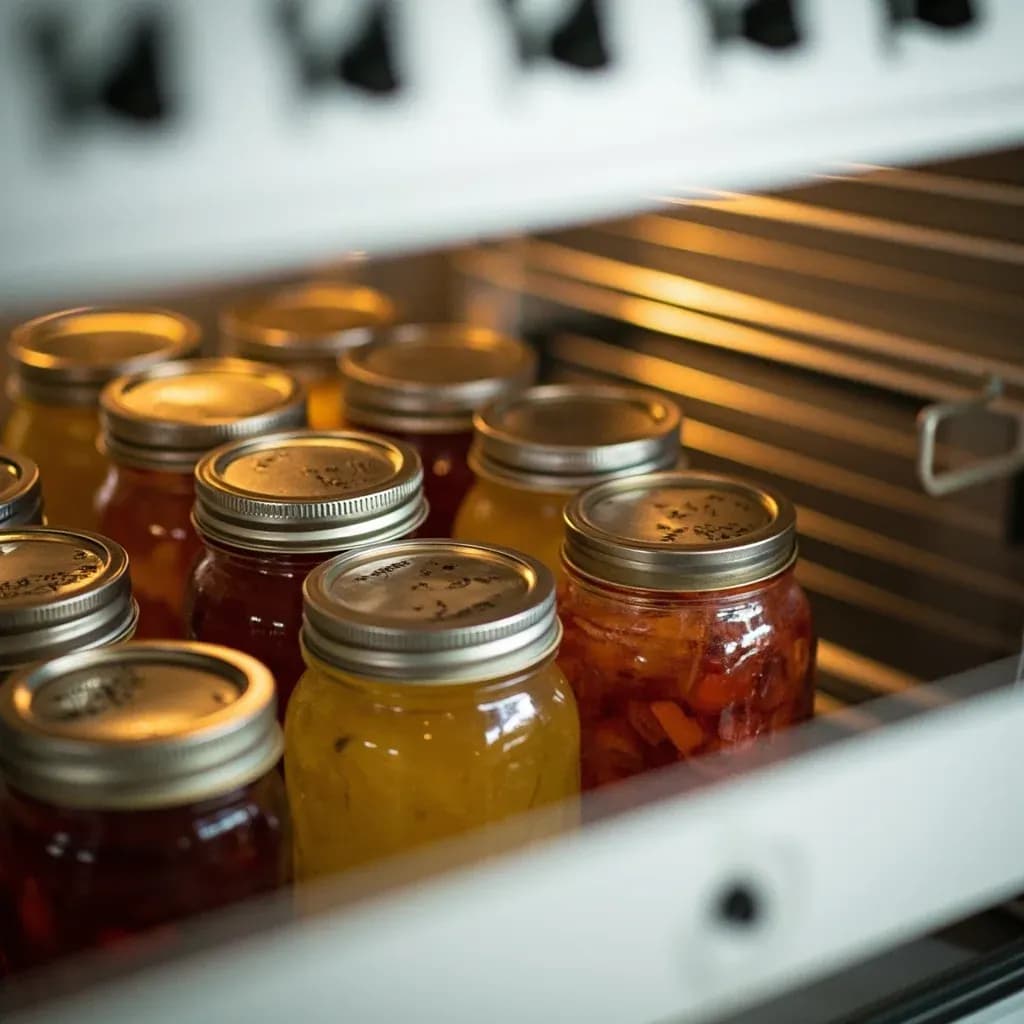
Home oven at 120–135 °C with jars on a rack for 15+ minutes; no special gear needed, but slower and more energy-hungry than other methods.
Jars fully submerged on a rack in a water-bath canner or tall stockpot; doubles as the processing vessel for filled high-acid jars, making it the North American default.
Countertop unit that holds jars upright over a heating element; about 10 minutes per cycle for 6–9 jars, popular in the UK and European home-preserving tradition.
Hot wash plus heated-dry cycle used to clean and pre-warm jars; convenient but not all machines reach validated sterilization temperatures.
Small jars with about 2 cm / ¾ in of water microwaved 2–3 minutes; suitable only for very small glass jars without metal lids.
Pressurized steam sterilization used for low-acid commercial canning; not a home method, but the reference standard for guaranteed sterility.
Choosing a method
The right sterilizer depends on what you are preserving and how often. A weekend jam-maker needs only an oven and a stockpot; a serious seasonal preserver who runs twenty kilos of tomatoes in August will want a water-bath canner (and, for low-acid vegetables, a pressure canner) far more than a steam unit. Steam sterilizers earn their keep when you make small batches frequently, because they pre-warm jars in minutes without heating the kitchen.
Sterilizing vs. processing
These two terms are often muddled in home kitchens. Sterilizing is what you do to the empty jar beforehand; processing is what you do to the filled, lidded jar afterwards, usually in the same boiling-water bath or in a pressure canner. Sterilizing alone does not make food safe to store on a shelf — only a properly timed water-bath (for high-acid foods) or pressure-canner (for low-acid foods) does that.
Troubleshooting seal failures
Most failed seals trace back to one of four causes: a nicked or chipped jar rim, food or syrup on the rim before the lid goes on, a reused flat lid whose gasket has lost its tack, or jars filled with food that was not hot enough to contract and pull a vacuum as it cooled. Check rims with a fingertip before each fill, wipe them with a damp paper towel, always use a new flat lid, and keep jars hot until the moment of fill.
Altitude adjustments
Water boils at a lower temperature as elevation rises, so both sterilization and processing times lengthen above 1,000 ft / 300 m. Add 1 minute per 1,000 ft to water-bath sterilization, and follow your canner's altitude chart for processing. For low-acid foods (vegetables, meats, seafood) a pressure canner is required at every altitude — boiling water never reaches a high enough temperature to make them shelf-stable, and the deficit only widens as you climb.
Common uses
Tips & pitfalls
- Always inspect jar rims for nicks and chips; even a hairline crack prevents a vacuum seal and ruins the whole batch.
- Never put a cold or wet jar into a hot oven — bring jars up to temperature together from room temperature, or warm them in a low oven before filling.
- Use a rack or folded tea towel under jars in the oven; direct contact with a hot metal shelf can cause thermal-stress fractures in tempered glass.
- Sterilize more jars than you think you will need — running out mid-fill is the surest route to under-processed preserves.
- Keep sterilized jars warm in a 95–110 °C / 200–230 °F oven until the moment of fill so the hot preserve does not cool on contact with the glass.
- Use a new flat lid every time; the gasket only seals once. Bands can be reused but should be rust-free and undented.
- Leave headspace exactly as the recipe specifies — typically ¼ in / 6 mm for jams and jellies, ½ in / 12 mm for fruit in syrup. Too little and the seal fails; too much and food can spoil under the lid.
- Do not try to 'oven-cure' filled jars as a substitute for water-bath or pressure processing — dry heat does not penetrate food evenly and cannot guarantee safety for low-acid preserves.
- If a sealed jar shows a lid that flexes up and down when pressed after 12–24 hours of cooling, refrigerate it and use within a few weeks rather than reprocessing.
Good to know
- Primary purpose
- Heat-sterilize glass preserving jars and lids so they are microbiologically clean and warm when filled, reducing spoilage risk in home canning.
- Common home methods
- Oven dry-heat, boiling-water bath (canner or stockpot), electric steam sterilizer, dishwasher cycle, and microwave steam for small jars only.
- Oven method
- 120–135 °C / 250–275 °F for at least 15 minutes, jars on a rack, never directly on a metal shelf.
- Boiling-water method
- Fully submerged jars for 10 minutes, plus 1 extra minute for every 1,000 ft / 300 m of altitude above sea level.
- USDA guidance
- Empty-jar sterilization is only mandatory when the filled jar will be water-bath processed for under 10 minutes; otherwise a hot wash plus hot rinse suffices.
- Lid system
- Two-piece: a single-use flat sealing disc with a rubber/plastisol gasket, plus a reusable screw band; the disc only seals once.
- Electric sterilizer capacity
- Countertop steam units typically hold 6–9 jars per cycle, finishing in roughly 10–12 minutes once up to temperature.
- Safety ceiling
- Do not exceed about 160 °C / 320 °F, and never put a cold or wet jar into a hot oven — thermal shock cracks tempered canning glass.
Also called
jar sterilizer · canning sterilizer · bottle sterilizer
Related

Stovetop
The everyday burners where most cooking actually happens

Oven
Enclosed dry heat for roasting, baking, and braising

Grill
Live-fire or gas grates for char, smoke, and high heat

Smoker
Low, slow heat and wood smoke for barbecue and brisket

Air Fryer
Countertop convection that crisps with little or no oil

Slow Cooker
Set-and-forget low heat for stews, beans, and braises

Pressure Cooker
Sealed steam pressure that cooks tough food in a fraction of the time

Rice Cooker
Foolproof, perfectly steamed rice every single time