Appliances & Heat
Kimchi Refrigerator (Gimchi-naengjango)
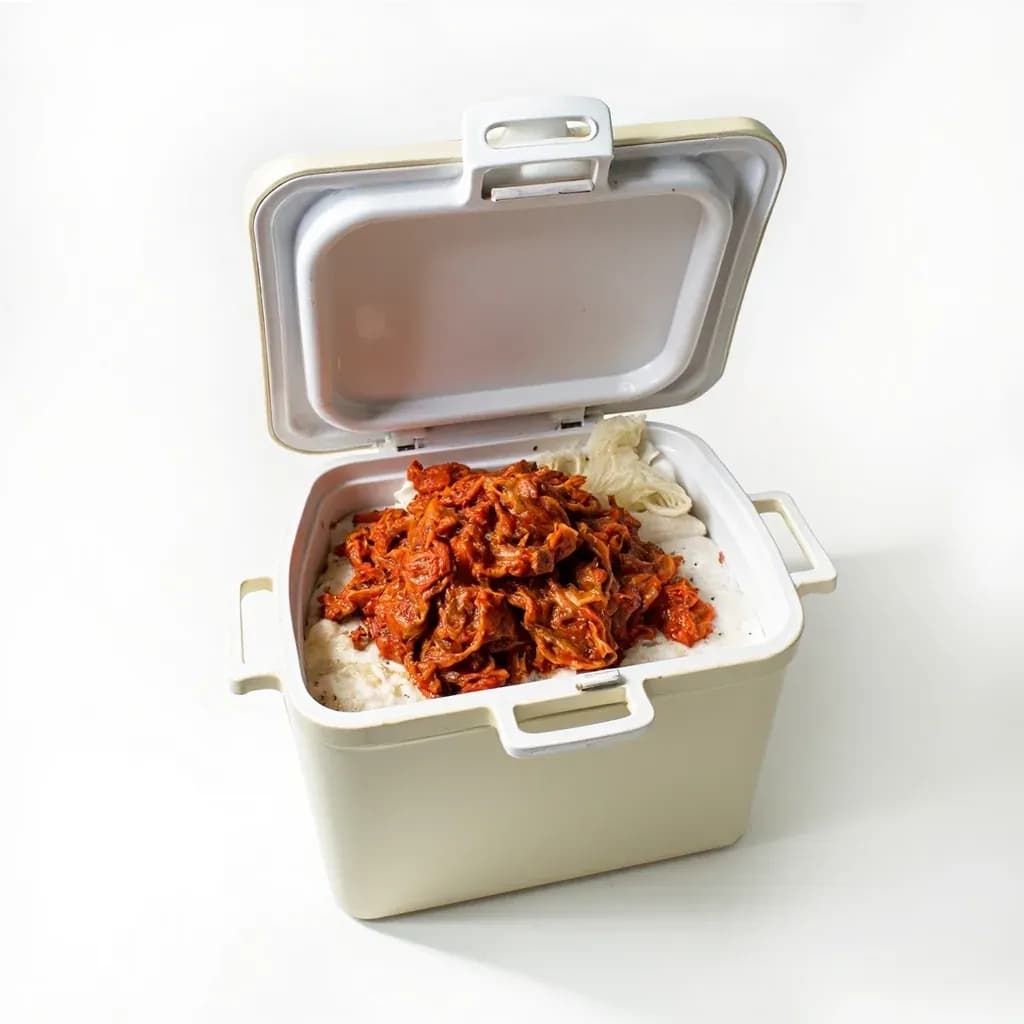
A specialized fridge that holds steady low temperatures to ferment and store kimchi.
A kimchi refrigerator keeps a very stable, slightly-above-freezing temperature ideal for fermenting and long-term storing kimchi and other Korean banchan. Households use it because ordinary fridges fluctuate too much and let kimchi over-ripen or pick up odors. Many models have separate compartments with modes for active fermentation versus storage.
A kimchi refrigerator (gimchi-naengjango, 김치냉장고) is a dedicated cold-storage appliance built around the specific needs of fermented Korean vegetables. Kimchi is alive: lactic bacteria continue working long after it is packed, and the texture and flavor of the cabbage, radish, or other vegetables depend on holding that fermentation at a steady, cool pace. A standard home refrigerator runs too warm and too dry for this, and its single, large compartment cannot give one household the flexibility to keep a fresh batch ripening while another drawer of well-aged kimchi sits quietly on hold.
The defining features of a kimchi fridge are: temperatures that sit just above freezing — typically -5°C to 5°C depending on the drawer and mode — without dipping low enough to freeze the vegetables; humidity noticeably higher than a normal fridge, so cabbage leaves stay plump rather than wilting at the edges; and independent compartments, often a stack of three to five drawers, each with its own temperature setting. Most models also include a fermentation mode for new kimchi, a storage mode for aged kimchi, a quick-cool function for loading warm, freshly made batches, and a replaceable carbon or ion deodorizer to manage the persistent, sulfurous aroma.
Outside Korea, a kimchi refrigerator remains a specialty item sold through Korean grocers and a handful of mainstream retailers. For cooks who make kimchi in large batches, age several kinds at once, or simply refuse to compromise on texture, it is a meaningful upgrade. For most casual users, a standard refrigerator set to 0–2°C with kimchi held in sealed containers in the coldest part of the cabinet is a workable substitute for short- to mid-term storage — though it cannot match the multi-zone control that lets a Korean household keep three different stages of kimchi under one roof.
Alternatives
Types & varieties
Small footprint with one to two drawers; suited to small households, apartments, or as a secondary storage unit beside a regular fridge
The classic home design: a tall cabinet with three to five independently temperature-controlled drawers stacked behind one door
Larger capacity with separately controlled columns, often used to keep fermenting kimchi on one side and long-aged kimchi on the other
Premium LG and Samsung units combining a dedicated kimchi section with a separate fresh section for fruits, vegetables, and dairy
Smaller drawer-style units designed for Western kitchens; the style most often sold in North America and Europe
Walk-in rooms or large upright units used by kimchi manufacturers, markets, and restaurants; not consumer appliances
How it differs from a standard refrigerator
Three engineering choices set a kimchi fridge apart, and understanding them explains why ordinary fridge storage never quite matches the result.
Temperature precision and range. A normal home refrigerator usually holds 2–5°C, but it cycles more widely, and the door area warms every time it opens. A kimchi fridge is built to hold a tighter band, often with a dedicated sensor per drawer, and most offer a true fermentation setting around 0–2°C and a colder storage setting for aged kimchi that should be put on pause.
Humidity. Standard refrigerators run dry, which is fine for dairy and leftovers but causes the outer leaves of cut cabbage to desiccate and turn brown within days. Kimchi drawers are designed to keep humidity at 65–85%, with the higher end for younger, fresher kimchi and the lower end for well-aged kimchi you want to keep firm rather than mushy.
Zoning. The single biggest practical advantage is the stack of independent drawers. A Korean household regularly keeps fresh baechu-kimchi ripening, a mid-aged batch ready for the table, and a long-aged mukeunji for winter stews — all at different ideal temperatures. One appliance, three different environments.
What to look for when buying
Not every kimchi fridge is built the same way, and a few features separate a genuinely useful unit from an expensive regular fridge with a Korean label.
Per-drawer temperature control is the single most important spec. Avoid models that offer only one or two temperature settings shared across all compartments; the whole point is to run different stages of fermentation simultaneously.
A replaceable deodorizing filter matters more than the marketing copy suggests. Kimchi odor is persistent, and once the carbon or ion cartridge is saturated it will transfer to anything stored nearby. A user-replaceable filter keeps the unit usable for years; a sealed one limits its lifespan.
Inverter compressors are quieter, more energy-efficient, and hold temperature more steadily than fixed-speed units — a meaningful difference in an appliance that runs continuously.
For non-Korean kitchens, pay attention to footprint and door clearance. Many Korean-market units are taller and deeper than European or American cabinetry expects, and the drawer pulls require clearance in front. Under-counter and French-door export models exist for this reason.
Common uses
Tips & pitfalls
- Set newly packed kimchi in fermentation mode for the first one to two weeks, then switch that drawer to a colder storage mode once the sourness reaches the level you want — most home cooks over-ferment because they never reduce the temperature
- Leave clear headspace in every container; kimchi continues to release liquid, and a tightly packed, full container will leak brine into the drawer and contaminate anything else stored there
- Keep kimchi in glass or BPA-free plastic containers inside the drawers rather than loose; the drawers themselves are not designed to hold liquid, and brine absorbed into plastic liners is nearly impossible to fully remove
- Use the higher-humidity drawer for younger kimchi and the lower-humidity drawer for well-aged kimchi you want to keep firm — a common mistake is treating all drawers identically, which produces both over-soft young kimchi and over-dry aged kimchi in the same appliance
- Clean the door gaskets and run a deodorizing cycle every one to two months; kimchi odor transfers to dairy and eggs stored in the same unit faster than most people expect, and a saturated filter cannot be fixed by wiping
- Do not store raw fish, blue cheese, or other strongly aromatic foods in the same drawers as kimchi — even with a deodorizer, kimchi absorbs odors readily and is harder to fix than the contaminating food
- Avoid letting the temperature dip below 0°C for extended periods; the unit is designed to sit just above freezing, and sub-zero cycling ruptures cabbage cell walls, producing a soft, watery texture on thaw
- If you age kimchi for many months — mukeunji, for example — dedicate one drawer and hold it at the coldest stable setting to slow over-fermentation rather than moving the batch around the appliance
Good to know
- Korean name
- 김치냉장고 (gimchi-naengjango)
- Origin
- South Korea; dedicated consumer models launched in the mid-1990s, with LG releasing one of the first widely sold units in 1995
- Primary function
- Precise temperature and humidity control for fermenting and storing kimchi, with independent zones
- Typical temperature range
- Roughly -5°C to 5°C, set per drawer
- Humidity control
- Adjustable per compartment, generally 65–85%
- Capacity range
- Home units commonly 200–400 L; large multi-door models exceed 600 L
- Construction
- Tall upright cabinet, airtight gaskets, carbon or ion deodorizer, often inverter compressor
- Distinct from a regular fridge
- Holds kimchi just above 0°C without freezing and at higher humidity, preventing the leaf drying common in standard refrigerators
- Lifespan
- Typically 10–15 years with regular gasket and filter maintenance
Also called
kimchi fridge · gimchi-naengjango · 김치냉장고
Related

Stovetop
The everyday burners where most cooking actually happens

Oven
Enclosed dry heat for roasting, baking, and braising

Grill
Live-fire or gas grates for char, smoke, and high heat

Smoker
Low, slow heat and wood smoke for barbecue and brisket

Air Fryer
Countertop convection that crisps with little or no oil

Slow Cooker
Set-and-forget low heat for stews, beans, and braises

Pressure Cooker
Sealed steam pressure that cooks tough food in a fraction of the time

Rice Cooker
Foolproof, perfectly steamed rice every single time