Appliances & Heat
Koji Incubator
A warm, humid chamber that grows Aspergillus koji mold on grains for miso, sake, and soy.
A koji incubator maintains the steady warmth and humidity that Aspergillus oryzae needs to colonize cooked rice, barley, or soybeans. Fermenters use it over a day or two to cultivate koji, the mold base for miso, soy sauce, sake, amazake, and shio koji. Precise temperature control is critical, as the mold dies if it gets too hot and stalls if too cool.
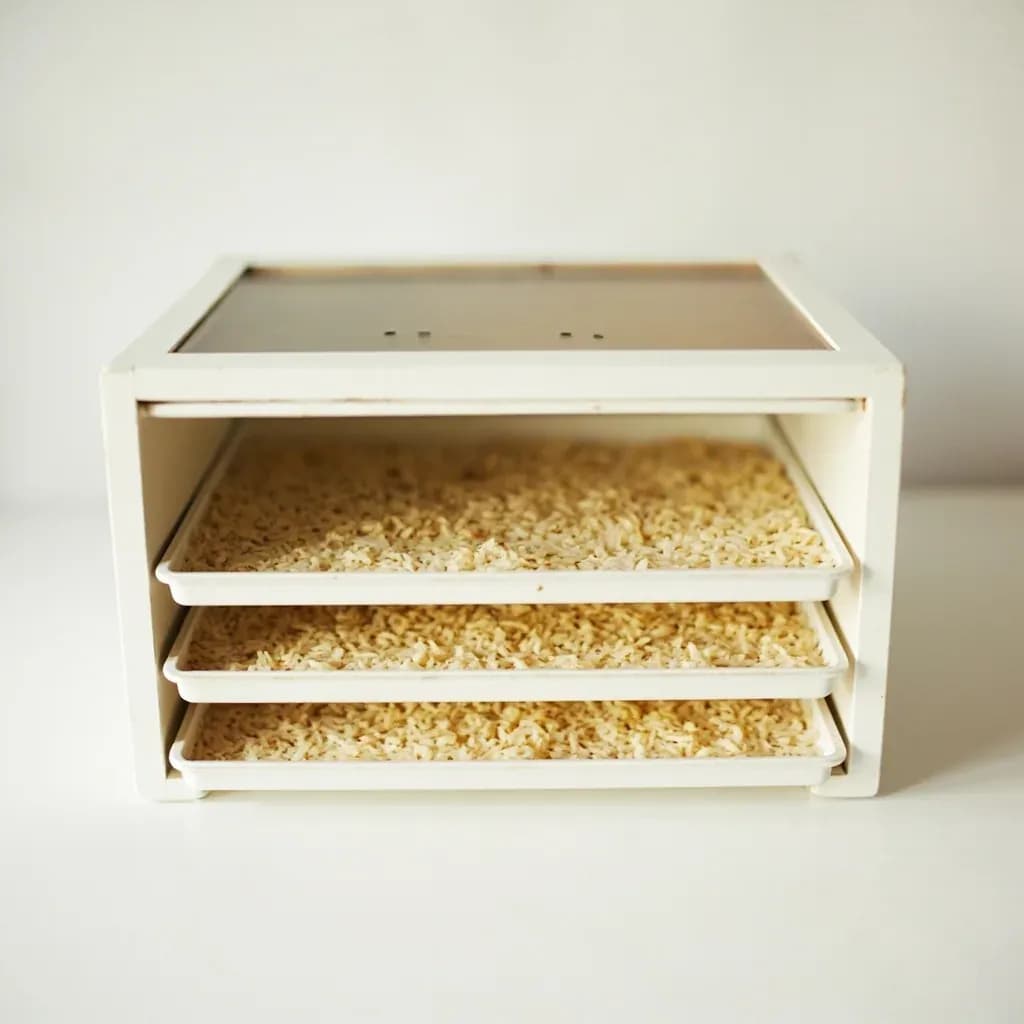
A koji incubator is a warm, humid chamber tuned to the narrow conditions Aspergillus oryzae needs to colonize cooked grains. In a brewery it is an insulated koji muro with stacked cedar trays, steam injection, and timed ventilation; at home it is most often a converted wine fridge, a styrofoam cooler with a heat mat, or a countertop unit, all governed by a probe thermostat holding roughly 30°C and 70–80% relative humidity. The name is slightly misleading — the incubator does not create the koji. It simply holds the environment steady while the spores you sprinkled onto steamed rice, barley, or soybeans germinate, knit a web of mycelium through the grain, and excrete the enzymes (amylases, proteases, lipases) that later convert starches to sugars and proteins to savory amino acids.
A. oryzae is a finicky organism. It grows well only between about 28 and 32°C, with 30°C as the standard setpoint, and needs near-saturated air to keep the grain surface from drying before the mycelium takes hold. A swing of even three or four degrees changes the outcome: too cool and the koji is sluggish and low-activity; too warm and the culture dies, inviting contamination signaled by black, green, or pink mold and ammoniac off-aromas. A kitchen oven, dehydrator, or sunny counter cannot hold this band reliably overnight, which is why a dedicated chamber — even a cheap one — earns its keep.
In practice a home incubator is a small insulated box with three jobs: deliver gentle heat, raise humidity without soaking the grain, and allow a controlled trickle of fresh air to bleed off the CO₂ the mold exhales. The default DIY build is a beverage cooler with a low-wattage heat mat, an ultrasonic humidifier, and a plug-in probe controller — quiet, ±1°C stable, and roomy enough for two or three trays. A koji bed is thin, typically 2–3 cm, and is broken up and remixed once mid-incubation to release CO₂ and redistribute moisture. Read the koji, not just the thermometer: the goal is a snowy white coat of fine mycelium, tiny "mizu" dewdrops on the grain, and a faint sweet, chestnut-like aroma.
Alternatives
Types & varieties
Large insulated chamber with HVAC and stacked cedar trays; used in sake breweries and miso factories for hundreds of kilograms per batch.
The most popular DIY route: a thermoelectric or compressor beverage cooler fitted with a reptile heat mat and an ultrasonic humidifier, governed by a probe thermostat.
Inexpensive entry-level build using a fishing or incubator heat mat and a dish of water for humidity; suitable for 1–3 kg test batches.
Purpose-built Japanese countertop units with integrated heater, humidifier, and timer; precise but costlier than DIY.
Immersion circulator in a water bath inside a well-insulated cooler for very stable temperature; small experimental batches only.
Off-the-shelf incubator with built-in thermostat; works for hobbyists but usually needs added humidity and airflow.
Bread proofing cabinets adapted with higher humidity and a slightly lower setpoint (30°C vs ~27°C typical for dough).
The Humidity Balancing Act
Heat is the easy part; humidity is where home koji makers get into trouble. The grain needs near-saturation at the surface so that spores can germinate and the mycelium can knit across it, but the chamber air cannot be so wet that water beads on the walls and drips back onto the bed. A 2°C difference between grain and air, or a sudden door opening, can fog a styrofoam cooler in seconds.
- An ultrasonic humidifier with its own float switch is more controllable than a tray of standing water.
- Aim the humidifier's mist away from the grain and toward an empty corner of the chamber.
- If you see fog or heavy condensation on the lid, drop humidity by ~5% or raise the setpoint 1°C to drive it off.
- A damp (not dripping) kitchen towel laid beside the trays is a low-tech alternative that rarely over-humidifies.
- Finished koji should look matte white with dewdrops, never glossy or beaded with free water.
Common uses
Tips & pitfalls
- Sterilize trays, hands, and the chamber interior with 70% alcohol or dilute vinegar before each batch — black, green, or pink mold contamination will ruin the koji.
- Never let the chamber exceed 35–37°C; A. oryzae dies above this and you will get a sour, ammoniac, or alcoholic off-aroma instead of the sweet chestnut scent.
- Spread cooked grains in a shallow, even 2–3 cm layer; deep beds stay cool in the center and overheat at the edges, leading to uneven enzyme production.
- Use a plug-in probe thermostat (e.g. Inkbird or Ranco-type) rather than the incubator's built-in dial for tighter ±1°C control.
- At 20–24 hours, break up and remix the clumping grains (tawashi) to release CO₂, redistribute moisture, and re-flatten the bed — standard sake practice that helps home batches too.
- Aim for visible 'mizu' — fine dewdrops forming on grains by mid-to-late incubation; no dew means humidity is too low and the surface is drying out.
- Cook grains to roughly 35% moisture (wet-weight basis) before inoculation: too wet encourages bacterial souring, too dry and spores germinate unevenly.
- If condensation drips from chamber walls onto the koji, raise the temperature a degree or reduce humidifier output — drips create wet spots that harbor contaminants.
Good to know
- Target temperature
- 28–32°C (≈82–90°F), with ~30°C as the standard setpoint
- Target humidity
- 70–80% relative humidity
- Incubation time
- 36–48 hours for rice koji; 50–60 hours for barley or soybean koji
- Heat source
- Electric heating element or silicone heat mat, paired with a probe thermostat (PID or plug-in controller)
- Humidity source
- Ultrasonic humidifier, open water tray, or damp towel
- Sign of success
- Snowy white mycelium, a faint sweet-spicy chestnut aroma, and fine 'mizu' dewdrops on the grain
- Ventilation
- Chambers need limited fresh-air exchange; fully sealed boxes stall growth from CO₂ buildup
- Substrate
- Steamed rice, barley, or soybeans inoculated with Aspergillus oryzae (yellow-green) or A. sojae (for shoyu)
- Grain bed depth
- 2–3 cm; deeper beds run cool in the center and overheat at the edges
Also called
koji incubator · koji chamber · muro
Related

Stovetop
The everyday burners where most cooking actually happens

Oven
Enclosed dry heat for roasting, baking, and braising

Grill
Live-fire or gas grates for char, smoke, and high heat

Smoker
Low, slow heat and wood smoke for barbecue and brisket

Air Fryer
Countertop convection that crisps with little or no oil

Slow Cooker
Set-and-forget low heat for stews, beans, and braises

Pressure Cooker
Sealed steam pressure that cooks tough food in a fraction of the time

Rice Cooker
Foolproof, perfectly steamed rice every single time