Appliances & Heat
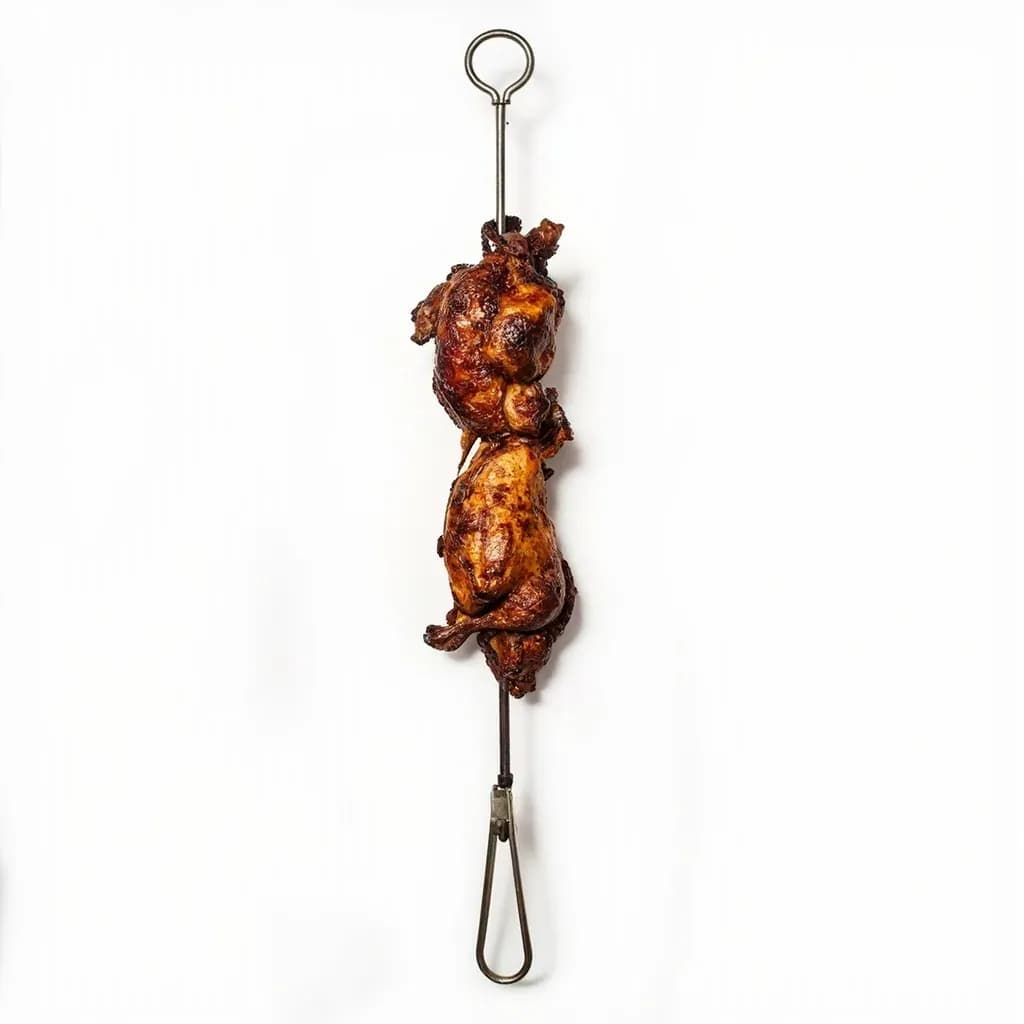
Lechón Rotisserie Spit (La Vara)
A long pole skewer that holds a whole pig for slow rotisserie roasting over coals.
A lechón rotisserie spit, or la vara, is a long sturdy pole, traditionally bamboo or steel, that runs through a whole pig so it can be turned slowly above a bed of charcoal. Constant rotation bastes the pig in its own fat and crisps the skin evenly for Filipino lechón. The spit rests on forked supports and is turned by hand or a motor for hours until the skin is glassy and crackling.
The lechón rotisserie spit — la vara in Cuban and Caribbean Spanish — is a long, rigid rod that runs the length of a whole pig, lifting and turning it over a slow bed of hardwood coals. Unlike the geared rotisseries of a modern backyard grill, this is a deliberately simple tool: a straight shaft, two forked posts to rest it on, and the muscle of a cook (or a small motor) to keep the carcass rotating. Its proportions — typically six to eight feet of square-section steel — exist because the animal does. A whole suckling pig or market hog is too heavy and too long to manage any other way, and the square cross-section is a small but critical detail: a round rod lets the carcass spin freely around the shaft, loosening bindings and shifting the animal off-balance over the fire.
Roasting on the spit is a low-and-slow discipline. The fire is held to a perimeter of coals at roughly 250–300°F at the carcass surface, with radiant rather than direct heat crisping the skin while the interior cooks gently toward 160°F in the deepest part of the shoulder. A suckling pig can finish in three to five hours; a full market hog will run six to ten or more, which is why this is festival and feast cooking rather than weeknight cooking. The reward is the entire pig translated into one dish: mahogany crackling skin, moist dark meat at the shoulder, rich fatty belly, and the social theater of a single animal turning in the open air.
The spit carries centuries of cultural weight behind it. Pre-Columbian Taíno cooks roasted whole animals on wooden poles; Spanish colonizers adopted and refined the method in Cuba, Puerto Rico, and the Dominican Republic, and the Manila galleon trade carried it to the Philippines, where lechón remains a regional signature. Choosing a spit comes down to matching rod length and capacity to the animal you intend to cook — and committing to the fire management that decides whether the feast lands.
Alternatives
Types & varieties
Long square-section steel rod driven lengthwise through the carcass, head to tail, supported on two forked posts over a coal bed; pig is tied or pinned on with wire.
Shorter (3–5 ft) spit designed for a tabletop or stand-mounted motor; well suited to suckling pigs and lamb, but not to full-size hogs.
Spit with a battery- or electric-driven rotisserie motor that turns the rod continuously, eliminating manual cranking; common for backyard setups.
Green hardwood or thick bamboo pole used in traditional Philippine lechon and rural Dominican puerco asado; effectively single-use because it chars through.
Heavy-gauge internal rod used inside the 'Chinese box' roasting method; anchors the pig inside the covered box while coals sit on the lid.
A T- or cross-shaped iron used for smaller animals or quartered halves; common in Argentine asado and Mexican barbacoa for lamb or goat.
Choosing and Setting Up a Spit
Selecting a spit is mostly a matter of matching three numbers — rod length, capacity, and the size of the cooking frame you can build or buy. A 6-foot rod handles a suckling pig with room to spare; a full market hog needs 7 to 8 feet, plus a frame wide enough to keep the carcass clear of the coals. The two non-negotiables are square cross-section and a secure way to pin or wire the animal on, because an unbalanced pig will not turn properly and may shear the supports in a worst case. Carbon steel is cheaper and traditional but needs oiling; stainless is heavier, costs more, and forgives the occasional rainstorm.
- Measure the longest animal you realistically plan to cook, then add 12–18 inches of rod past each end for support and tying.
- Square stock of 3/4" to 1" is the sweet spot for hogs up to about 100 lb; go to 1.25" for very large sows.
- Y-forked hardwood posts (horquetas) are the traditional support and work fine for occasional cooks; a welded rebar or steel frame is more durable for catering.
- To motorize, the spit must be perfectly straight and balanced — a wobbly rod will hammer the motor and the pig alike.
Fire Management and the Cook
The discipline of the lechón cook is fire, not meat. Build the fire well in advance and let it burn down to a deep bed of glowing coals; the flames that look impressive in photos are the enemy of even cooking. Push the coals into a ring or perimeter around (not under) the carcass, so the loin and tenderloin — the leanest, most exposed parts — do not scorch while the thicker shoulder and ham catch up. Plan the cook in shifts: the first two to three hours with skin toward the heat to set the crackling, then rotate. Resist the urge to baste; every brush of fat or marinade softens the skin you have spent hours drying out.
- Target 250–300°F at the carcass surface, measured with an infrared thermometer aimed at the skin, not the coals.
- Use a drip pan or a bed of yuca, malanga, or leafy greens under the carcass to catch fat and double as a side dish.
- Probe the deepest part of the shoulder and the thickest part of the ham; both should read 160°F+ before resting.
- A 20–30 minute rest, tented loosely with foil, lets juices redistribute and firms the crackling back up for carving.
Common uses
Tips & pitfalls
- Use a square cross-section rod whenever possible — a spinning pig inside its own skin will not slide off a square shaft the way it can on a round one.
- Pre-trim the rod's entry points through the pelvis and shoulder so the pig slides on smoothly; a dull or burred rod tears the skin and lets juices escape.
- Weigh or pin the carcass with heavy wire (alambre) and S-hooks at the hocks and jaw so the center of gravity stays balanced on the supports — an off-balance pig refuses to turn and may fall.
- Build the fire as a perimeter of coals, not a single pile directly under the spine; even radiant heat is what crisps the skin without burning the loin.
- Marinate or season the night before and inject the interior cavity with mojo or a saltwater brine — a surface rub alone will not season a whole hog.
- Start the pig with the skin side toward the heat and rotate from there; resist continuous basting, which softens the prized chicharrón.
- Common mistake: too much heat, too fast. A roaring fire blackens the outside while leaving the shoulder and ham undercooked — go low and slow.
- Common mistake: forgetting to plan for the drippings. Position a drip pan or a bed of yuca, malanga, or greens beneath the spit to catch fat and serve as a side.
- Allow the cooked pig to rest 20–30 minutes off the spit, tented loosely, before carving — the juices redistribute and the skin firms back up.
- For transport and storage, sand or wire-brush any carbon steel rod after each use and oil it lightly; a rusted rod is hard to clean and can stain the next pig.
Good to know
- Also known as
- La vara (Cuban/Caribbean Spanish), asador de lechón, pork spit, lechonera spit
- Primary material
- Stainless steel or carbon steel rod; hardwood dowels used historically and in some home builds
- Typical length
- 6–8 ft (1.8–2.4 m); longer for whole sows or to span larger pits
- Cross-section
- Square stock is most common — it resists spinning inside the carcass; round rod also used
- Capacity
- Sized for a whole suckling pig (20–40 lb) up to a market hog (80–150 lb), or larger for fiestas
- Heat source
- Hardwood charcoal or split hardwood logs; briquettes are acceptable but impart less flavor
- Cook time
- Roughly 3–5 hours for a suckling pig, 6–10+ hours for a full hog
- Target pit temperature
- 250–300°F (120–150°C) at the carcass surface
- Origin
- Pre-Columbian Caribbean (Taíno roasting on wooden poles); adopted across Spanish colonial cuisines in Cuba, Puerto Rico, Dominican Republic, and the Philippines
- Companion support
- Two Y-forked posts (horquetas), a rebar frame, or a purpose-built rotisserie box (cajón/parrilla)
- Cleaning
- Scrape while warm, wash with hot soapy water, oil lightly to prevent rust on carbon steel; stainless is typically dishwasher-safe
- Storage
- Long and awkward; many cooks store outdoors under cover, hang on wall hooks, or use a dedicated shed/lean-to
- Skill level
- Intermediate to advanced — fire management, securing the carcass, and a 6–10+ hour cook require planning and experience
Also called
La Vara · Lechon Spit · Pig Roasting Spit
Related

Stovetop
The everyday burners where most cooking actually happens

Oven
Enclosed dry heat for roasting, baking, and braising

Grill
Live-fire or gas grates for char, smoke, and high heat

Smoker
Low, slow heat and wood smoke for barbecue and brisket

Air Fryer
Countertop convection that crisps with little or no oil

Slow Cooker
Set-and-forget low heat for stews, beans, and braises

Pressure Cooker
Sealed steam pressure that cooks tough food in a fraction of the time

Rice Cooker
Foolproof, perfectly steamed rice every single time