Appliances & Heat
Lowboy Refrigerated Prep Cooler
A low, counter-height refrigerator that doubles as a worktop and undercounter cold storage.
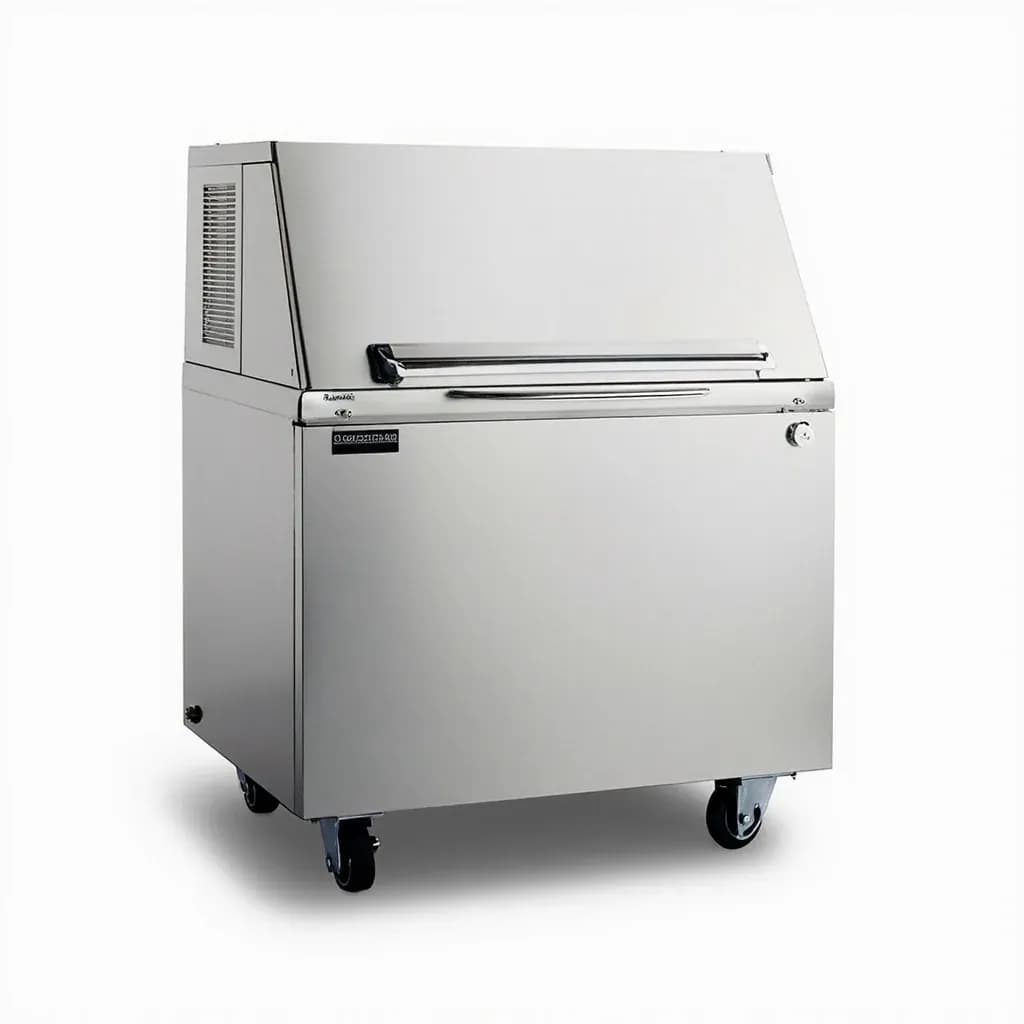
A lowboy cooler is a short, under-counter commercial refrigerator topped with a sturdy work surface. Line cooks use it to keep proteins and prepped ingredients cold within arm's reach while using the top as additional prep or plating space. Its low profile fits beneath grills and counters to maximize a tight kitchen footprint.
The lowboy refrigerated prep cooler — often simply called a lowboy or prep table — is the workhorse of any line that assembles cold food in volume. It does two jobs at once: a 36-inch-high stainless work surface for cutting, plating, or sandwich assembly, and an undercounter cold-storage compartment holding the mise en place for the work above. In a sandwich shop, salad restaurant, sushi counter, or pizzeria, the cabinet below the worktop is sized and configured specifically to the workflow on top, so the cook rarely has to break stride to the walk-in for the next handful of toppings.
What separates a lowboy from a household undercounter fridge is its commercial construction: a stainless top, front, and sides, a compressor sized for frequent door and drawer openings, and (on prep-table models) a refrigerated pan well built into the worktop. Standard sandwich and salad prep tables accept 1/6-size hotel pans; deeper "mega-top" wells accept 1/3- and 1/2-size pans. All are designed to hold 33–41°F (1–5°C). The cabinet is meant for short-term chill holding of ready-to-use ingredients — sliced meats, washed lettuces, portioned cheeses, condiments — not for produce storage or long curing. NSF/ANSI 7 certification means the unit will hold 41°F or below under the standard NSF test conditions, which is the rule every health department enforces.
How it behaves in use: cold air is either pulled up into the worktop pan well (sandwich, salad, pizza, and mega-top tables) or held entirely within drawer or door compartments (chef bases, undercounter refrigerators). The compressor and condenser reject heat out the back and sides, so the unit runs quietly but absolutely needs a few inches of rear and side clearance to dump waste heat. Forget that, and the compressor never cycles off, the cabinet creeps up in temperature, and the unit dies young.
Alternatives
Types & varieties
Front-opening hinged doors with wire shelves; most common, lowest cost, easiest interior to clean
Full- or half-size drawer pans; fastest access, best organization, easiest on a line cook's back
Top fitted with a recessed rail holding 1/6-size hotel pans (typically 6–12 pans) for toppings
Longer, narrower worktop with a deeper raised pan rail (15- to 18-pan capacity) for sauce, cheese, and toppings
Deeper pan well (6 in vs. standard 4 in) to accept 1/3 and 1/2 size pans or taller ingredients
Replaceable polyethylene or composite board fitted over the stainless worktop to take knife abuse
Glass front for customer-facing use at beverage or grab-and-go stations
Built-in chilled bottle well or speed-rail at the front edge for bar or coffee stations
Refrigerated drawer base engineered to support a countertop griddle, charbroiler, or salamander on top
Matching the model to your menu
The right lowboy is the one whose top mirrors the work you actually do. A sandwich or salad line that cycles through ten toppings an hour wants a sandwich prep table with a 6- to 12-pan well and a door cabinet below for backup proteins and produce. A pizzeria wants the longer, narrower pizza prep with its deeper raised rail so sauce, cheese, and fifteen toppings sit in reach of the right hand while the left stretches dough. A line that plates composed salads and charcuterie benefits from a cutting-board-topped unit with drawers rather than doors — drawers let the cook pull out one pan at a time without exposing the rest of the cabinet to room air. And a kitchen that runs a griddle, charbroiler, or salamander needs a chef base rather than a prep table: the cabinet is a drawer base rated to hold several hundred pounds of hot equipment, with the cold storage tucked under and out of the way.
- Sandwich/salad tables for 6–12 pan toppings; 1/6-size hotel pans are the lingua franca
- Pizza prep tables for 15–18 pan topping layouts; deeper rail means taller ingredient bins fit
- Mega-top tables when the menu runs 1/3- or 1/2-size pans of bulk prep (taco fillings, salad grains)
- Drawer models for ergonomic line work and tighter temperature control during frequent access
- Door models for backup storage and lower cost where access is less frequent
- Chef bases for supporting countertop cooking equipment with refrigerated storage underneath
Installation, airflow, and longevity
Most lowboy failures trace to installation mistakes that are easy to avoid. The compressor and condenser reject heat out the back and sides, so the unit needs breathing room on every non-front face; push it flush into a wall and the compressor will run hot, the cabinet will drift up in temperature, and the unit will fail years early. A dedicated 15 A circuit prevents voltage drop that makes the compressor work harder. Before the first load, the empty cabinet should be pre-chilled so it isn't trying to pull room-temperature product down from ambient at the same time. Finally, the cabinet must be level — an unlevel unit strains door hinges, prevents drawers from sealing, and pools condensate in one corner where it grows biofilm.
- Place the unit on a dedicated 15 A circuit to protect the compressor
- Air-gap the condensate drain line into a floor drain or floor sink — direct-plumbing a drain to a sewer is a code violation in most jurisdictions
- Lock the casters once the unit is positioned; an unlocked lowboy drifts during heavy chopping
- Clean condenser coils every 90 days in a greasy kitchen; clogged fins are the leading cause of premature compressor failure
Common uses
Tips & pitfalls
- Allow at least 3 in of clearance at the rear and sides for airflow; tight fits overwork the compressor and shorten its life
- Pre-chill the empty cabinet for 1–2 hours before first load — never ask the unit to pull itself and a full load of warm product down to 41°F at the same time
- Use only NSF-certified cutting boards on the worktop; cutting directly on stainless scars the surface and harbors bacteria in scratches that are impossible to sanitize
- Place a calibrated NSF thermometer in the warmest part of the cabinet (usually the door shelf) and log temperatures at open and at every shift change
- Keep door and drawer gaskets clean with mild soap and water; a fouled or torn gasket is the single most common cause of temperature loss in a commercial refrigerator
- Never slide hot pans (over 140°F / 60°C) directly into the cabinet — blast-chill them first or the heat load will spike the cabinet and tax the compressor
- Load drawers and shelves so cold air can circulate; overpacking blocks vents and creates warm pockets that food safety inspectors will flag
- Drain and defrost drawer-style units on a schedule; many lack automatic defrost and ice buildup steadily reduces usable pan depth
- Verify the unit is level before first use; an unlevel cabinet strains hinges, prevents drawers from sealing, and pools condensate where biofilm grows
Good to know
- Category
- Commercial refrigerated prep table
- Standard height
- 36 in (91 cm) — matches counter and chef-base equipment
- Common widths
- 27, 36, 48, 60, and 72 in (single-section to three-section)
- Depth (body / with upstand)
- 30–32 in body; 36 in with rear rail
- Operating temperature
- 33–41°F (1–5°C); NSF 7 holds to 41°F under load
- Power
- 115 V / 60 Hz on a dedicated 15 A circuit, 5–15P plug
- Capacity
- Roughly 5–15 cu ft depending on width and section count
- Insulation & refrigerant
- CFC-free polyurethane foam (~2 in); modern units use R-290, some use R-448A/R-449A, older units R-134a
- Exterior & interior
- Stainless top, front, and sides; galvanized or stainless back and bottom; ABS or stainless interior with removable/adjustable shelves or drawer pans
- Common certifications
- NSF/ANSI 7, UL 471, cUL; ENERGY STAR on qualifying models
Also called
lowboy cooler · undercounter refrigerator · lowboy fridge
Related

Stovetop
The everyday burners where most cooking actually happens

Oven
Enclosed dry heat for roasting, baking, and braising

Grill
Live-fire or gas grates for char, smoke, and high heat

Smoker
Low, slow heat and wood smoke for barbecue and brisket

Air Fryer
Countertop convection that crisps with little or no oil

Slow Cooker
Set-and-forget low heat for stews, beans, and braises

Pressure Cooker
Sealed steam pressure that cooks tough food in a fraction of the time

Rice Cooker
Foolproof, perfectly steamed rice every single time