Appliances & Heat
Magnetic Stirrer Hotplate
A heated plate with a magnetic field that spins a stir bar to mix and warm liquids hands-free.
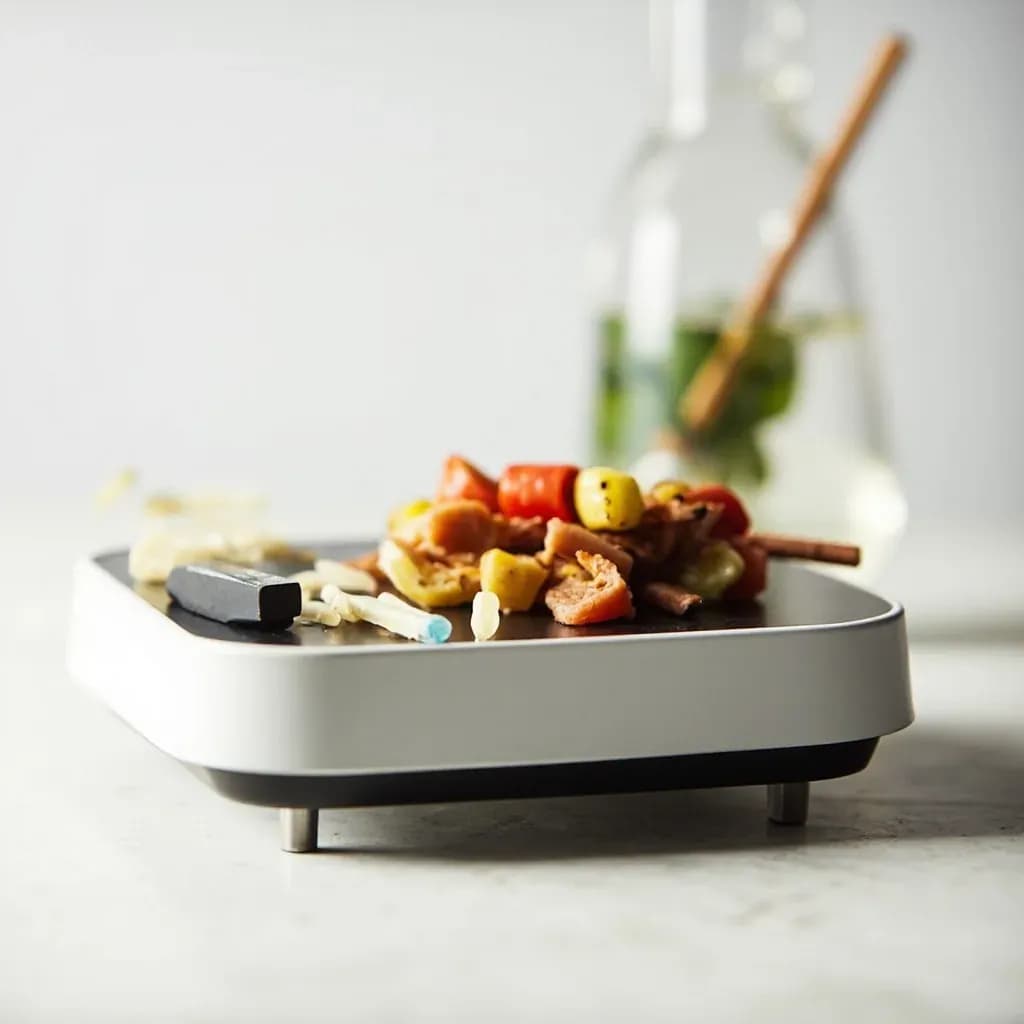
A magnetic stirrer hotplate heats a vessel from below while a rotating magnet spins a small coated stir bar dropped into the liquid. Modernist and lab-style kitchens use it to dissolve hydrocolloids, hold sauces at temperature, and keep mixtures evenly blended without manual whisking. The combined controlled heat and constant gentle stirring give very even, repeatable results.
A magnetic stirrer hotplate pairs two tools in one footprint: an electric hotplate and a rotating magnet housed beneath the surface. The magnet spins a small PTFE- or glass-coated bar placed inside the vessel, so a liquid on the plate is heated and agitated continuously, with no spoon, no whisk, and no hand on the pan. In a kitchen that translates to custards that never catch on the base, chocolate that holds its temper, sugar syrups that resist crystallization, and emulsions that hold through service.
The appeal is precision married to patience. The plate regulates temperature while the bar keeps the contents moving, evening out hot spots that form on any bare hotplate and replacing the constant wrist work a cook would otherwise do. Because mixing is steady rather than vigorous, shear is gentle — air is not whipped in and fragile networks (a gelled fluid, a seeded caramel, a held béarnaise) are not torn apart. It is the rare appliance that gets out of the cook's way while quietly doing the work that tends to ruin a sauce.
In practice the tool has a learning curve worth respecting. The vessel must be non-ferromagnetic with a flat bottom, the stir bar sized to that vessel, and the plate's temperature readout understood as a separate thing from the actual temperature of the liquid. Once those three habits are in place, the magnetic stirrer hotplate becomes the kind of equipment you set, walk away from, and return to when something is exactly where you wanted it.
Alternatives
Types & varieties
One stirring point with a heated top plate; the workhorse form found in both labs and restaurant pastry kitchens.
Plate carries 4, 6, 9, or 15 stirring positions driven by a single motor — useful for parallel infusions, jellies, or tasting flights of one sauce.
White ceramic glass surface; chemical-resistant and easy to wipe, but slower to heat and slower to cool.
Cast or coated metal top with faster heat-up and stronger thermal contact for flat-bottomed metal pans.
No heating element; used for cold emulsions, dispersions, and hydrations held at room temperature.
Digital units give precise RPM, plate temperature, and often a timer or external probe input; analog dial units are cheaper and faster to set by feel.
Some models accept a thermocouple in the liquid so the unit regulates the bath, not the plate — important for custards and chocolate work.
Vessel and Bar Pairing
The magnetic coupling only works through certain materials and is sensitive to geometry. A mismatched pair will spin erratically, decouple, or grind against the glass.
- Borosilicate beakers and flasks are the classic lab pairing and work well for sauces, custards, and small sugar batches.
- Clad stainless saucepans (stainless-aluminum-stainless) couple through the thin stainless layer and give better heat transfer for reductions and demi-glace.
- Copper, aluminum, and ceramic vessels all work provided the base is flat and the material is non-magnetic.
- Avoid cast iron and most 18/0 stainless — the bar will not spin and heat distribution suffers.
- Match bar length to roughly one-third the diameter of the vessel base; too small and the bar skitters or decouples, too large and it scrapes the wall.
- Keep a few PTFE bars and a couple of glass-coated bars on hand; PTFE is fine to about 200°C, glass-coated is the safer choice above that.
Plate Temperature vs. Bath Temperature
The number on the dial is the temperature of the metal or ceramic plate, not the liquid sitting on it. That gap is the single most common source of ruined work on a magnetic stirrer hotplate.
- On startup, the plate heats far faster than the bath and can scorch a thin sauce before the liquid catches up.
- On shutdown, the plate holds heat long after the burner is off, so a custard continues to cook unless it is pulled off the surface.
- Aluminum tops store more heat than ceramic tops, so overshoot is more pronounced on aluminum.
- For tight temperature work (chocolate, custards, gels), use a unit with an external probe and clip the thermocouple into the liquid — the controller then regulates to bath temperature, not plate temperature.
- Always finish delicate sauces by hand over residual heat rather than trusting the last few degrees on the plate.
Speed and Shear
Stirring speed looks like a dial but behaves like a shear setting. The goal is enough movement to even out temperature and prevent skin or sticking, not enough to whip or tear.
- 200–600 RPM covers most sauces, custards, and reductions.
- Higher speeds incorporate air, which is the enemy of glossy sauces and stable emulsions.
- Very high speeds can throw liquid out of an uncovered vessel and will shear fragile gels (methylcellulose, fluid gels) before they set.
- If the bar stalls, decouples, or jumps, slow down — drag from the liquid has exceeded magnetic grip, not the other way around.
- Cover the vessel when speeds are high or when working with alcohol- or water-based reductions that lose mass quickly.
Common uses
Tips & pitfalls
- Center the vessel on the plate; off-center placement gives uneven heating and erratic spin.
- Drop the stir bar in before adding liquid — fishing a bar out of a thick fluid is the most common kitchen frustration with this tool.
- Bring temperature up gradually; aluminum tops store a lot of heat and overshoot is common.
- Never heat an empty vessel — the plate will climb rapidly and damage non-stick or ceramic coatings.
- Retire bars that have lost their coating or have chips; exposed iron will rust and contaminate food.
Good to know
- Origin
- Laboratory instrument; the first magnetic stirrer was patented by Arthur Rosinger in 1944. Adopted in restaurant kitchens from the early 2000s alongside modernist and molecular gastronomy.
- Speed range
- Typically 100–1,500 RPM on kitchen and lab units; some bench models reach 2,000 RPM.
- Temperature range
- Bench units are rated from room temperature to roughly 300–500°C; actual food work almost always stays under 200°C.
- Stir bar construction
- Neodymium or alnico magnet coated in PTFE; glass-coated bars are used for high-heat sugar work.
- Stir bar sizing
- Standard lengths 10–80 mm; pick one about one-third the diameter of the vessel's base.
- Vessel requirements
- Non-ferromagnetic with a flat bottom — borosilicate glass, clad stainless, copper, aluminum, or ceramic. Cast iron and most 18/0 stainless will not spin the bar.
- Plate material
- Ceramic-coated aluminum, ceramic glass, or cast aluminum; ceramic tops resist chemical attack, aluminum tops heat faster and recover more quickly.
- Power draw
- Roughly 500–1,500 W depending on plate size and model.
- Plate diameter
- Common single-position plate sizes are 135 mm (5 in), 155 mm (6 in), 185 mm (7 in), and 250 mm (10 in).
Also called
magnetic stirrer · stir plate · hotplate stirrer
Related

Stovetop
The everyday burners where most cooking actually happens

Oven
Enclosed dry heat for roasting, baking, and braising

Grill
Live-fire or gas grates for char, smoke, and high heat

Smoker
Low, slow heat and wood smoke for barbecue and brisket

Air Fryer
Countertop convection that crisps with little or no oil

Slow Cooker
Set-and-forget low heat for stews, beans, and braises

Pressure Cooker
Sealed steam pressure that cooks tough food in a fraction of the time

Rice Cooker
Foolproof, perfectly steamed rice every single time