Appliances & Heat
Malaxer (Kneading Machine)
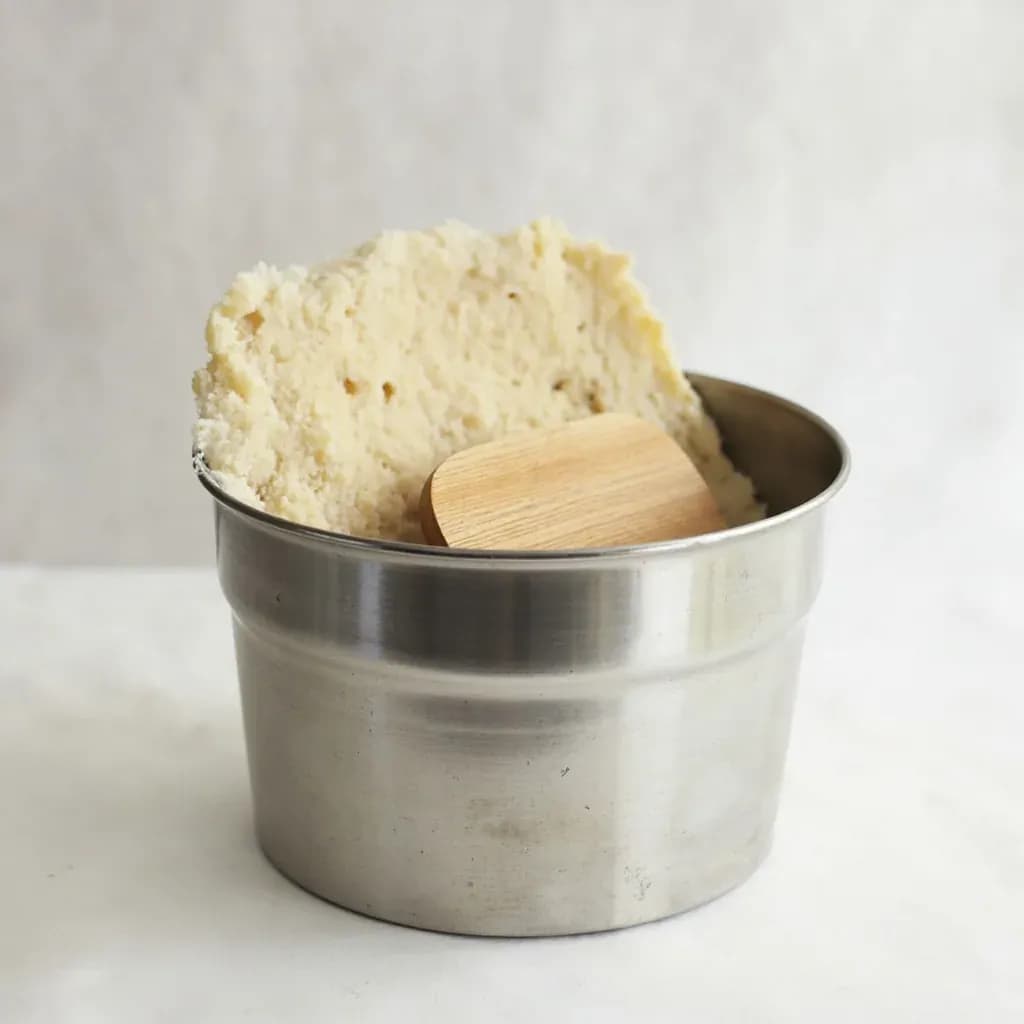
A slow-mixing machine that kneads olive paste or dough to coalesce oil or develop gluten.
A malaxer slowly churns a paste to encourage particles to merge, most notably in olive oil production where it mixes crushed olive paste so tiny oil droplets join into larger ones for extraction. The same kneading principle is used in some industrial dough and confection mixers. Temperature and mixing time are controlled carefully to maximize yield and protect flavor.
A malaxer is the slow, often temperature-controlled kneading tank that sits between the crusher and the centrifuge in any modern olive mill. After olives are milled into a paste of flesh, skin, pit fragments, and vegetation water, the cells have ruptured and released oil as microscopic droplets suspended in an emulsion. The malaxer's job is to give those droplets time to drift toward one another and merge into larger, separable droplets — a coalescence that takes patience and would never happen at the speed of a food processor. Paddles turn at roughly 15 to 25 RPM, slow enough to avoid whipping air into the paste or smearing oil into the watery phase as a permanent emulsion.
What makes the malaxer genuinely interesting to a cook is that it is the stage where the sensory character of the oil is decided. Time, temperature, and atmosphere each reshape the chemistry: enzymatic activity develops bitterness and pungency from oleocanthal and other polyphenols; volatile aroma compounds form; and oxygen exposure begins the oxidation clock. Running the paste too cold or too short gives a watery, hard-to-separate paste with green, bitter, sometimes grassy oil; running it too warm or too long flattens aroma, drops polyphenol content, and shortens shelf life. Premium mills treat malaxation parameters as carefully as a baker treats bulk-fermentation timing.
The word "malaxer" appears in two distinct kitchens. In the olive mill it always means the slow paste-kneader above. In artisan bakeries the same name is sometimes given to a spiral-hook or fork mixer designed for long, gentle dough development at low RPM — the bread-world cousin that uses identical mechanics (slow rotation, low friction, no heat build-up) for gluten rather than oil.
Alternatives
Types & varieties
Tall cylindrical tank with vertical helical paddles; the most common configuration in modern mills.
Horizontal trough with a rotating auger; older style still found in small mills and traditional presses.
Jacketed tank with precise water or electric heating for tight paste-temperature control.
Closed tank that can be flushed with nitrogen to displace oxygen; used for high-end extra-virgin oils.
Long chamber through which paste flows continuously; pairs with industrial centrifugal extraction lines.
Small (5–50 kg) units used by micro-mills and by researchers comparing cultivars and extraction parameters.
Bakery-context spiral-hook mixer that develops gluten slowly at low RPM without heating the dough.
Why a malaxer is the slowest tool in the room
The temptation in any mill is to treat malaxation like mixing bread dough — push harder, finish faster. Olive paste punishes that instinct. Each kilogram of paste is roughly 50–70% vegetation water and only 15–30% oil, with the oil present as droplets a few micrometers across, each one wrapped in a film of phospholipids and crushed cell-wall debris. High-speed mixing smears those droplets smaller and drags them into the water phase, producing a stable emulsion that the centrifuge cannot break cleanly. Slow rotation, by contrast, lets droplets bump and merge into drops large enough to separate cleanly in the decanter.
- Speed matters more than total agitation: emulsification from high RPM is harder to undo in the decanter than a slightly shorter malaxation time is to recover from.
- Paddles are usually helical rather than flat-bladed so they fold the paste rather than shear it.
- Most of the yield gain in a well-tuned malaxer comes from the first 20 minutes; the next 20 mainly reshape flavor.
Common uses
Tips & pitfalls
- Keep the paste below 27 °C (80.6 °F) if the oil is to qualify as cold-extracted; above roughly 30 °C you begin losing volatile aromas and degrading polyphenols.
- Don't over-mix: malaxation beyond about 45 minutes increases oxidation, drops polyphenol content, and pushes the oil toward a flatter, 'warmed' flavor.
- Don't under-mix either — paste that goes straight from mill to centrifuge gives a watery, hard-to-separate must and a noticeably lower yield.
- Watch the speed, not just the timer: a fast mixer emulsifies oil with vegetation water and makes centrifugal separation almost impossible.
- For premium oils, flush the tank with nitrogen (or CO₂) before sealing; oxygen exposure during malaxation is one of the biggest drivers of short shelf life and 'rancid' defects.
- Use stainless steel only — copper or other reactive metals catalyze oxidation and can ruin an entire batch.
- Clean thoroughly between batches: oxidized paste residue taints the next pressing with rancid or musty off-flavors.
- Match malaxation time to the cultivar — thick, high-polyphenol olives like Coratina or Moraiolo often need longer than tender, low-polyphenol varieties like Arbequina.
- In the bakery, treat the spiral malaxer gently: overworking warms the dough and over-oxidizes the flour; aim for a finished dough temperature in the 24–26 °C (75–79 °F) range.
Good to know
- Mixing speed
- Roughly 15–25 RPM — slow enough to coalesce oil droplets without emulsifying them into vegetation water.
- Malaxation time
- 20–45 minutes per batch, depending on olive cultivar, ripeness, and paste temperature.
- Working temperature
- 25–30 °C (77–86 °F); 'cold extraction' oils must stay below 27 °C (80.6 °F).
- Position in workflow
- Step 2 of 3 in olive milling: after the crusher/mill and before the decanter (centrifuge) or press.
- Construction
- Food-grade stainless steel tank, almost always jacketed for water circulation or electric heating.
- Atmosphere control
- Modern sealed models can be blanketed with inert gas (nitrogen) to limit oxidation during malaxation.
- Capacity
- 50–300 kg per batch in artisan mills; 500–1,500 kg per batch in industrial continuous lines.
- Bakery synonym
- In artisan bakeries, 'malaxer' also refers to a slow spiral- or fork-hook dough mixer for long, gentle gluten development.
Also called
malaxer · kneading machine · olive paste mixer
Related

Stovetop
The everyday burners where most cooking actually happens

Oven
Enclosed dry heat for roasting, baking, and braising

Grill
Live-fire or gas grates for char, smoke, and high heat

Smoker
Low, slow heat and wood smoke for barbecue and brisket

Air Fryer
Countertop convection that crisps with little or no oil

Slow Cooker
Set-and-forget low heat for stews, beans, and braises

Pressure Cooker
Sealed steam pressure that cooks tough food in a fraction of the time

Rice Cooker
Foolproof, perfectly steamed rice every single time