Appliances & Heat
Meat Mincer
A grinder that forces meat through a plate of holes to mince it for burgers, sausages, and fillings.
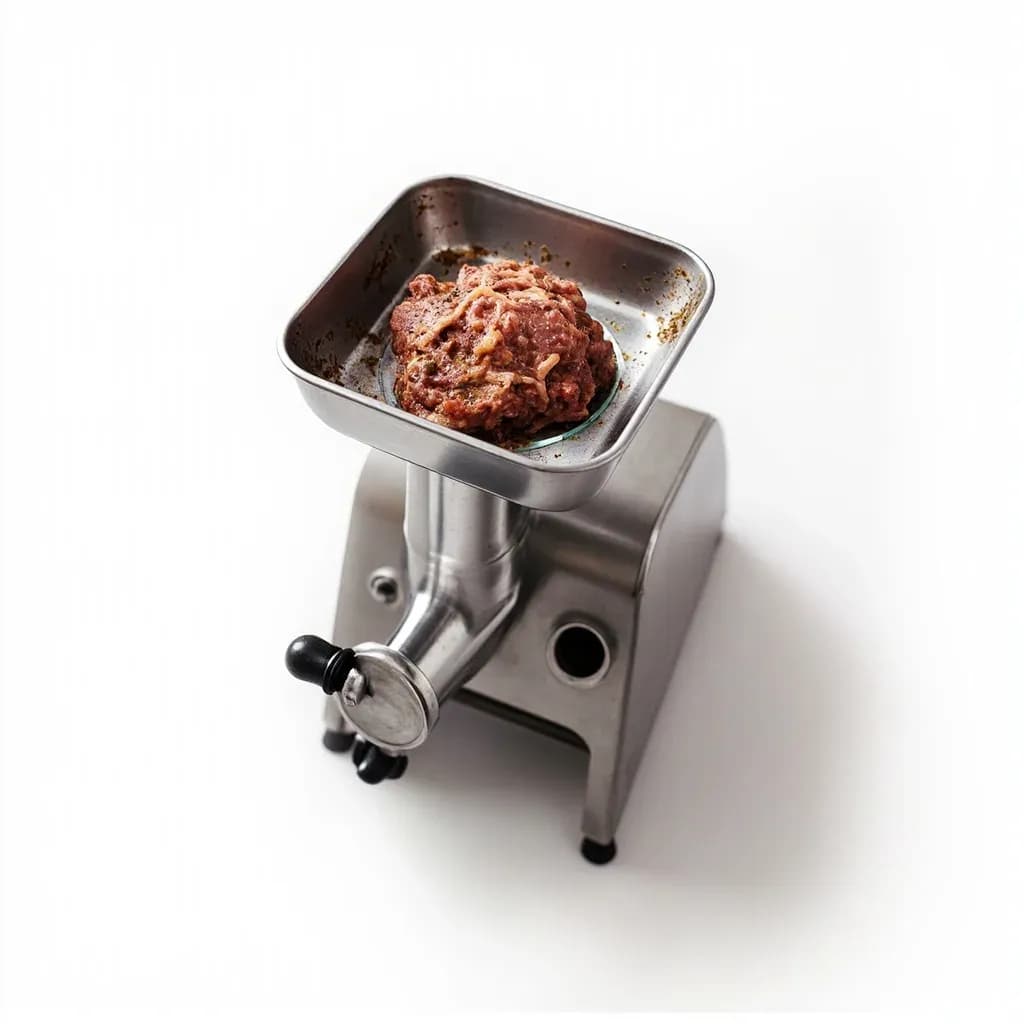
A meat mincer pushes chunks of meat with a rotating screw through a cutting blade and a perforated plate to produce ground meat. Swapping plates changes the coarseness, and a sausage-stuffing tube lets it pipe the mince into casings. It comes as a hand-cranked clamp model or an electric machine, prized for grinding fresh, well-controlled meat at home.
A meat mincer is a screw-extrusion tool, not a chopping tool. A helical auger inside a barrel rotates and pushes chunks of meat past a four-pronged star blade, which shears them against a perforated plate to produce uniformly sized strands. That geometry matters more than its simplicity suggests. Unlike a food processor, which chops with a spinning knife and tends to smear fat, a mincer extrudes meat in clean, defined pieces that retain structure in the cooked dish — a ragù made from a mincer has a coarser, more toothsome texture than one blitzed in a processor, and the fat stays as distinct droplets rather than emulsifying into the lean. This is why virtually every charcuterie tradition, from Italian cotechino to Lebanese kibbeh, specifies a mincer rather than a chopper, and why a burger patty formed from freshly minced meat has a different bite from one made with pre-ground supermarket product.
The tool has changed very little since Karl Drais's 1845 patent in Germany. The same core parts drive everything from a hand-cranked clamp model to a multi-horsepower butcher's machine: a feed hopper, the barrel, the auger, the rotating blade, the perforated plate, the locking ring, and the pusher. Electric motors arrived in the early twentieth century; modern safety additions include reverse switches, circuit breakers, and BPA-free hoppers, but the underlying geometry is the nineteenth-century original.
For most kitchens, the practical question is not whether to own one but which type and how to use it well. A good electric countertop mincer with a reverse function and three plates — coarse, medium, and fine — will cover everything from burger patties and meatballs to smooth pâtés and properly emulsified sausages. The two non-negotiables are cold meat and a sharp blade: warm meat smears, a dull blade smears, and a smeared mince is a sad mince.
Alternatives
Types & varieties
Bolts to the worktop; the cheapest and longest-lasting option, but slow and best for small batches and coarse mince.
Standalone plug-in appliance with a reverse function; the everyday choice for home cooks who grind regularly.
Powered by the mixer's head (KitchenAid, Bosch, Ankarsrum, and others); convenient if you already own a mixer, but lower torque and slower throughput.
Larger auger and a more powerful motor (often 800–1500 W or more), capable of handling sinew and regular charcuterie work; favoured by hunters and small charcuterie operations.
Strictly a stuffer rather than a grinder, but commonly sold alongside mincers for filling casings; some mincers accept a stuffing horn in place of the plate.
Floor-standing, 2–5+ HP, with a feed pan and optional mixer feeds; used in butcheries, abattoirs, and large production kitchens.
Plate selection: matching hole size to the dish
The plate determines the texture of everything that comes out of the machine, and choosing the right one is the difference between a coarse, juicy sausage and a smooth, sliceable pâté. Coarse plates (around 8–10 mm) are right for burger patties, ragù, and the first pass of a sausage mix, where you want visible strands of meat and fat. Medium plates (5–6 mm) are the everyday workhorse for meatballs, cottage pie, and shepherd's pie fillings. Fine plates (3–4 mm) are reserved for emulsified sausages, smooth pâtés, and the second pass that refines a coarse grind into something closer to a paste.
- Coarse plate (~8–10 mm): burger patties, ragù, rustic sausages, kibbeh shells.
- Medium plate (~5–6 mm): meatballs, kofta, cottage and shepherd's pie fillings.
- Fine plate (~3–4 mm): emulsified sausages, smooth pâtés, terrines, second pass for refined texture.
The two-pass method for smooth results
For any application where you want a defined, fine texture — breakfast sausages, frankfurters, pâté de campagne, smooth kibbeh — run the meat through twice. The first pass on a coarse plate cuts and extrudes cleanly; the second on a fine plate refines the strands and produces the uniform, slightly sticky texture that holds seasoning and binds well. A single pass through a fine plate is slower, heats the meat more, and tends to leave larger fragments that the blade has to keep working on, which smears fat and toughens the protein.
- First pass: coarse plate to break the meat down and distribute fat.
- Second pass: fine plate to refine the texture and develop bind.
- Keep both plates and the bowl receiving the mince well chilled between passes.
Why cold is non-negotiable
Fat begins to soften and smear at around 10–12 °C, and once smeared it clogs the plate, drags through the next batch, and produces a finished mince with a greasy, pasty texture that will not hold its shape when cooked. The remedy is mechanical and unforgiving: chill the meat to about 2 °C, freeze the plate and blade for 30 minutes before you begin, and have a chilled bowl waiting at the spout. Work in small batches, return the mince to the refrigerator between passes, and never grind meat that has warmed to room temperature — even if it means a longer afternoon.
- Meat target temperature: around 2 °C.
- Plate and blade: 30 minutes in the freezer.
- Receiving bowl: pre-chilled in the refrigerator.
- Work in small batches; rest the mince in the fridge between passes.
Common uses
Tips & pitfalls
- Chill every component before grinding: meat to about 2 °C, plate and blade in the freezer for 30 minutes, and a chilled bowl to receive the mince.
- Cut meat into 2–3 cm strips or chunks that drop freely into the throat; never push with fingers — always use the supplied pusher.
- Feed at a steady pace and let the auger do the work; forcing meat or crowding the throat smears fat and stalls the machine.
- For smooth sausages and pâtés, run the meat through a coarse plate first, then a second time through a fine plate.
- Alternate fatty and lean pieces through the throat so fat does not build up and clog the plate in one continuous ribbon.
- Run a slice of bread or a few chunks of back fat through at the end to purge the last of the meat from the auger and blade.
- Sharpen the star blade regularly on a fine whetstone; a dull blade smears rather than cuts and overheats the fat.
- Disassemble and dry all metal parts immediately after washing to prevent oxidation, especially on cast-iron bodies.
- Avoid running frozen-solid meat through a standard mincer unless the manufacturer explicitly allows it; semi-firm, just-thawed meat is the safe limit.
- If the machine stalls, stop and clear the blockage using the reverse switch on electric models rather than reaching in with a knife or utensil.
Good to know
- Also known as
- Meat grinder (US), meat chopper, mincing machine, mincer
- Origin
- Mid-19th-century Europe; Karl Drais patented an early screw-type mincer in Germany around 1845
- Core mechanism
- Rotating auger (worm screw) feeds meat past a four-pronged star blade and through a perforated plate
- Typical plate sizes
- Coarse (~8–10 mm), medium (~5–6 mm), fine (~3–4 mm) hole diameters
- Power options
- Hand-crank clamp, electric countertop, stand-mixer attachment, and heavy-duty motorised models
- Home throughput
- Roughly 1–3 kg per minute for electric home models; hand cranks considerably slower
- Care
- Blades and plates are best hand-washed and dried immediately; cast-iron bodies benefit from a light film of food-grade mineral oil
- Not for
- Hard bones (unless a dedicated bone-cutting model), frozen-solid blocks, or very fatty cuts without prior chilling
Also called
Mincing Machine · Meat Grinder
Related

Stovetop
The everyday burners where most cooking actually happens

Oven
Enclosed dry heat for roasting, baking, and braising

Grill
Live-fire or gas grates for char, smoke, and high heat

Smoker
Low, slow heat and wood smoke for barbecue and brisket

Air Fryer
Countertop convection that crisps with little or no oil

Slow Cooker
Set-and-forget low heat for stews, beans, and braises

Pressure Cooker
Sealed steam pressure that cooks tough food in a fraction of the time

Rice Cooker
Foolproof, perfectly steamed rice every single time