Appliances & Heat
Microwave Oven
Countertop appliance that heats food fast using microwave radiation to excite water molecules.
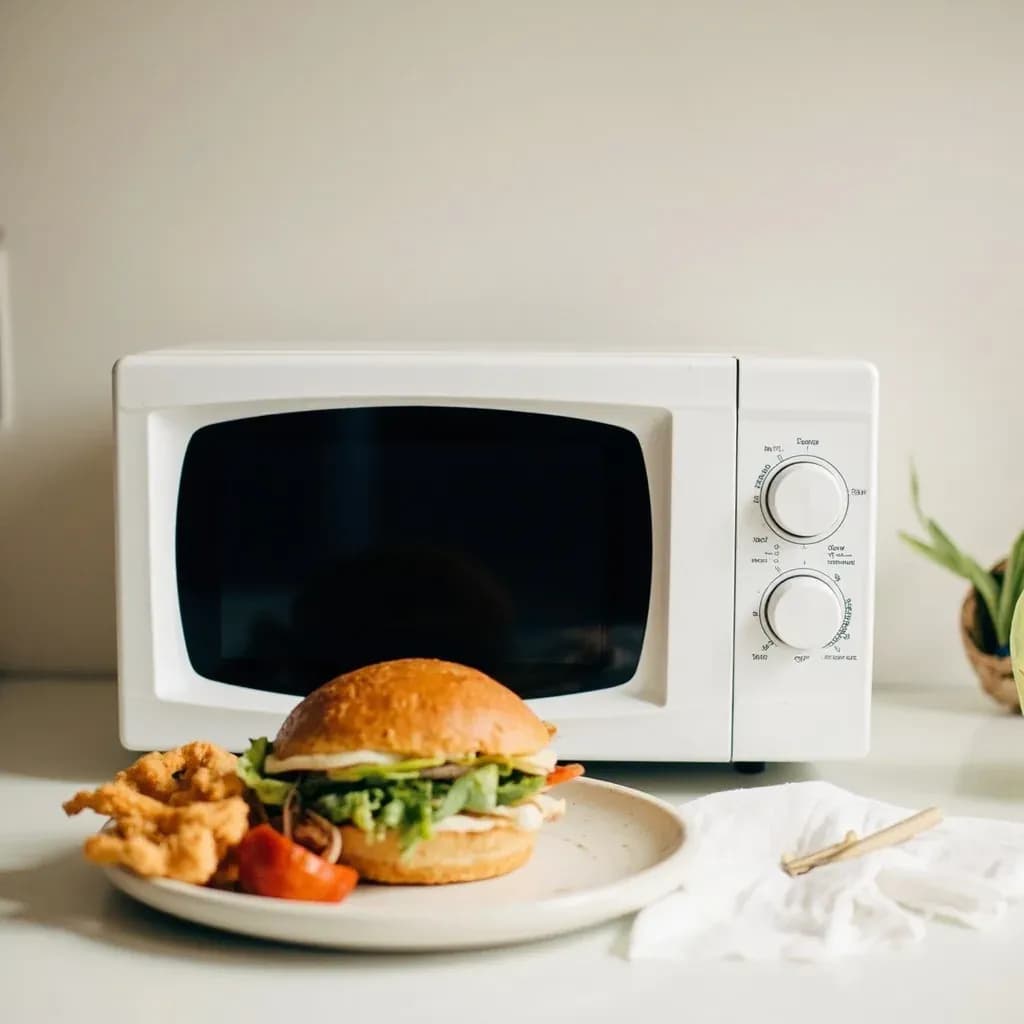
A microwave oven is a compact countertop appliance that cooks and reheats food by emitting microwaves that agitate water molecules, generating heat from within. Cooks rely on it for fast reheating, melting butter or chocolate, steaming vegetables, and softening or proofing in a pinch. Because it heats unevenly, stirring or rotating mid-cycle helps avoid cold spots.
The microwave oven is the workhorse of the modern kitchen for speed: reheating a plate of leftovers, defrosting a chicken breast, steaming broccoli in three minutes, melting chocolate without a double boiler. Unlike a pan, which delivers heat through a single hot surface, the microwave deposits energy throughout the outer inch or so of food at once by exciting polar molecules — water, fat, and sugar — with electromagnetic radiation at 2.45 GHz. That distinction explains both its strengths (fast, even heating of moist foods) and its limits (no browning, no crisping, poor penetration past about 1.5 inches into dense food).
The 2.45 GHz frequency was chosen because it is absorbed efficiently by water and fat but passes through glass, ceramic, and most plastics largely untouched, so the dish stays cool while the food heats. Microwaves penetrate only about 1 to 1.5 inches into food; beyond that, heat moves inward by conduction, which is why thick cuts and dense casseroles need standing time to finish evenly. Standing waves inside the cavity also create persistent hot and cold spots, which is why stirring, rotating, and arranging food on the plate matters more than most recipes admit.
For cooks, the microwave is best understood as a complement to the range and oven, not a replacement. A conventional or convection oven still owns browning, roasting, and anything that needs the Maillard reaction; a microwave owns speed, moisture retention, and gentle heating. A unit with inverter or convection capability narrows the gap, but even the best microwave cannot toast a slice of bread or sear a steak the way a hot pan can.
Alternatives
Types & varieties
The most common form factor; portable, plugs into a standard outlet, capacities typically 0.5–2.2 cu ft.
Mounted above the cooktop, combining a microwave with a built-in vent hood and task light.
Designed to integrate into cabinetry, often paired with trim kits; usually requires professional installation.
Pull-out drawer installed under counter or in an island; favored in accessible and modern kitchens.
Adds a heating element and fan for true baking, roasting, and browning — can bake cookies, small cakes, and roast vegetables.
Includes a quartz or halogen grilling element for browning meats and toasting sandwiches.
Delivers true variable power for gentler defrosting, more even cooking, and better simmering.
1,000–3,000 watts; stainless interior, often stackable and programmable, used in restaurants and cafeterias.
How It Heats
A magnetron tube inside the unit — mounted at the back, side, or top of the cavity depending on the model — generates microwaves at 2.45 GHz, which bounce off the metal walls and pass through the food. Polar molecules, chiefly water but also fats and sugars, absorb the energy and try to align themselves with the rapidly reversing electromagnetic field, oscillating billions of times per second. The friction of that oscillation is the heat you feel. The frequency was chosen because it is absorbed efficiently by water and fat but passes through glass, ceramic, paper, and most plastics largely untouched, so the dish stays cool while the food warms. Penetration is shallow — roughly 1 to 1.5 inches — so in anything thicker, heat finishes traveling inward by conduction, which is why a standing period after cooking is non-negotiable for dense foods like meatloaf, lasagna, or whole potatoes.
Inverter vs. Conventional
A conventional microwave has one true power setting: full blast. To approximate lower power, it cycles the magnetron on and off in short bursts — typically a few seconds on, a few seconds off, with the ratio of on-time to total time determining the displayed power level. This pulsing is why defrosted edges start to cook while the center is still icy, and why chocolate scorches in patches even at low settings. Inverter technology, introduced by Panasonic around 2002, modulates the magnetron's output continuously, so 50 percent really is 50 percent of the energy delivered over time. The result is gentler, more even thawing; smoother melting of chocolate and cheese; the ability to actually simmer a sauce; and a useful proof box for yeast doughs. For any cook who treats the microwave as more than a reheater, an inverter unit is the most meaningful upgrade the category has seen in decades.
What the Microwave Cannot Do
No microwave will brown, crisp, or sear food on its own. The energy excites water and fat molecules; it does not produce the surface temperatures (roughly 300°F and up) needed for Maillard browning or the dry heat that crisps bread. A convection-microwave combination narrows the gap — the heating element and fan do what the magnetron cannot — but even then browning is uneven compared to a real oven, and the small cavity limits the size of what you can roast. The microwave also struggles with very dense, very dry, or very large foods, because the waves never reach the center and conduction finishes the job slowly. The right mental model: a microwave is a faster, more efficient steamer and reheater, not a substitute for an oven or a hot pan.
Common uses
Tips & pitfalls
- Cover food with a vented lid, plate, or microwave-safe wrap to trap steam and prevent splatter — vent the wrap so pressure can escape.
- Stir, rotate, or flip food at the halfway point; standing waves inside the cavity create persistent hot and cold spots, especially in foods that don't circulate naturally.
- Always allow standing time after cooking; heat continues to migrate toward the center for 1–5 minutes and finishes the job — pull the food out early and let residual heat do the work.
- Use 30–50% power for defrosting, melting butter or chocolate, and softening butter or cream cheese; full power overheats the edges before the center is ready.
- Pierce foods with a skin or membrane — potatoes, sausages, egg yolks, tomatoes — or they can burst from internal steam.
- Never microwave whole eggs in the shell, grapes, or sealed containers; pressure or steam buildup can cause them to burst, and grapes can spark.
- Never run the microwave empty; the magnetron absorbs the reflected energy and can overheat or burn out.
- Avoid superheating water in a very smooth cup — it can erupt when disturbed; place a wooden stir stick or chopstick in the cup to provide nucleation sites.
- Use only containers labeled microwave-safe; keep metal, aluminum foil (except smooth, small pieces well away from the walls), and foil-trimmed takeout containers out of the cavity.
Good to know
- Inventor
- Percy Spencer, an engineer at Raytheon, discovered microwave heating in 1945 when a candy bar in his pocket melted near a magnetron he was testing for radar.
- Operating frequency
- 2.45 GHz — chosen because it is absorbed by water and fat but passes through glass, ceramic, and most plastics.
- How it heats
- Dielectric heating: microwaves are absorbed by polar molecules (water, fats, sugars), which oscillate and generate heat through molecular friction.
- Typical home power range
- 600–1,200 watts for compact and mid-size units; up to ~1,500 watts for full-size and over-the-range models.
- Penetration depth
- Roughly 1–1.5 inches (2.5–3.8 cm); heat then conducts inward, which is why thick foods need resting time.
- Inverter technology
- Panasonic introduced inverter microwaves around 2002, allowing continuous variable power rather than the pulsed on/off cycle of conventional units.
- Safety
- Door mesh and interlock switches contain the radiation; a properly sealed door should not leak measurable energy.
Also called
countertop-microwave · microwave
Related

Stovetop
The everyday burners where most cooking actually happens

Oven
Enclosed dry heat for roasting, baking, and braising

Grill
Live-fire or gas grates for char, smoke, and high heat

Smoker
Low, slow heat and wood smoke for barbecue and brisket

Air Fryer
Countertop convection that crisps with little or no oil

Slow Cooker
Set-and-forget low heat for stews, beans, and braises

Pressure Cooker
Sealed steam pressure that cooks tough food in a fraction of the time

Rice Cooker
Foolproof, perfectly steamed rice every single time