Appliances & Heat
Spindle Milkshake Mixer
A motorized spindle blender that whips milkshakes and malts to a frothy texture.
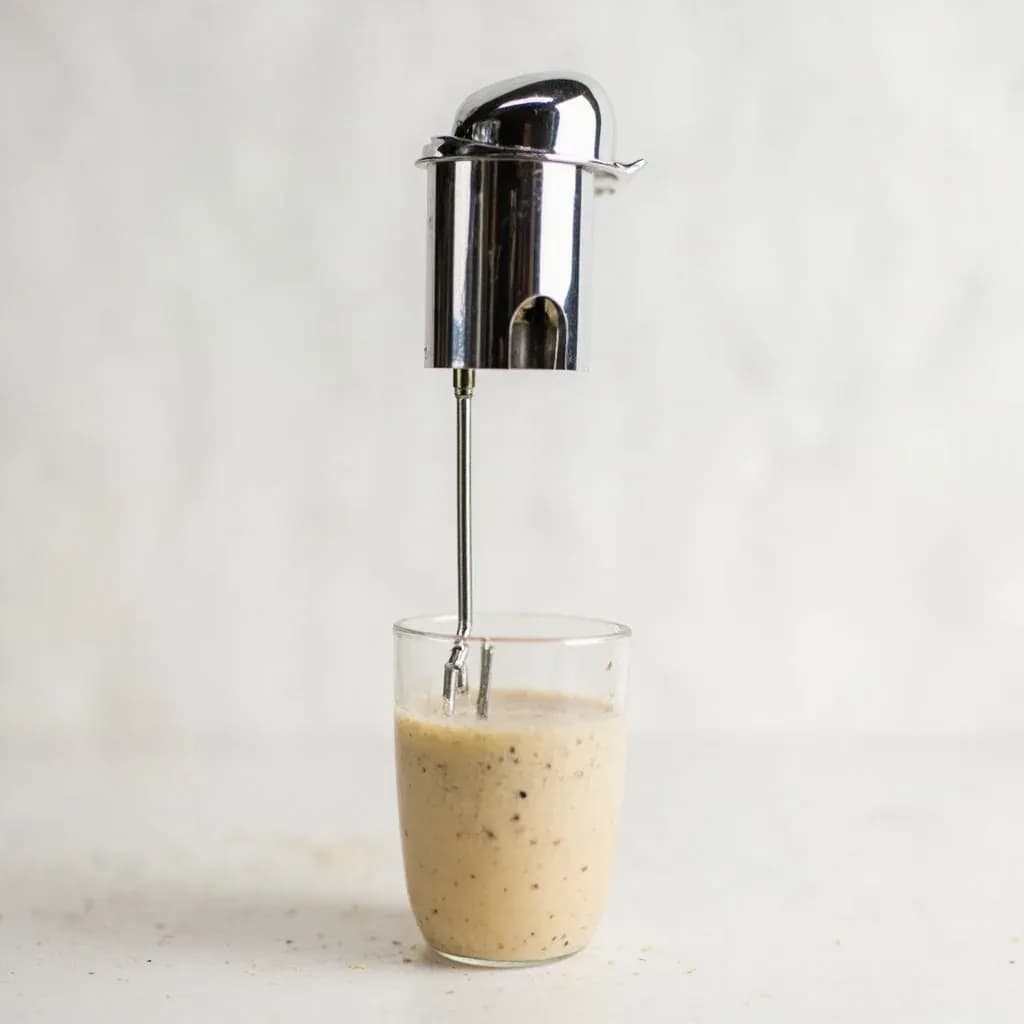
A spindle milkshake mixer is a countertop machine with one or more vertical rotating spindles that drop into a metal cup to aerate and blend ice cream, milk, and flavoring into a smooth, frothy shake. The classic soda-fountain design produces a lighter texture than a jar blender. Multi-spindle versions let an operator make several shakes at once.
A spindle milkshake mixer — also called a drink mixer or malt mixer — is a countertop motorized tool built around a single exposed vertical shaft that drops into a small stainless-steel cup. The shaft carries either a wire whip or a solid finned agitator spinning at roughly 15,000 to 18,000 RPM, turning the cup's contents into a frothy, homogenized shake in seconds. Its visual identity was set in 1933 with Hamilton Beach's DrinkMaster: a rounded chrome base, a tall bare spindle, and a slide-on cup — a silhouette nearly every competitor has copied since.
What separates a spindle mixer from a countertop blender is what it does not do. It is a high-RPM stirrer, not a pulverizer: it circulates an already-liquid mixture very quickly and folds in air, but it does not crush hard solids the way a blade blender can. This is why every soda-fountain guide insists on softened ice cream and a base of milk in the cup — the spindle's job is to marry a liquid to a soft solid, not to chew ice. The trade-off is texture: a properly run spindle mix produces a lighter, airier shake with more froth than a blender typically achieves, giving the classic fountain mouthfeel, with visible foam on top and a thin, drinkable body.
The practical consequence is heat. Spinning a viscous dairy liquid at 18,000 RPM builds friction quickly, so good technique means pulsing in short bursts rather than holding the switch. Done right, the mixer is faster, easier to clean, and more consistent across batches than any blender for the small volumes — roughly six to sixteen fluid ounces per cup — that a milkshake actually calls for.
Alternatives
Types & varieties
Standard diner and soda-fountain format; one cup at a time; the most common configuration.
Two side-by-side spindles on a shared or paired motor; lets one operator run two drinks at once during a rush.
Larger motors, all-metal gearing, and thermal protection; built for continuous bar or shake-shop service.
Smaller motors for home or low-volume café use; usually one speed, sometimes plastic gears.
The 1933 original and its descendants (HMD200, HMD400, etc.); the rounded chrome base and exposed spindle most people picture.
Waring's commercial spindle drink mixers, typically two-speed; common in bar programs.
Other commercial makers offering spindle mixers for cafés and bars, with varying cup and motor specs.
Wire whips fold in more air for lighter shakes; solid fins move thick malts and frozen drinks more forcefully.
Choosing the Right Spindle
The spindle is the part that does the work, and the two common styles behave differently. A wire whip is a small cage of stainless wires that beats the liquid like a tiny whisk; it incorporates more air and is the right choice for a classic light, frothy milk shake. A solid finned agitator — a shaped piece of metal with curved blades — pushes the liquid more forcefully and is the better tool for thick malts, frappé-style drinks, and anything with a heavy syrup or protein load. Many commercial units ship with one of each, and experienced operators swap them depending on the drink. If you buy a mixer with only one spindle, pick the wire whip for general shake work and the solid fin if you plan to lean on malted drinks.
- Wire whip: more aeration, lighter body, best for plain milk shakes and fruit-flavored shakes.
- Solid fin: more torque through thick mixtures, best for malts, frozen coffee, and protein shakes.
- Most commercial spindles unscrew by hand from the motor shaft — no tools needed to swap.
Heat Management
A spindle mixer at 18,000 RPM generates real friction in a small volume of liquid. Holding the switch for thirty seconds will warm a shake noticeably and stress the motor; five-to-ten-second pulses separated by a second or two give the mixture time to settle and let the motor breathe. This is also why experienced fountain operators build the drink cold to begin with: a chilled cup, softened (not melted) ice cream, and cold milk. Anything you do to lower the starting temperature buys you more pulse time before the shake thins.
- Pulse 5–10 seconds, release, check, repeat — rather than holding the switch.
- Chill the stainless cup in the freezer 10–15 minutes before service.
- Soften ice cream on the counter 5–10 minutes; never microwave it, which changes the texture.
- If the shake looks curdled or grainy, the mix was too cold or pulsed too long — shorten the next cycle.
Common uses
Tips & pitfalls
- Build the drink in order: milk first, then syrup or malt powder, then ice cream on top — the liquid reaches the spindle first and pulls the solids down.
- Soften hard-scoop ice cream on the counter for 5–10 minutes before mixing; rock-hard ice cream stalls the spindle and can burn out the motor.
- Hold the cup firmly against the spindle housing and pulse in 5–10 second bursts rather than holding the switch — continuous spinning thins the shake and overheats the motor.
- Chill the mixing cup in the freezer for 10–15 minutes before building the shake to keep the finished drink from slumping under its own weight.
- Use only the cup the spindle is designed for; a too-narrow cup binds the spindle and a too-wide cup lets it whip air instead of the drink.
- For a true malt, bloom 2–3 tablespoons of malted milk powder in a splash of milk before adding ice cream, otherwise the powder clumps against the cup wall.
- Rinse the spindle immediately after each flavor change and sanitize at the end of service; dairy residue collects around the shaft threads and is the usual source of off-flavors.
- Never run the mixer dry with the cup empty or nearly empty — the spindle can score the inside of the cup and overheat the motor.
Good to know
- Type
- Countertop motorized drink mixer with an exposed vertical spindle and a slide-on stainless cup
- Typical Speed
- Roughly 15,000–18,000 RPM at the agitator
- Motor
- Typically 1/3 to 1 HP, single- or two-speed
- Common Cup Sizes
- 12, 16, 20, and 28 oz stainless steel mixing cups
- Materials
- Die-cast metal or aluminum housing; stainless steel spindle and cup; Bakelite or molded plastic base
- Origin
- Commercial versions appeared in the U.S. in the 1930s; the Hamilton Beach DrinkMaster (1933) is the archetypal model
- Heat Buildup
- Continuous running warms both the drink and the motor; mixes are run in short bursts
- Power
- 120 V household in light-commercial models; 208–240 V in some heavy-duty units
Also called
drink mixer · malt mixer · soda fountain mixer
Related

Stovetop
The everyday burners where most cooking actually happens

Oven
Enclosed dry heat for roasting, baking, and braising

Grill
Live-fire or gas grates for char, smoke, and high heat

Smoker
Low, slow heat and wood smoke for barbecue and brisket

Air Fryer
Countertop convection that crisps with little or no oil

Slow Cooker
Set-and-forget low heat for stews, beans, and braises

Pressure Cooker
Sealed steam pressure that cooks tough food in a fraction of the time

Rice Cooker
Foolproof, perfectly steamed rice every single time