Appliances & Heat
Moisture Analyzer
A benchtop instrument that heats a sample and reports its precise moisture content.
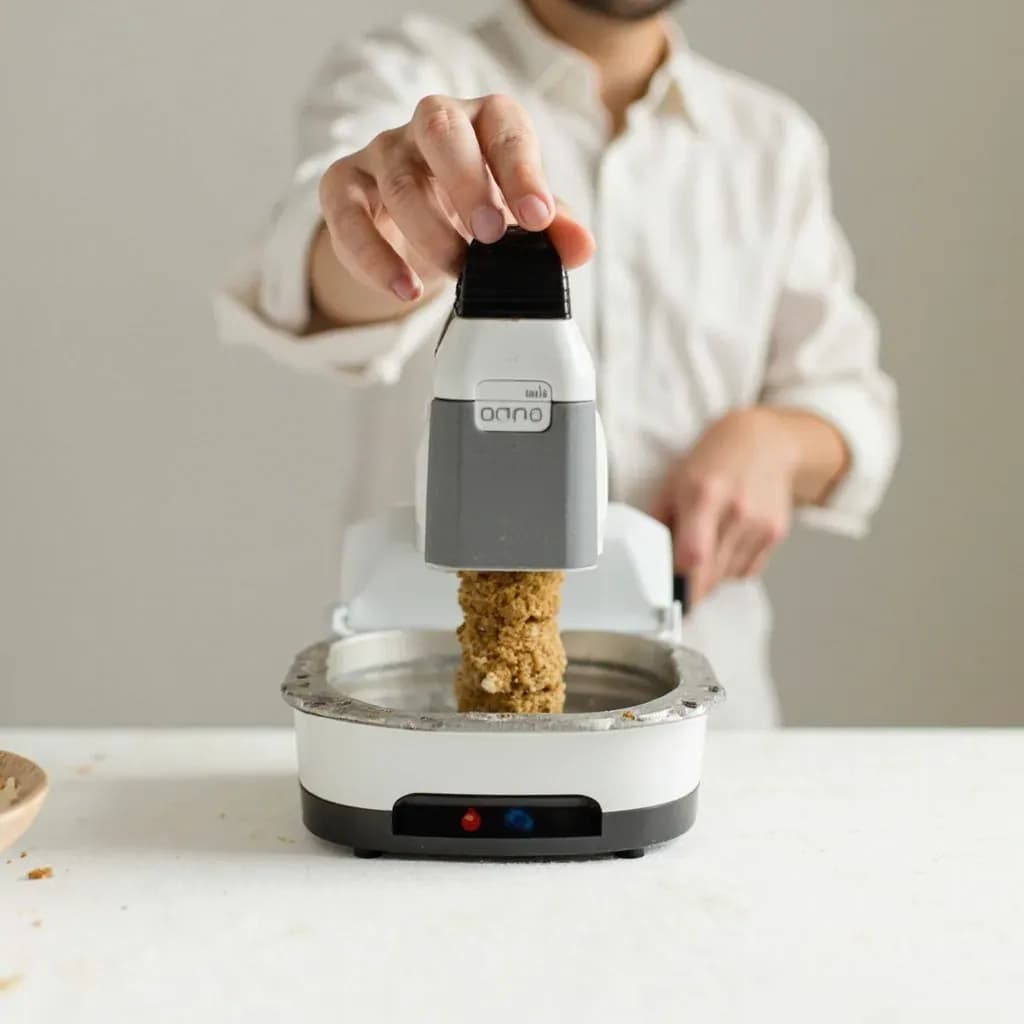
A moisture analyzer combines a precision balance with a heating element to dry a small sample and calculate the percentage of water lost. Bakeries, drying and curing operations use it to verify flour, cured meat, dried fruit or spice moisture for consistency and shelf stability. The reading is far faster and more exact than weighing before and after an oven.
A moisture analyzer is the bridge between guesswork and true measurement in any kitchen where water content drives the outcome. In baking, chocolate work, cured meats, dried goods, and brewing, the difference between a 13% and a 15% moisture flour changes crumb structure, and a few tenths of a percent in finished chocolate moisture can mean the difference between a stable bar and one that sugars out within weeks. In a salami log, a small shift in moisture loss can determine whether the sausage dries safely or spoils. The instrument is essentially a precision scale married to a controlled heater: it weighs a sample, drives off moisture under set conditions, weighs what is left, and reports the loss as a percentage. That single number drives decisions on drying times, formula hydration, label claims, and food safety.
Most modern units use a halogen bulb above the sample pan, which delivers fast, even radiant heat and finishes a reading in one to five minutes. The principle is gravimetric, measuring total mass loss rather than water specifically, which is a critical distinction. Sugars caramelize, essential oils volatilize, and Maillard reactions release compounds that are not water, all of which the analyzer counts as moisture. For routine kitchen work this is close enough, but for compliance labels and arbitration the reference method remains a forced-air drying oven at 105 °C to constant weight, often three to sixteen hours. In a working kitchen the analyzer earns its place by being fast enough to use during production rather than after.
Alternatives
Types & varieties
The most common design. A halogen bulb delivers fast, even radiant heat from above, with typical run times of thirty seconds to five minutes.
Uses a ceramic or metal-foil infrared emitter. Slightly slower warm-up, but very gentle drying, favored for heat-sensitive or dark samples.
Heating element is a ceramic infrared plate with uniform surface temperature; durable and common in industrial settings.
Dries from the inside out. Very fast, often under two minutes for high-moisture foods, but sensitive to sample uniformity and density.
Higher-end units add a small fan to circulate hot air across the sample, improving repeatability on powders, pastes, and liquids.
Choosing a drying temperature
The right temperature is the difference between an honest reading and a misleading one. Heat does two things at once: it drives off water, and it drives off everything else that can volatilize. Run too hot and the surface crusts, trapping interior moisture and reading low, or browning reactions release volatiles that read high. The rule of thumb is to use the lowest temperature that dries the sample cleanly within a reasonable time, and to record the method you used so the same product is always measured the same way.
- 100–105 °C: chocolate, cocoa mass, cocoa butter, and honey (cross-check honey with a refractometer for true sugar-adjusted moisture).
- 105–110 °C: flour, milled grain, malt, breadcrumbs, crackers, and most baked goods.
- 110–130 °C: dried herbs, spices, mushrooms, dried fruit, and fruit leather.
- 120–140 °C: cured meat, salami, and jerky. Expect some loss from rendered fat, so results are best treated as total mass loss rather than water.
- 130–160 °C: roasted coffee and cocoa nibs. Higher heat shortens runs but raises the risk of scorching at the sample surface.
- 120–160 °C: high-moisture liquids like milk, cream, or sauce spread thin on a glass-fiber pad. The pad absorbs moisture quickly, so a moderate temperature is usually enough to clear it.
Why the oven still sets the legal standard
A halogen balance reports total mass loss under heat, and that mass loss is not pure water. It includes essential oils from spices, alcohol from ferments, short-chain fatty acids from cheese, and breakdown products from Maillard browning. For a working kitchen checking batch-to-batch consistency, that is perfectly useful. For a nutrition label, an FDA filing, or a dispute with a supplier, the reference method is a forced-air drying oven at 105 °C to constant weight, typically three to sixteen hours, run in duplicate with a desiccator cool-down. The moisture analyzer is the rapid secondary method; it must be correlated against the oven for each product before its readings are trusted for compliance. A working rule: use the analyzer for in-process decisions, the oven for anything that goes on a label.
Common uses
Tips & pitfalls
- Spread the sample thinly and evenly across the aluminum pan; a thicker, clumped center reads artificially low because moisture trapped inside never escapes.
- Keep sample size small, about 1–3 g for powders and up to 5 g for coarse pieces. Larger samples run longer and can crust over, sealing in moisture.
- Start at a lower temperature, 105–110 °C, for sugar-, honey-, or protein-rich samples. High heat caramelizes or Maillard-reacts the surface, releasing volatiles other than water and skewing the result high.
- For chocolate and cocoa, stay at 100–105 °C. Higher temperatures drive off volatiles like acetic acid and give falsely high moisture readings.
- Always tare with the empty sample pan on the pan handler before adding sample. Disposable aluminum pans weigh roughly one gram each and that mass matters.
- Use a glass-fiber pad under wet or liquid samples (milk, sauces, honey, batters) to spread them thin and prevent spatter onto the sensor.
- Do not trust a single reading. Run duplicates and accept results within 0.1–0.2% of each other, otherwise re-sample and re-run.
- Calibrate the built-in temperature at least annually with a temperature calibration kit. A 5 °C drift is enough to shift a 14% reading down to 13%.
Good to know
- Instrument type
- Benchtop halogen or infrared drying balance, also called a moisture balance
- Measurement principle
- Gravimetric: weighs sample before and after drying, reports moisture as a percentage of original mass
- Typical readability
- 0.01% moisture, with 0.001 g resolution on a 1 g sample
- Sample size
- 0.5–10 g typical; some industrial models accept up to 200 g total capacity
- Drying temperature range
- Approximately 50–200 °C, set in 1 °C increments
- Read time
- 1–30 minutes depending on sample, temperature, and shutdown criterion
- Result formats
- % moisture, % solids, % dry weight, weight loss in grams, ATRO on wet or dry basis
- Primary manufacturers
- Mettler Toledo (HE series), Sartorius (MA/MMA), A&D (MX/MF/MS), Shimadzu (MOC), Precisa, VWR
Also called
Moisture Balance · Halogen Moisture Analyzer
Related

Stovetop
The everyday burners where most cooking actually happens

Oven
Enclosed dry heat for roasting, baking, and braising

Grill
Live-fire or gas grates for char, smoke, and high heat

Smoker
Low, slow heat and wood smoke for barbecue and brisket

Air Fryer
Countertop convection that crisps with little or no oil

Slow Cooker
Set-and-forget low heat for stews, beans, and braises

Pressure Cooker
Sealed steam pressure that cooks tough food in a fraction of the time

Rice Cooker
Foolproof, perfectly steamed rice every single time